
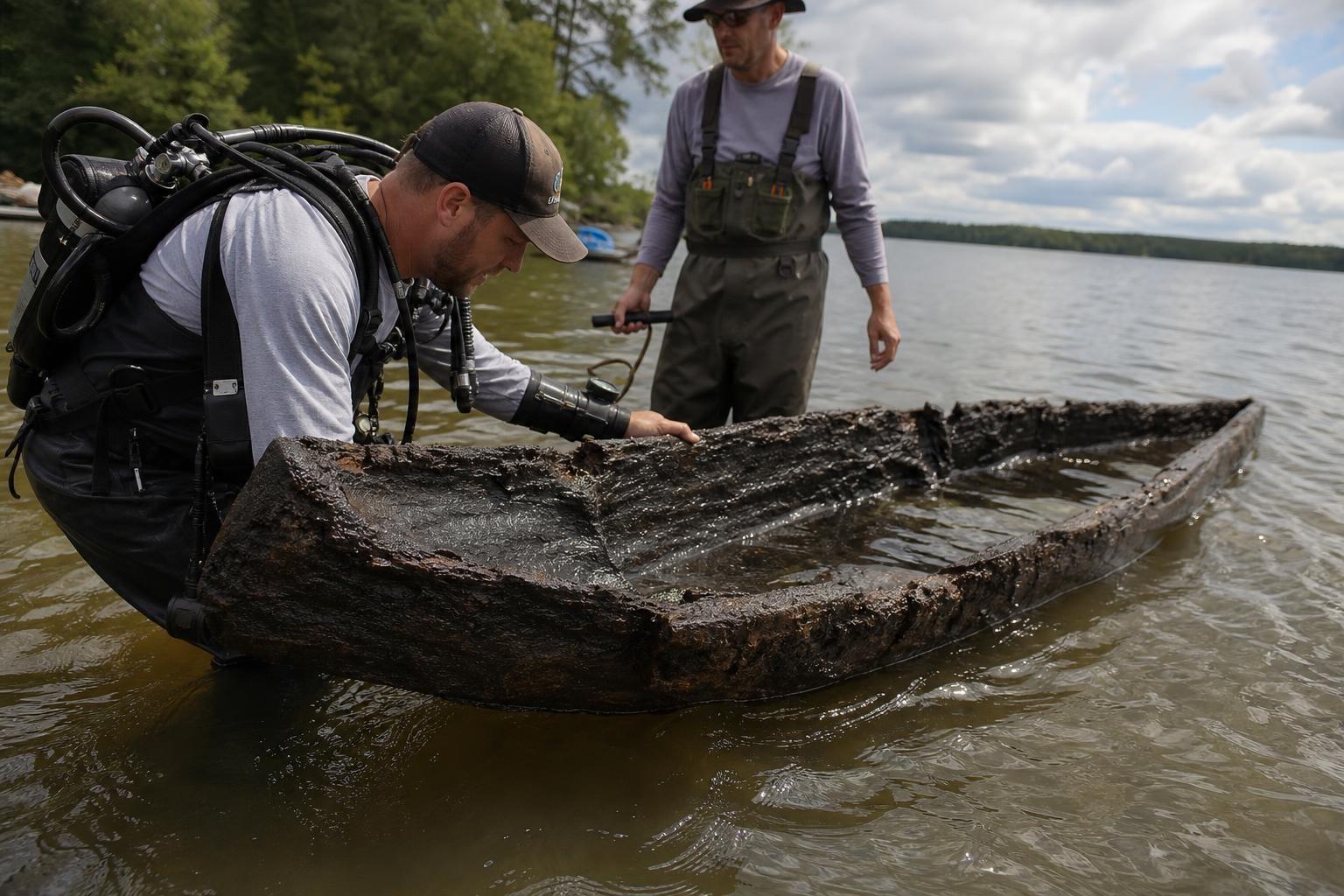
The late-summer water was clear, the shoreline quiet, and a weekend dive turned into a brush with very old history. Drifting over rippled sand, a recreational diver spotted a long, dark silhouette tucked into the lakebed—a shape too straight and too smooth to be a log. “I wasn’t looking for history,” the diver later said, “but history definitely found me.”
Discovery in still water
Curiosity pulled the swimmer closer, fins gently stirring silt as the object sharpened into a narrow, hewn hull. The form was unmistakable: a dugout canoe, carved from a single tree, resting calmly beneath the Wisconsin waves. “My first thought was, ‘How did this survive down here?’” the diver recalled.
A quiet survivor from another century
Initial measurements suggested a relatively slim, maneuverable craft—designed for stability more than speed. Cold, low-oxygen water had preserved the wood, muting decay and keeping the vessel intact enough to recognize. The lakebed, with its soft sediment, acted like a blanket; time pressed down, but didn’t erase the shape.
From chance sighting to scientific care
After the report, state archaeologists moved quickly, mindful that a waterlogged artifact can collapse if mishandled. A cautious survey mapped the site, documented every curve, and assessed the risks. “This is a once-in-a-generation find,” a project lead noted, “and we only get one chance to do it right.”
Dating the wood and decoding the craft
Samples went for radiocarbon analysis, placing the canoe around 1,200 years old, at the tail of the first millennium CE. The style—hollowed from a log, with a slightly raised rim—fits regional traditions of dugout boatbuilding. Tool marks hint at careful work, likely done with stone or early metal edges, each stroke a physical record of its maker’s skill.
Working with the people whose past is present
Consultation with tribal representatives shaped next steps, from field decisions to interpretive plans. One cultural advisor put it plainly: “This canoe isn’t just old; it’s part of a living story.” That perspective guided language, access, and the pace of conservation, keeping community respect front and center.
Raising a fragile time capsule
Lifting a soaked wooden hull is more like moving a jellyfish than a log—everything is soft, heavy, and liable to tear. Divers set padded slings, slid a supportive cradle underneath, and let buoyant bags do the lifting. On the surface, the canoe went straight into fresh water and then a temperature-controlled bath, where it could rest and slowly stabilize.
How conservators keep waterlogged wood from collapsing
For long-term care, specialists use polymers like PEG to replace water within the wood’s cells. Over months, concentration rises, strengthening the fragile structure without drastic shrinkage. A careful drying phase may follow—sometimes freeze-drying—to lock the canoe’s shape in place for future study and display.
What a single canoe can reveal
Even one small boat can open wide questions about daily life, trade, and travel across inland waters. Researchers will compare dimensions, tool signatures, and wood species against regional patterns, looking for echoes of known routes and seasonal habits. From there, a fuller story can emerge.
- Possible uses: fishing in quiet shallows, ferrying goods between villages, waterfowl hunting, or swift travel along known portages.
The diver’s moment, and everyone’s memory
Back at the shore, the original finder watched the operation with equal parts awe and relief. “I just wanted to see something cool underwater,” they said, “and now it feels like the lake wanted us to remember.” That sentiment resonated with the field team, who often work where memory and material overlap.
Why lakes keep history so well
Midwestern lakes can be quiet archives: low light, steady temperatures, and shielding sediment make preservation more likely than on exposed shores. Storms cover, winters seal, and centuries pass, but a carved shape endures where wood on land would have long vanished.
Sharing the find without losing the site
Archaeologists keep precise locations confidential to protect sites from looting or unintentional harm. The plan is to share verified details, publish open research, and collaborate on respectful exhibits that foreground Indigenous voices. “Public access and protection don’t have to be at odds,” one curator emphasized.
A small craft, a large horizon
Stand near any Midwestern shore, and the water still hums with routes that stitched communities together long before highways and maps. This canoe turns that hum into something tangible, a narrow vessel with a wide story. The lake kept the memory safe; modern hands, carefully, will carry it forward.
