
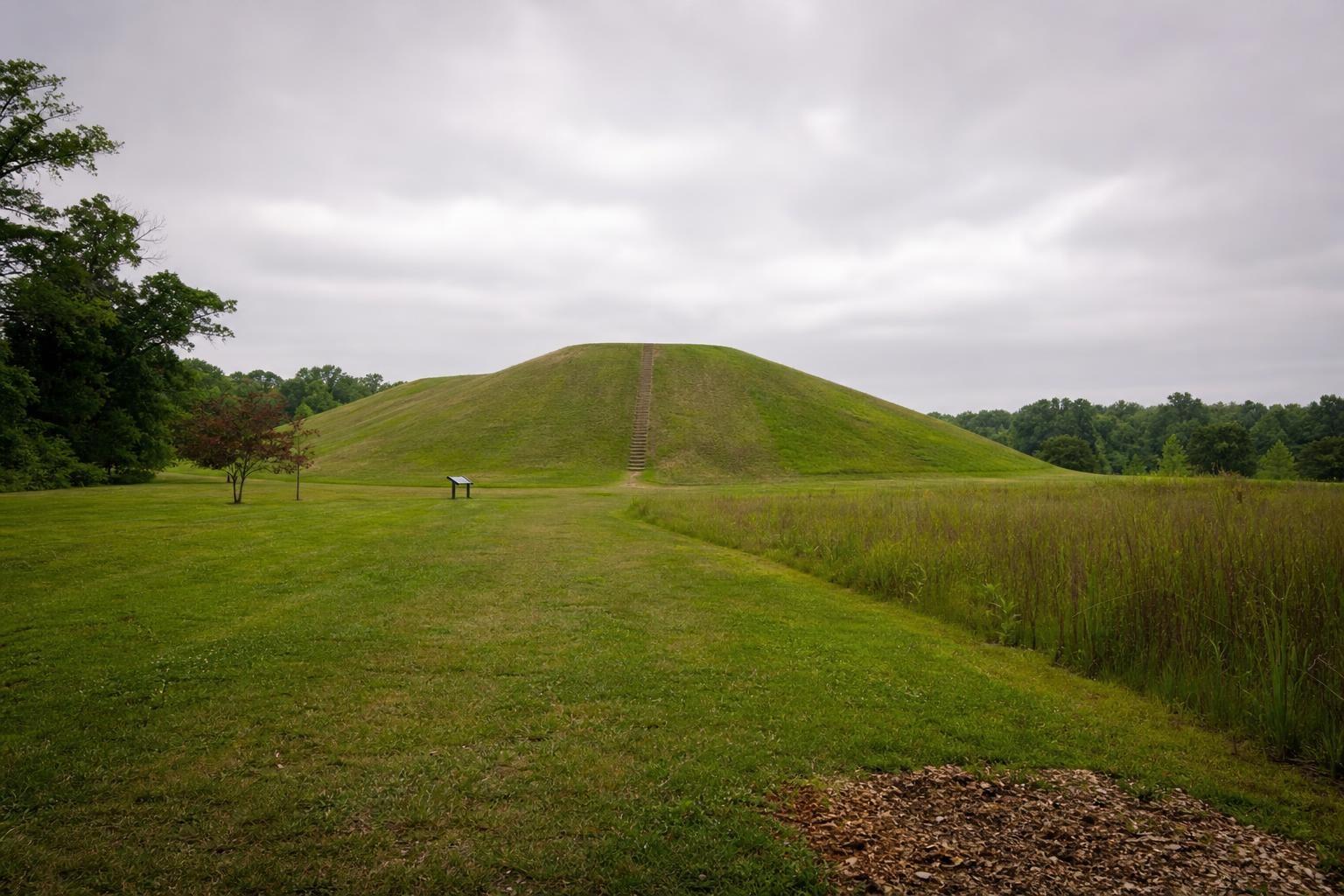
Under a hot, ancient sun, a community on the lower Mississippi moved the earth with astonishing speed. In what amounts to a few short weeks, they raised a massive platform of soil and clay, a human-made hill taller than a seven-story building. The pace challenges our assumptions about prehistory, recasting dispersed foragers as focused organizers who could plan, mobilize, and deliver on a deadline few modern builders would dare.
The monument rises about seventy-two feet, its flanks once sharp, now softened by centuries of rain and roots. Researchers argue that the core went up in less than three months, an effort compressed into a single campaign of digging, hauling, and packing. “It wasn’t a slow accumulation,” one archaeologist notes, “it was a deliberate, orchestrated event.”
A feat of speed and scale
Measured by sheer volume, the mound is a marvel of coordinated labor. Tens of thousands of cubic meters of soil were excavated, carried in woven containers, and set into courses that still hold shape. The builders managed water, slope, and compaction so the core would not slump, even under its own weight. They did this without draft animals, metal tools, or written plans, leaning instead on shared knowledge and lived experience.
“Picture hundreds of people in rhythm,” a researcher says, “each basket a beat, each layer a measure, the monument a finished song.” It is hard not to see the mound as a performance, its scale read as both engineering and ceremony.
Clues in the dirt
The case for rapid building rests on careful evidence, not romantic guesswork. Scientists sliced profiles through the structure, reading the earth the way a librarian reads stacked pages. They looked for pauses in construction—signs like burrowed roots, settled crusts, or rain-lain films that would mark seasons between lifts. They found remarkably few.
- Uniform layers show minimal weathering, suggesting a near-continuous sequence of deposits rather than intermittent, years-long phases.
- Microscopic thin-sections reveal fresh, angular grains tamped into place, not slowly reworked by soil life or frost.
- Dating of embedded char and surrounding sediments clusters within a narrow window, aligning with a short, intense build.
- Internal heat marks and oxidation patterns hint at rapid accumulation, where damp soils could still warm as layers locked in moisture.
Together these lines of evidence say “now,” not gradual, and tie a community to a singular, focused act.
Organizing the surge
A project like this needed plan, place, and season, plus the social glue to hold them together. Likely, leaders choreographed teams: diggers in source pits, haulers on packed paths, and placers who spread and stomped each lift. Work probably ran in long days, paced by songs, calls, and shared rituals. “You don’t get this done with orders alone,” says one field archaeologist. “You get it done with belief, with feasts, with an agreed why.”
The why includes kinship, alliance, and the magnetic pull of communal courage. Such an effort doubles as a festival, binding people through food, dance, and the adrenaline of making something visibly impossible become real.
What it took to move a landscape
This was not a casual weekend project. It meant tools, materials, and a steady pipeline of calories.
Food, tools, and flow likely looked like this:
- Baskets of fiber and hide, renewed quickly as they wore from wet soil and coarse grit.
- Staging zones where loads were stacked, then relayed up ramps to waiting crews.
- Cook fires and communal meals, turning fish, nuts, and game into sustained energy.
- Ramps graded for safe traffic, then peeled away as the final profile was shaped.
Work created its own momentum, with every layer making the next more attainable, every team seeing the hill rise and feeling ownership.
Purpose on the horizon
Why build so big, so fast? Visibility is one answer. The platform commands views over water, woodland, and sky, turning gatherings into spectacle. Another answer is ritual: elevated ground for ceremonies, processions, or timekeeping aligned with sun and season. Elevated places make statements—of sovereignty, of shared myth, of who belongs and who can speak.
Practicality may also have mattered. High ground resists flood, stores goods above damp air, and fixes a community’s presence in terrain that otherwise shifts.
Rethinking “simple” societies
For years, textbooks cast early foragers as thinly spread and politically loose. A sprint-built monument says otherwise. It implies leaders with credibility, networks with reach, and a calendar pulsing with appointments that drew people on time and in number. Complexity is not just clay bricks and bureaucrats; it is promise, kept at scale.
“Speed is a kind of signature,” one investigator notes. “It tells us about coordination, trust, and the power of a shared story.”
What the earth remembers
Stand near such a mound and the ground feels thick with intention, every contour a human decision. Erosion rounds the edges, trees root and lift, but the form holds, stubborn as a collective memory. To study it is to meet determined hands across time—hands that filled baskets, climbed ramps, and stamped the soil firm.
The message travels well across millennia: with purpose, even loosely settled peoples can build fast, build high, and leave a mark that outlasts names. The earth keeps score, and here the tally is bold.
