
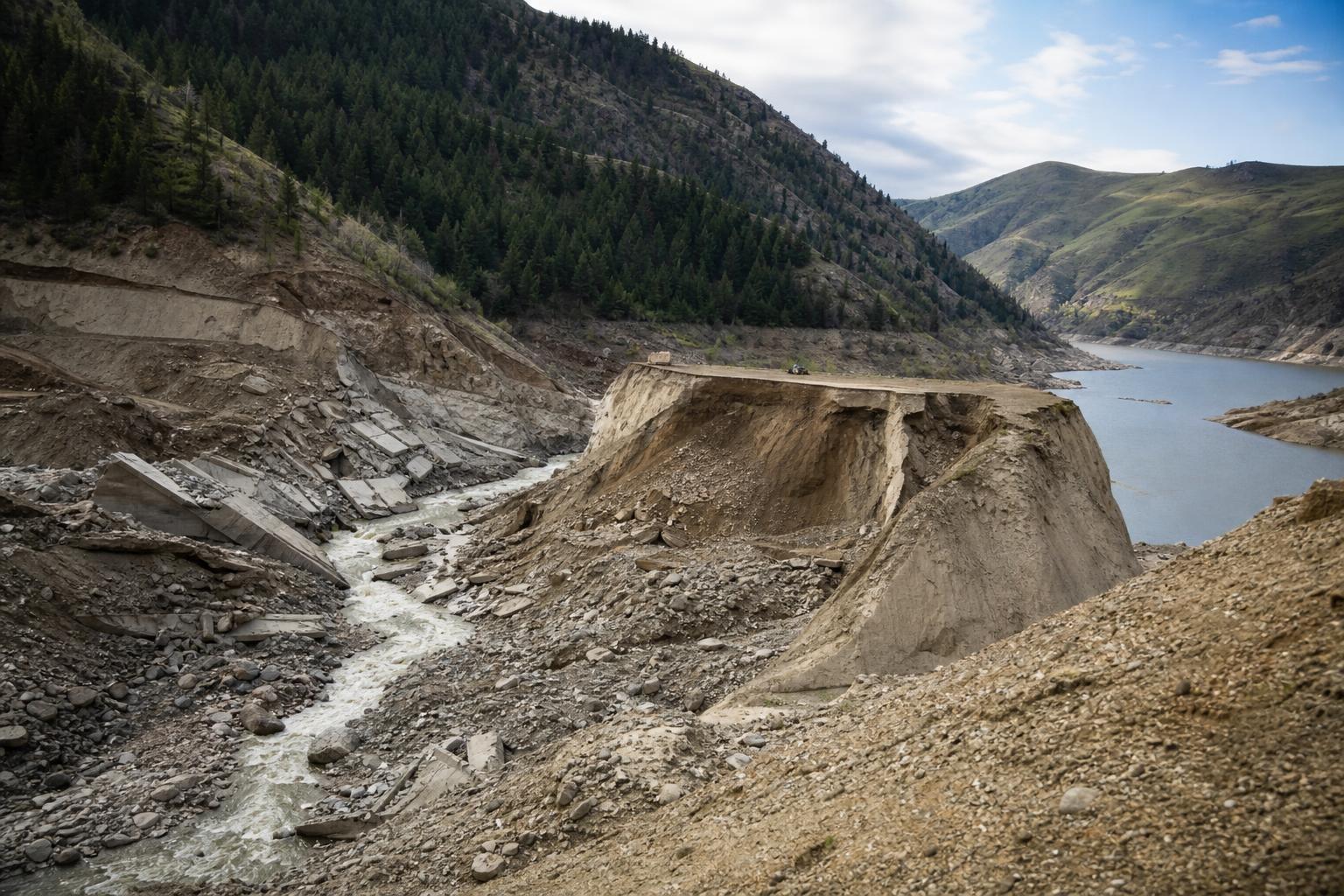
Dawn broke over eastern Idaho with the same crisp, blue certainty it always had, but by late morning the valley was a different world. A wall of water, mud, and splintered timbers surged down the Teton River, turning fields into churning lakes. “It went from calm to catastrophic in minutes,” one resident would later say. Another remembered only “a deep rumble and a dark line rushing toward us.”
A New Promise in the High Desert
The structure was an earthfill embankment, towering more than three hundred feet above a rugged canyon cut through volcanic rock. It was conceived as a modern solution to ancient problems: flood control, irrigation, and regional power. Engineers drilled, grouted, and mapped the fractured bedrock, trusting that a lattice of concrete and clay would tame what lay beneath. “We believed the foundation could be sealed,” echoed the optimism of the project’s early years.
The Morning the Earth Let Go
As the reservoir rose during initial impoundment, small signs began to whisper. Turbid seepage appeared where clear water should have shimmered, and a damp spot widened into a muddy stain. Within hours, a gash opened in the right abutment, a wound that bled earth and gravel. Crews rushed forward with bulldozers, trying to push material into the opening as if plugging a growing storm. Helicopters dropped loads; trucks shuttled sandbags; radios crackled with clipped orders. But the water carved faster than men could fill, and the hillside slumped with a muffled groan. “It’s going,” someone said on the radio, and then it simply went.
A River of Loss
The flood fan raced through Wilford, Sugar City, and Rexburg with astonishing force. Streets turned to rivers, rivers turned to seas, and familiar landmarks vanished under brown, fast‑moving weight. Families fled to rooftops, livestock scattered into rising eddies, and bridges buckled like bent straw. When the water receded, the human toll numbered in the dozens of injuries and several tragic deaths, with economic losses cresting well beyond a billion in today’s terms. “You don’t measure it in dollars,” a farmer murmured, “you measure it in memories.”
Why the Structure Failed
Investigations pointed to internal erosion, known as “piping,” that exploited fractured rock and inadequately protected interfaces. The canyon walls held a mosaic of rhyolitic and basaltic formations, crisscrossed by joints and voids. Grout curtains, intended to seal these pathways, did not fully penetrate the complex network. Once seepage found a route, it began to carry fine particles, enlarging its own tunnels. Filters and drains—critical lines of last defense—proved too coarse or too discontinuous to intercept migrating fines. The result was a self‑accelerating failure, hidden at first, then violently visible.
- Key factors frequently cited: foundation fissures, incomplete grouting, vulnerable filters, rapid initial filling, and underestimated geological complexity.
The Human Response
Local deputies banged on doors, pilots flew low over flooded streets, and neighbors towed neighbors to safety. Churches filled with cots and coffee, and gymnasiums became supply depots. Dairy tankers hauled drinking water, while National Guard convoys rumbled in with pumps and fuel. “We saved what we could,” a volunteer said, “and we shared what we had.” In the debris field, a patchwork of resilience replaced the splintered fences, proving that recovery can be both stubborn and swift.
Lessons That Reshaped Dam Engineering
In the wake, dam safety evolved with a new urgency. Agencies refined risk‑informed standards, mandated independent design reviews, and widened the lens on geological hazards. Embankment dams saw stricter criteria for filter gradation, chimney drains, and foundation treatment. Instrumentation—piezometers, seepage weirs, and automated alerts—moved from helpful extras to operational musts. Perhaps most importantly, operators learned to respect the early signals: discolored seepage, changing flows, and twitchy gauges. “Water talks,” one engineer now says, “and you have to listen.”
The Ethics of Big Infrastructure
Beyond calculations and contours lies a civic question: how to balance regional benefit with local risk. Large projects promise long‑term gains, yet concentrate consequences when they fail. Modern practice presses for transparency, community input, and clear lines of emergency authority. Risk communication—once an afterthought—is now a living plan, tested in drills rather than written in dust. Trust is a structure too, built layer by layer, and it can erode if left untended.
What Endures in the Canyon
Today, the broken scar remains a stark lesson, etched into the high desert’s edge. Wildflowers stitch color across gray talus, while the river continues its patient work below. People still stop to look and to ask, because the shape of what failed is also the shape of what we must remember. “We built a thing we thought would hold,” says the landscape, “and learned how fragile certainty can be.” Out of that reckoning came sturdier filters, humbler timelines, and a sharper habit of listening to stone. In a land shaped by water and fire, the safest path forward is honest, layered, and watchful.
