
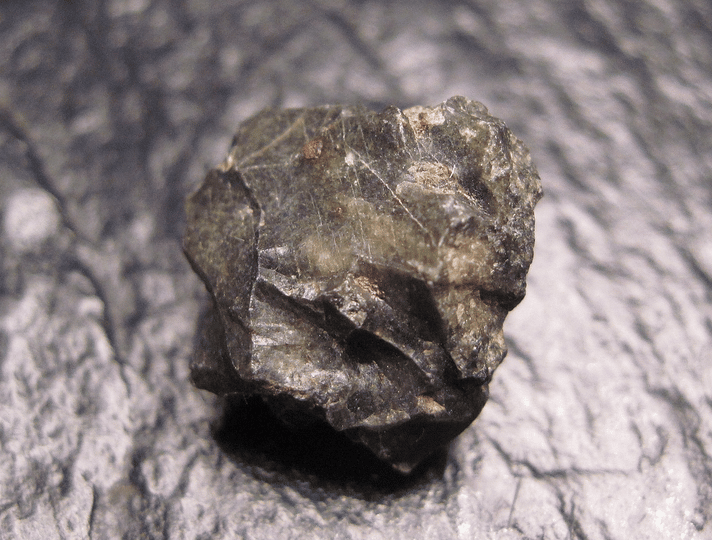
In France, as in many countries, finding a meteorite is extremely rare. Nevertheless, since it is entirely possible that such an event could occur, there are a few key things to know before picking up the object.
A discovery of scientific interest
In 2020, a craftsman living in Indonesia saw his life turn upside down overnight. Indeed, a meteorite pierced the roof of his house, and an American collector bought it from him for about 200 million rupiahs (roughly $14,000), a sum far less than the multi‑million figures often reported by the press. Yet such a heartening story is rare, since most meteorites are of definite scientific interest and such a sale remains exceptional. More often, scientists themselves go hunting for meteorites, as happened last year in Antarctica.
In February 2023, the student Loïs Leblanc living in Seine-Maritime recovered a meteorite originating from the asteroid (or meteoroid) 2023 CX1 (see photo below). Scientists mentioned other fragments that ended their journey in France, belonging to the same asteroid, notably at Saint-Pierre-le-Viger and Autigny.
Although this is very rare, anyone can potentially stumble upon a very dark rock that is a meteorite. The black crust is nothing more than the fusion crust of the object, and if it breaks, the interior is often lighter in color. After the discovery, a question arises: to whom does the meteorite belong?
What does the law say?
In reality, the answer is not straightforward since no law governs this kind of fortunate discovery. In the past, several cases have made the finder the owner of the object. However, Deputy Stéphane Viry believed in 2018 that research centers should be able to access meteorites in order to exploit their data. He then proposed joint ownership (or a right of use), to allow researchers to study the meteorite without harming its finder. A year later, the French government had stated that such a directive would require European-level consultation. Thus, as things stand, a private individual discovering a meteorite is not legally obliged to inform the authorities.
In case of discovery, are there precautions to take? First, one must not touch or even move the object. The best course of action is to photograph the meteorite, identify the GPS coordinates, and share the discovery on the Vigie Ciel platform. If handling is necessary, wear gloves and use a bag. It should be reminded that such a freshly fallen object displays a temperature of -30°C. Finally, never bring a magnet near the object, to avoid altering its magnetic properties.
