
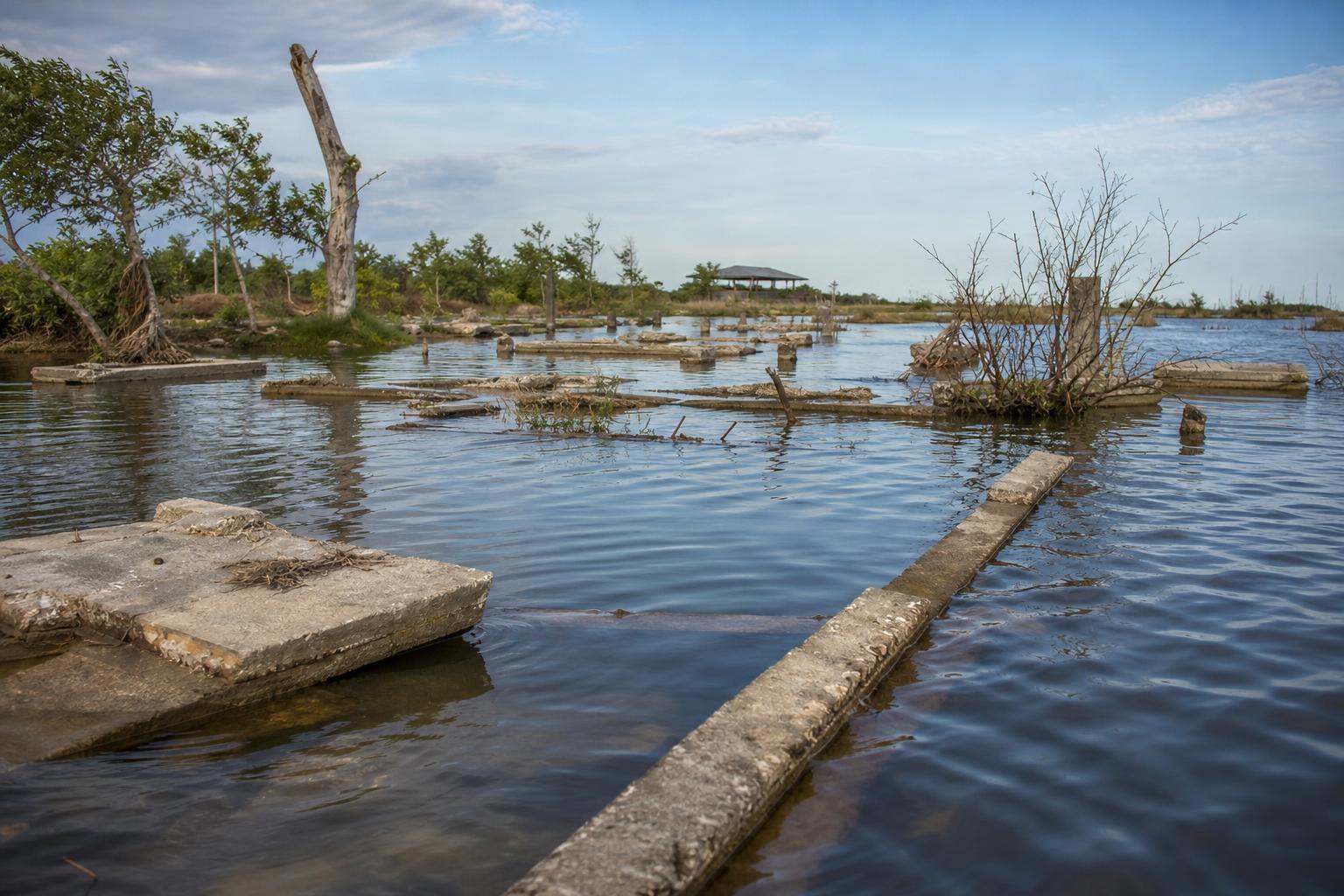
Water once lapped at lawns where children played, and driveways sloped toward a shimmering horizon. The transformation felt slow, then suddenly total, as tides crept over curbs and porch steps. “We kept raising the air‑conditioners, then the floors,” goes a common refrain, “but the water kept coming.” What remains now is a quiet shoreline park where herons replace mailboxes, and memory moves like a current beneath the marsh.
A suburb built on shifting ground
In the 1950s, families chased space and sunshine along the Galveston Bay fringe. Streets curled into neat cul‑de‑sacs, and brick homes faced broad lawns and tidily clipped hedges. Industry thrummed nearby, offering steady jobs and a promise of resilient prosperity. Few suspected the ground itself carried a hidden compromise.
The region’s prosperity drew on pumping vast amounts of groundwater and hydrocarbons. That extraction compacted deep sediments, lowering the land like a slow exhale. “The bay didn’t rise first,” locals say, “the ground fell.” Elevations slipped by feet, not inches, leaving streets only breaths above tide.
Storms exploited the new lowlands, pushing salty surges through backyards and garages. After a punishing sweep of hurricanes, repeated inundations made humble repairs feel absurdly temporary. Insurance grew skittish, while foundations learned the language of mud and retreat.
When the water claimed the map
At first the fix seemed simple: elevate homes, add fill, build higher pads. Neighbors pooled sandbags, jacked up porches, and moved breakers skyward. Each effort bought a little time, but less certainty.
“Water always wins where gravity helps,” a planner once quipped, staring at a tide chart and a sinking lot. Floods came on sunny days, summoned by wind‑piled bays and low barometers. Streets that once carried schoolbuses became shallow canals for mullet and crab.
Buyouts followed the soaked mortgages, one kitchen at a time. Bit by bit, houses were cleared, slabs were broken, and culverts opened to the tide. What couldn’t fight the hydrology learned to welcome the egrets.
Turning loss into a living edge
With the rooftops gone, a different map began to form. The city and its partners recognized a chance to build a buffer instead of a brittle barrier. Marsh channels were re‑cut, native grasses planted, and oyster rakes encouraged to clutch the shore.
Today the restored landscape feels both intimate and expansive. Boardwalks trace former avenues, and interpretive signs whisper stories where doorbells once rang. “Retreat isn’t defeat; it’s design,” reads a small placard near a rookery’s shade. You can watch roseates swing their spoons over tidal flats, while fiddler crabs raise one comedic claw.
Park staff manage living infrastructure that repairs what steel never could. Marshes sieve pollutants, slow waves, and store storm‑driven water. The result is quieter coasts, richer habitat, and a public place that heals its own past.
How the ground keeps score
Subsidence is not flashy science, but its math is merciless. Pull fluids from porous layers, and grains settle like a deflating cushion. Add global sea‑level rise, and the difference becomes visible at every king‑tide mark.
Engineers now track land elevations with satellites and gauges. “Measure what moves, then manage what matters,” says a favorite field mantra. The lesson is durable: extraction carries costs that the surface must pay.
What other coastal cities can learn
Elsewhere, leaders face similar tradeoffs with tighter timelines. Temperatures climb, seas expand, and subsidence tugs from below. The most durable strategies share a theme: work with water, not against physics.
- Map the true elevation, curb risky pumping, and design green buffers that absorb energy before it reaches the brittle edge.
“Protect where you must, yield where you can,” offers a pragmatic credo. Parks can be purposeful sponge space, not leftover scraps of land. Buyouts feel brutal in the moment, yet create safer futures for families and for the shore.
Walking the old streets, softly
Visit on a still morning, and the place speaks in ripples and wings. A street sign peeks from cordgrass, a quiet artifact of suburban ambition. You can trace a driveway that dissolves into spartina and silt. Ghosts are gentle here, more tidal than tragic.
“Home,” someone etched in curing concrete, survives at a curb’s faint arc. The word holds, even as blue crabs patrol the gutter and minnows flash like loose change. What was once a zone of forced resilience has become living infrastructure with daily, tidal grace.
The arc from loss to wetland doesn’t erase the ache, but it reframes risk as design space and time. In that framing, a drowned neighborhood becomes a regional teacher, and the new park becomes a promise: let water have its room, and it will return the favor.
