
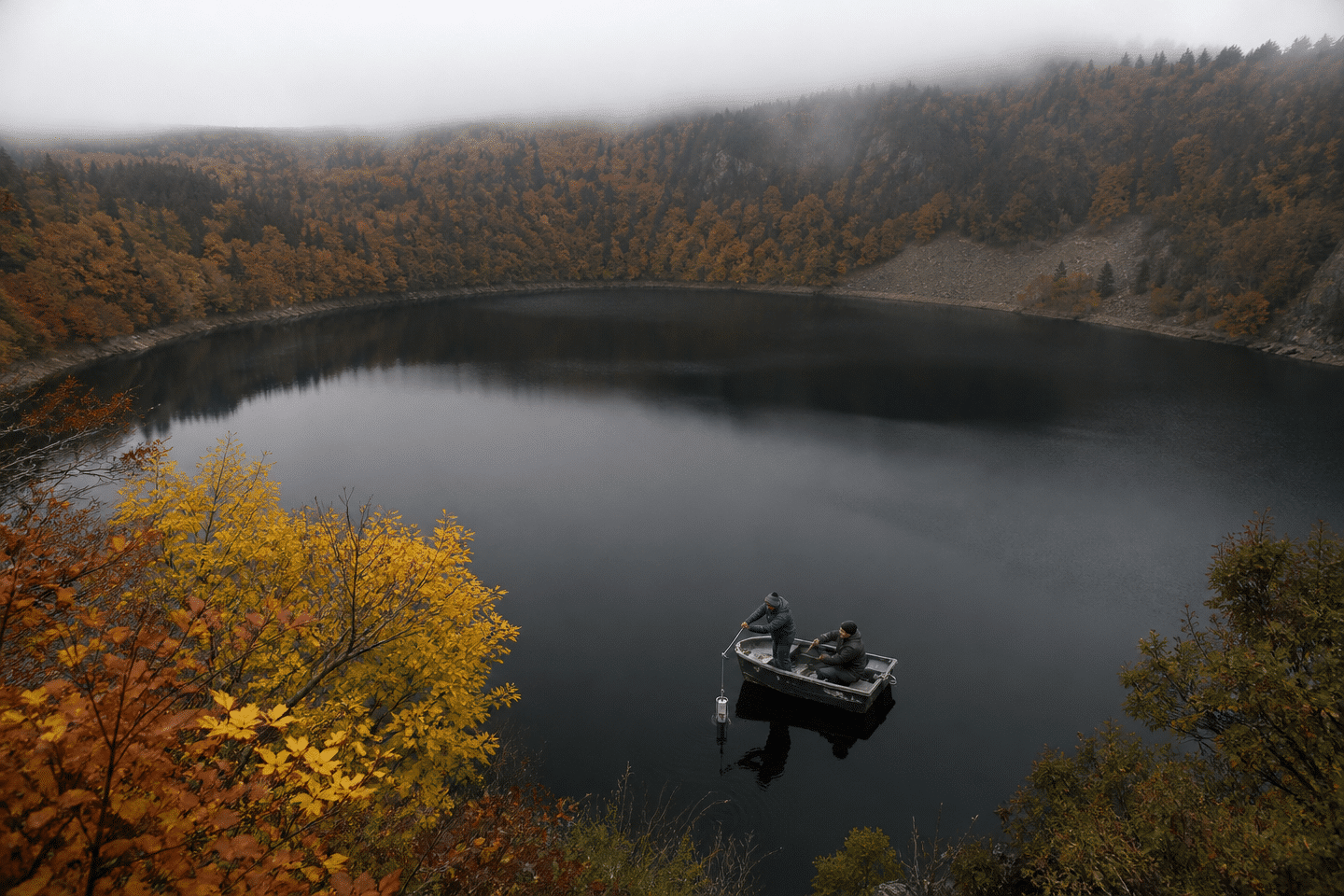
In the depths of a peaceful-looking Auvergne lake, water aged 6,000 years has never seen daylight or breathed free air. This mineral silence has fascinated scientists for decades, because a tragedy that occurred in Cameroon in 1986 proved that a lake can, under rare conditions, become a silent weapon.
A lake that has never mixed for six millennia
Nestled at Besse-et-Saint-Anastaise, in the Puy-de-Dôme, Lake Pavin is no ordinary lake. It formed about 6,700 years ago in the crater of a volcano, what geologists call a maar. Its nearly circular shape and its deep blue waters already make it a distinctive site in the Massif Central.
But its true peculiarity lies beneath the surface. Pavin is France’s only meromictic lake, meaning its two layers of water never mix. Most lakes churn their waters fully through the seasons, driven by winds and temperature changes. Here, that process concerns only the upper sixty meters.
Yet the lake plunges to 92 meters of depth. Everything below the mixing boundary has remained frozen in time for millennia, like a liquid subsoil completely isolated from the outside world. No currents, no air bubbles, no exchange with the surface disturb this forgotten stratum.
In this oxygen-starved environment, carbon dioxide, methane and hydrogen sulfide accumulate slowly. These gases come from mofettes, a kind of cold fumaroles that vent volcanic-origin CO2, as well as from the decomposition of organic matter that has fallen to the bottom over the centuries. This is partly why swimming there is prohibited.
1986, Cameroon and the night when a lake killed 1,700 people in silence
To understand why a lake in Auvergne unsettles researchers so much, one must look to Central Africa. On August 21, 1986, in the northwest of Cameroon, Lake Nyos experienced one of the strangest natural disasters ever documented.
That night, between 100,000 and 300,000 tons of carbon dioxide escaped suddenly from the lake’s depths. The phenomenon has a precise name, a limnic eruption: a sudden release of dissolved gases, comparable to the abrupt opening of a bottle of soda that had been shaken for a long time.
The CO2 cloud rose at nearly 100 kilometers per hour before descending toward the surrounding valleys. Heavier than air, it spread along the ground and asphyxiated everything in its path, up to 25 kilometers from the lake. The toll remains chilling: 1,746 people and about 3,500 head of livestock lost their lives, often without ever waking up.
Lake Nyos is not an isolated case. It is part of, along with Lake Monoun and Lake Kivu, the three only lakes in the world known to meet the conditions conducive to a limnic eruption, namely an exceptional concentration of dissolved gases in their deep waters. It is precisely this precedent that drives scientists to monitor meromictic lakes like Pavin closely.
Why researchers regularly lower a probe into the heart of Pavin
Since the Cameroonian tragedy, the level of dissolved gas in Lake Pavin has been the subject of regular monitoring. According to the official briefing from DREAL, a significant rise in this concentration could, in theory, trigger a limnic eruption.
A biogeochemical study conducted on the lake identified the origin of the deep-seated CO2 accumulation. About 70% would originate from a magmatic source, 20% from methanogenic fermentation related to organic matter, and the remaining 10% from subterranean water circulations at the crater floor.
These data currently reassure specialists. At a scientific conference held in 2009, the Observatoire de physique du globe in Clermont-Ferrand and BRGM agreed on a key point: the current concentration of dissolved gas in Pavin is too low to, by itself, trigger a spontaneous degassing comparable to that of Lake Nyos.
This conclusion does not exclude vigilance. It is precisely because the risk, even a small one, has been identified that regular measurements are carried out. A probe lowered into the depths allows monitoring the evolution of dissolved gases and detecting any anomaly before it becomes worrisome.
Thus Lake Pavin continues to sleep, motionless beneath its tranquil surface, while scientific teams watch what unfolds in its depths. Between geological curiosity and methodical caution, this small lake in the Puy-de-Dôme reminds us that nature, even when it appears the most peaceful, deserves to be studied with due seriousness.
Source: What is a “meromictic” lake, this potentially dangerous geological curiosity, of which Lake Pavin is an example (france3-regions.franceinfo.fr)
Article prepared with the help of AI · Our method
