
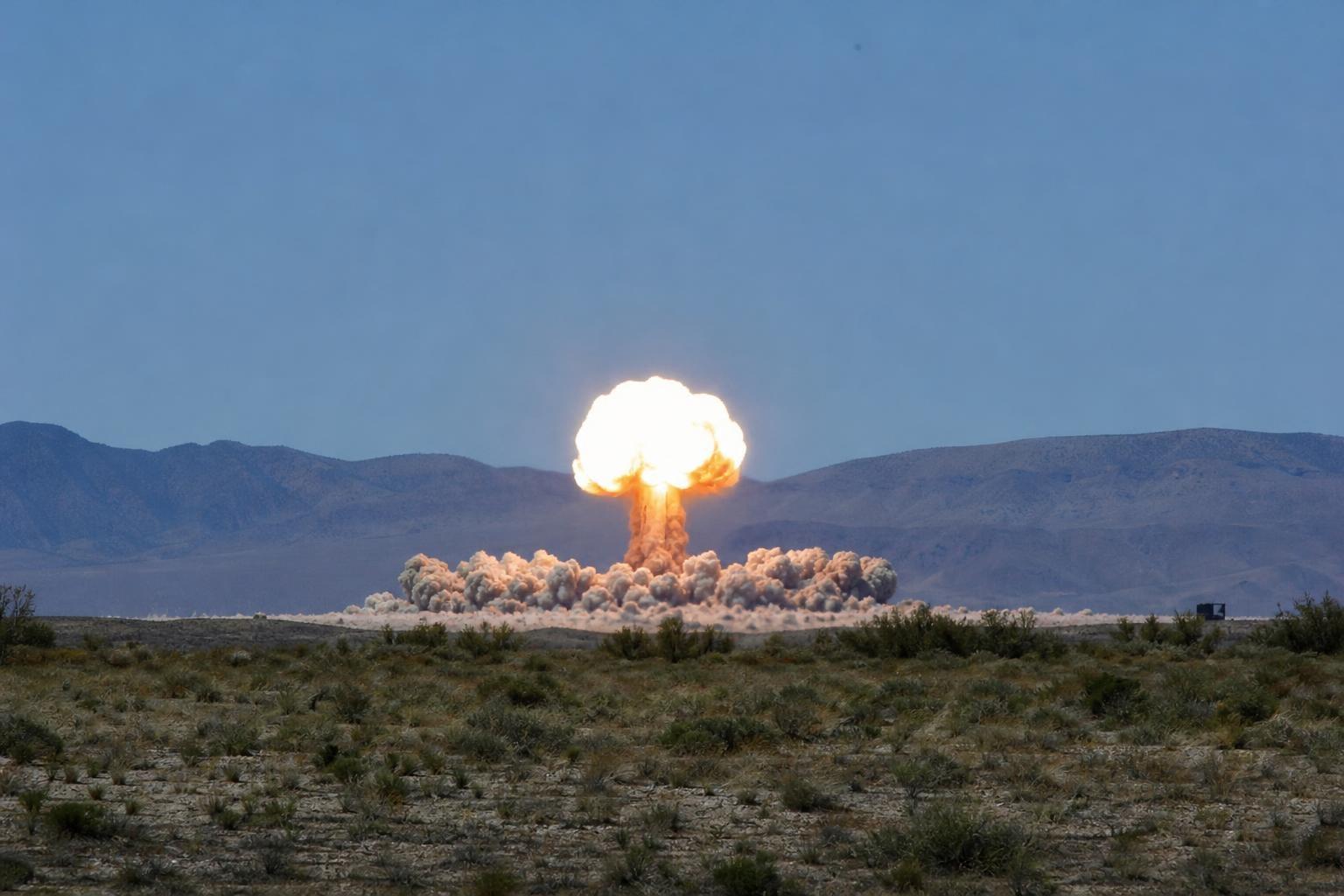
In the late 1950s, at the height of Cold War anxieties, American planners weighed an idea so stark it feels like fiction: a nuclear detonation on the Moon to produce a bright flash visible from Earth. In their minds, the night sky would become a kind of geopolitical billboard, a proof-of-capacity designed to jolt rivals and reassure a nervous public.
The notion wasn’t only about theatrics. It also promised raw data at a time when even basic lunar facts—dust behavior, surface composition, the Moon’s extreme environment—were still murky to top scientists. But as plans matured, a different light emerged: the glow of ethical concern, strategic doubt, and scientific humility.
Why the Idea Took Shape
Sputnik’s sudden beep in 1957 created a powerful void in American confidence. U.S. leaders craved a dramatic signal that the nation could do more than compete—it could undeniably lead. Some officials called for a “spectacular demonstration,” a phrase that echoed through Pentagon hallways like a crisp order.
Public-relations instincts fused with curiosity. Could a blast reveal lunar chemistry via a brief cloud of debris? Could it validate delivery systems and deep-space navigation? The Moon, so close and yet profoundly unknown, became a proposed stage for “shock and awe” that also promised fresh insight.
The Plan on Paper
Behind closed doors, a small U.S. Air Force–linked study took shape, later known as Project A119. Led at the Armour Research Foundation, the group modeled trajectories, light yields, dust plumes, and what a human eye on Earth might actually see. A young Carl Sagan contributed calculations on dust distribution and optical visibility, work that would resurface decades later in archival finds.
Engineers eyed a small, relatively lightweight warhead—often described as akin to a low-kiloton device—to maximize delivery feasibility. Planners favored detonation near the lunar terminator (the day-night boundary) to heighten contrast, so the flash and plume were stark against darkness. As one internal aim was framed at the time, the event needed to be “clearly observable” from Earth, not lost in glare or geometry.
Risks, Unknowns, and Scruples
Enthusiasm met a wall of questions. What if the rocket missed? What if the flash proved underwhelming or public reaction turned horrified? Even if no atmosphere meant no traditional fallout on the Moon, were there other scientific or moral costs? Inside the debate, a sober refrain gained volume: “Just because we can doesn’t mean we should.”
- Potential mission failure and public embarrassment
- Damage to the Moon’s scientific value and symbolic heritage
- Uncertain dust and ejecta behavior with unknown downstream effects
- Escalation risks in a fragile, fast-evolving arms competition
The more analysts peered into the unknowns, the less the stunt felt like strength and the more it resembled a risky gambit with permanent implications.
What the Soviets Considered
Across the ocean, the USSR reportedly explored a parallel concept, later linked to the E-4 project family of early Luna efforts. The idea—detonate a device to create a visible burst—reflected the same Cold War psychology, a desire to rewrite the night sky as a ledger of national prowess. Ultimately, their path bent toward robotic lunar flybys and hard landings, trading spectacle for incremental proof.
What Stopped It—and What Came After
By late 1958 and into 1959, the American proposal lost steam. Caution, reputational risk, and scientific uncertainty outweighed public-relations benefits. Soon, a broader global shift followed: the 1963 Partial Test Ban Treaty curtailed atmospheric and outer-space explosions, and the 1967 Outer Space Treaty forbade stationing nuclear weapons on celestial bodies. These agreements translated moral instincts into legal guardrails.
Yet the nuclear-space chapter did not end cleanly. The U.S. and USSR conducted high-altitude tests in the early 1960s, leaving auroral glows and artificial radiation belts as haunting afterimages. In hindsight, the Moon-bomb proposal became a path not taken, a pivot point where spectacle yielded to sustained exploration—orbiters, soft landings, and eventually human footprints.
Why the Story Still Matters
This episode compresses a century’s worth of tensions into a single, startling idea. It spotlights how national fear can masquerade as technical ambition, and how scientific curiosity can be drafted into geopolitical theater. It also shows that restraint—quiet, unglamorous, deeply strategic—can expand what is scientifically and morally possible.
As nations return to the lunar frontier, from resource mapping to permanent outposts, the old dilemma feels nearby. How do we balance dazzling goals with planetary ethics? How do we ensure that “firsts” in space aren’t merely loud, but lasting and wise? The best answer may be the one the world edged toward after 1958: let the sky be a place for shared knowledge, careful risk, and human-scale wonder—not a canvas for radioactive signatures.
