
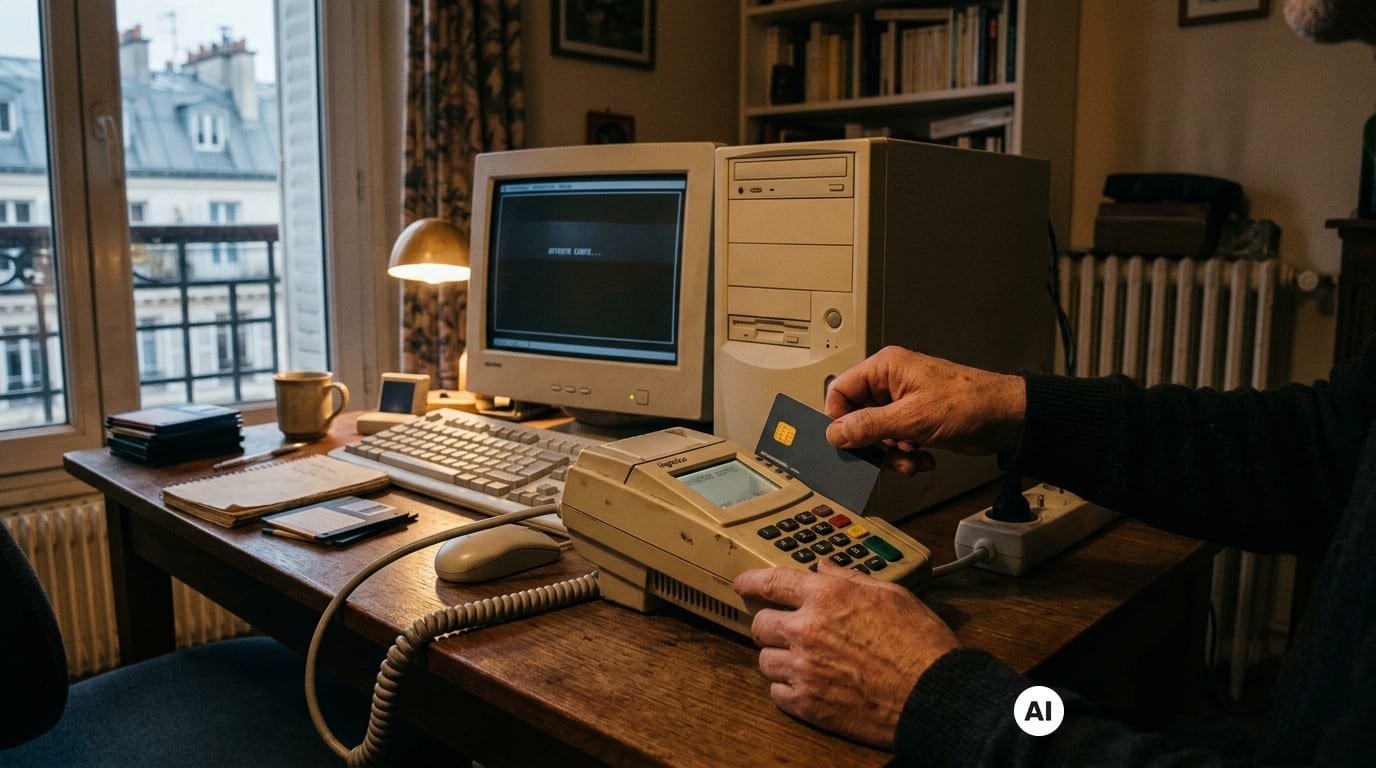
A solitary man, at home, with his calculations and his patience, manages to do what the largest French banks judged impossible: to break the mathematical lock meant to protect all of the country’s bank cards. It is neither a police operation, nor an internal bank audit, nor a hacker seeking to enrich themselves who uncovers this glaring vulnerability. It is the author himself who, attempting to sell it legally, ends up denouncing himself and finds himself trapped by those very people he thought he was helping. A look back at a tale as audacious as it is revealing, that of Serge Humpich, the engineer who shook the French banking system in the late 1990s.
The Flaw That No One Should Have Found
By the end of the 1990s, the security of card transactions in France rested on an asymmetric encryption system called RSA, locked by a 320-bit key. This length, today trivial in the face of available computing power, was then considered by industry experts to be robust enough to deter any hacking attempt. The paradox is that as early as 1988, ten years prior, cryptography specialists had already warned against using such a short key, deeming it fragile in the long term.
It is in this context that Serge Humpich enters the scene, an electronic engineer with a passion for cryptography, who decides to tackle the problem alone, without the industrial resources of a laboratory or a specialized company. His approach is not a premeditated hacking operation: it is primarily an intellectual challenge, the test of whether the much-vaunted security of the French banking system truly holds up to the test of mathematics. After several months of relentless calculations carried out from his home, he achieves the improbable: factorizing the RSA key and obtaining the corresponding private key, the very one that can authenticate any French bank card as perfectly legitimate.
The False Card That Should Never Have Existed
Armed with this key, Serge Humpich creates what would later be called Yes Cards: modified smart cards that accept any secret code entered by the user, never rejecting it. To prove that his discovery truly works, and not merely on paper, he chooses a test ground that is as symbolic as it is accessible: Paris metro ticket vending machines. He buys ten booklets there with his counterfeit cards, carefully preserving the tickets and the receipts obtained as tangible evidence of his success.
The transaction passes without the slightest hitch. The banking system, supposed to detect any anomaly, accepts the card as perfectly legitimate. This demonstration confirms what Humpich suspected: the flaw is not theoretical, it is perfectly exploitable under real-world conditions. Rather than profiting from this discovery through fraud, he chooses a path he believes to be responsible and honest: contact the Groupement des Cartes Bancaires, through an attorney, to propose a transfer of know-how, in other words to sell them the information so that the flaw can be corrected before it falls into the wrong hands.
The Trap Set by Those He Meant to Warn
Convinced that he was acting in the public interest, Serge Humpich offers his knowledge for remuneration. But the Groupement des Cartes Bancaires, far from viewing this as a service rendered, first requires concrete proof of his ability to mislead payment terminals, which explains the demonstration carried out in the Paris metro. A meeting is then arranged, officially to negotiate the terms of this knowledge transfer. In reality, this meeting turns out to be a genuine ambush: on August 4, 1998, the GIE Cartes Bancaires files a complaint for fraudulent intrusion into an automated data system and for counterfeiting bank cards.
The banking group’s lawyer would even go so far as to describe Humpich’s approach as an attempt at extortion, likening it to mafia-style blackmail. A year and a half later, the trial opens before the 13th chamber of the Paris criminal court. Facing the judges stands a 35-year-old electronic engineer, the first man to have cracked the security system of France’s smart cards. His trial becomes the symbol of the persistent legal ambiguity surrounding security research: the line between a whistleblower acting with good intentions and a cybercriminal proves dangerously thin in French law at the time. The sentence comes soon after: ten months in prison with a suspended sentence, a 12,000-franc fine, and a symbolic one-franc damages payment to the Groupement des Cartes Bancaires.
What This Case Changed for Banking Security
The Humpich affair exposes a paradox that still sits at the heart of cybersecurity debates today: the person who reveals a vulnerability in good faith can end up punished more severely than the one who would have exploited it quietly, in the shadows, for truly criminal purposes. Humpich receives a conviction despite the complete absence of real financial harm to banks or users. This imbalance between intention and sanction continues to fuel discussions about the need for a clear legal framework for the responsible disclosure of computer vulnerabilities.
Technically, the case nevertheless pushed the Groupement des Cartes Bancaires to react. The old 320-bit keys were gradually replaced by 768-bit keys, far more robust against the computing power of the time. However, it would not be until May 2007, nearly ten years after Humpich’s discovery, that the underlying flaw was completely corrected. This formative episode showed that a RSA key that is too short no longer protects anything against available computing power, and the case is still cited today as a landmark in the history of applied cryptography and card-payment security in France.
More than two decades after the events, the story of Serge Humpich continues to raise questions about how our society treats security researchers who discover, often alone and without resources, critical flaws in systems believed to be inviolable. Between well-deserved recognition and legal prosecutions, the fate of these technological whistleblowers remains an open question today. And what if the true flaw of this case was not only mathematical, but also legal and human?
Sources: Humpich Case (legalis.net) | Paris Court of Grand Instance, 13th Correctional Chamber, Judgment of February 25, 2000 (legalis.net)
Article prepared with the help of AI · Our method
