
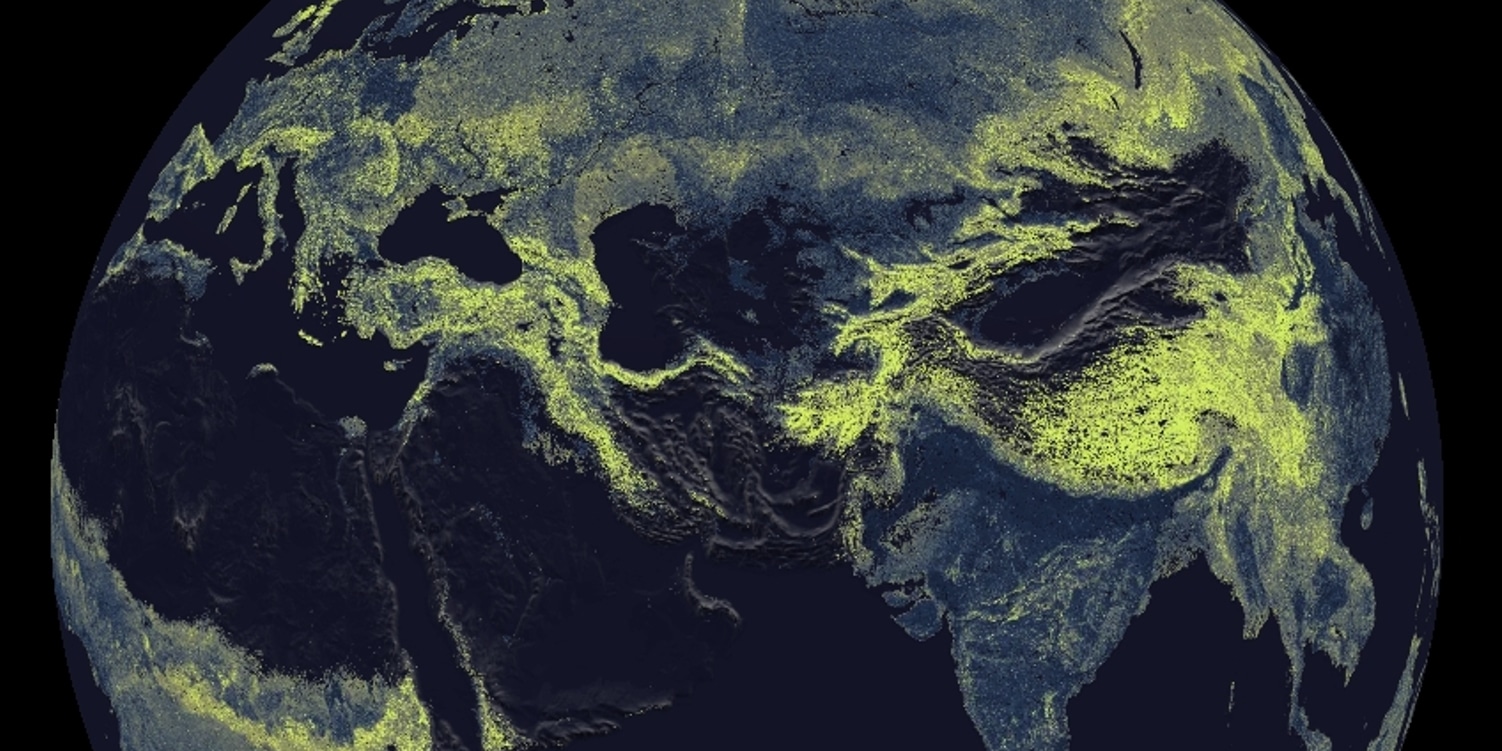
Recently, a team has developed the world’s first interactive global map of arbuscular mycorrhizal fungal networks. This is a monumental project that reveals the extent and biomass of an underground fungal infrastructure essential to terrestrial life and climate regulation, among other things. Scientists are set to present their map at upcoming United Nations summits, with the aim of changing current global soil conservation policies.
The Incredible Reach of Mycorrhizal Networks
As a reminder, arbuscular mycorrhizal fungi (AMF) are microscopic soil fungi living in symbiosis with the roots of 70 to 80% of terrestrial plants. This symbiotic partnership allows the fungi to receive sugars produced by the plants through photosynthesis. The plants themselves also benefit, as the fungi enable roots to absorb water and soil minerals more effectively. Importantly, these fungi form networks that are often referred to as the “Wood Wide Web.” With activity dating back at least 475 million years, these networks would have greatly contributed to the colonization of land by plants.
On June 11, 2026, an international team of researchers under the supervision of the Amsterdam Institute for Life and Environment (A-LIFE) published their latest work in the journal Science. These scientists have produced the first-ever interactive global map of arbuscular mycorrhizal fungal networks, an enormous project that reveals their astonishing extent. The map in question is available on the website of the Society for the Protection of Underground Networks (SPUN), a global nonprofit scientific initiative.
“Using more than 2.8 billion fungal DNA sequences from soil samples collected across 130 countries, we created the first high-resolution maps that allow us to predict the mycorrhizal fungal biodiversity at a 1 square kilometer (km²) resolution on a planetary scale.”, reads the project description page.
A Map Revealing Critical Soil Vulnerabilities
The researchers estimated the total length of fungal filaments present in topsoil at 110 quadrillion kilometers, the equivalent of about a billion times the distance from the Earth to the Sun. The authors also assessed the carbon stored in these mycorrhizal networks at 300 megatons of carbon – four to six times the combined mass of all humanity. Additionally, there is an extraordinary density: a teaspoon of soil can contain up to ten meters of filaments.
Through its symbiotic relationship with plants, the Wood Wide Web makes a major contribution to the integrity of life on Earth and to climate regulation. However, the global map highlights certain critical vulnerabilities in the face of human activities. In areas of intensive agriculture, the density of mycorrhizal networks is about half that found in wild ecosystems. The culprits include mechanical tillage, as well as the use of fungicides and chemical fertilizers. Moreover, grasslands alone harbor no less than 40% of the world’s fungal biomass, notably in regions such as the Everglades (Florida), the floodplains of South Sudan, and the Tibetan Plateau. Unfortunately, these essential areas are poorly protected and, worse still, being converted to agricultural land four times faster than forests.
Finally, the researchers plan to present their map to governments at upcoming United Nations summits. The aim will be to finally integrate mycorrhizal networks into global conservation policies – chiefly the global “30×30” agreement – on par with plants and animals themselves. This crucial communication will occur notably through Toby Kiers, an evolutionary biologist and 2026 Tyler Prize laureate for the Environment.
Sources: A Hidden Infrastructure (spun.earth) | One billion times the distance from the Earth to the sun: First global map of mycorrhizal fungi reveals true size (eurekalert.org)
Article prepared with the help of AI · Our method
