November 14, 2026
At a Glance
- The Renon fairy chimneys are columns of glacial till shielded from erosion by an upper rock cap, whose shedding leads to their collapse within a few years.
- A 2026 study shows that the share of landslides from north-facing slopes above 2,000 metres in the Dolomites has risen from 4% (1970–1999) to 12% (2000–2025), linked to permafrost thaw.
- The phenomenon affects the entire range, from Cima Falkner to Marmolada (which could vanish as early as 2040) to the Alps, where the summer of 2026 set a new record for rockfalls, surpassing 2022.
Contents
- A Stone Hat, a Race Against Time
- The Glacial Till, a Fragile Memory of Vanished Glaciers
- When Rain Lasts Longer Than Soft Rock
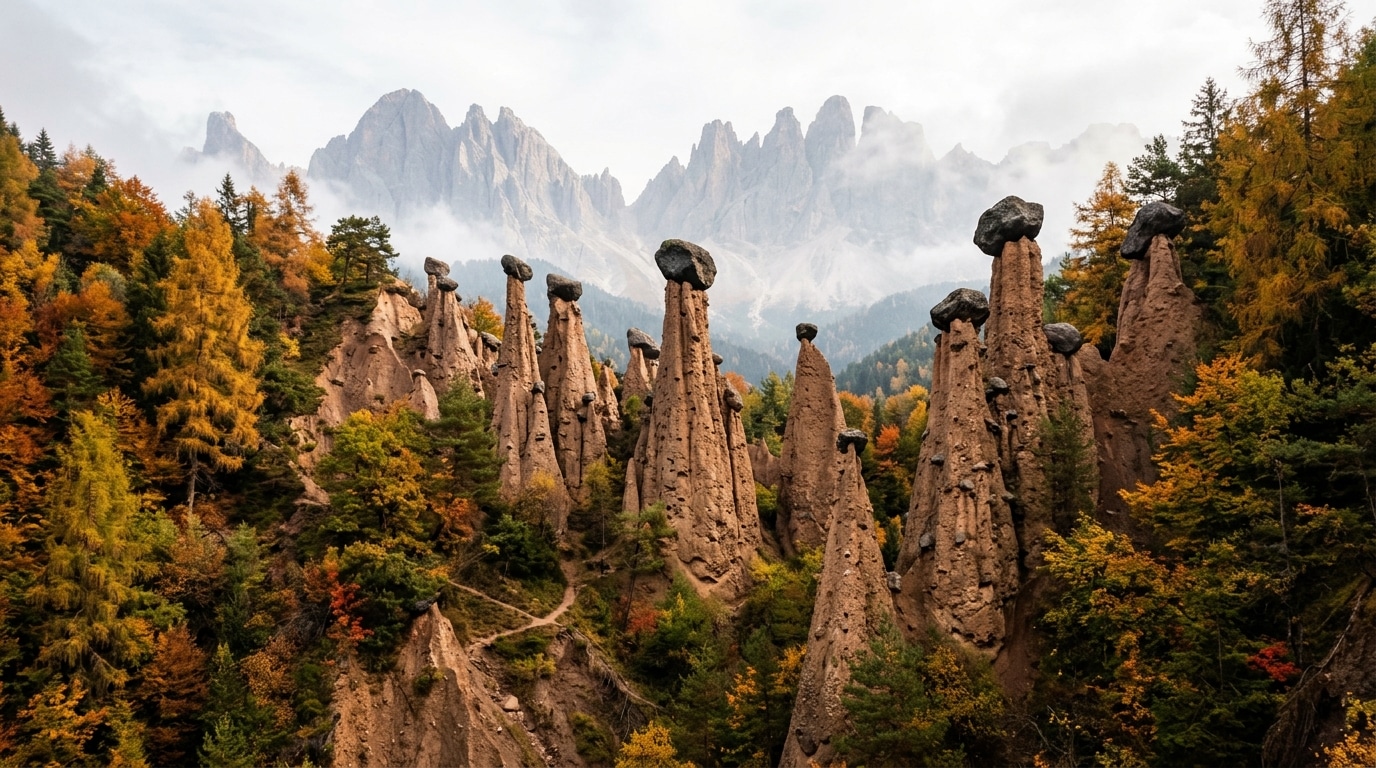
Above Renon, in the Dolomites, columns of compacted earth have stood for millennia, each topped by a rock slab that shields it from the rain. These fairy chimneys, sometimes several metres tall, owe their survival to a precarious balance: the day their cap falls, the column collapses in just a few seasons.
It takes only you to lift your eyes to the wooded slopes of the Renon plateau to glimpse these strange silhouettes, planted in the landscape like earth’s sentinels. Each column bears, balanced atop its summit, a rock block sturdier than the surrounding material. This cap is not mere ornament: it is, and only it is, what keeps erosion at bay from razing the entire column.
Key Points
- The Renon fairy chimneys are columns of glacial till protected from erosion by a capstone, whose fall leads to their collapse within a few years.
- A 2026 study shows that the share of landslides from north-facing slopes above 2,000 metres in the Dolomites rose from 4% (1970–1999) to 12% (2000–2025), linked to permafrost thaw.
- The phenomenon affects the entire range, from Cima Falkner to Marmolada (which could disappear as early as 2040) to the Alps, where the summer of 2026 set a new record for rockfalls, beating the 2022 record.
Contents
- A Stone Hat, a Race Against Time
- The Glacial Till, a Fragile Memory of Vanished Glaciers
- When Rain Lasts Longer Than Soft Rock
The mechanism at play is what geologists call differential erosion. Around the pillar, rain and wind nibble away the surrounding soil year after year. Under the protective cap, however, the matter remains sheltered, as if under a mineral umbrella placed there by chance.
The result of this silent work is a landscape that looks carved in stone yet is incredibly vulnerable. As soon as the capstone tilts or detaches, the column loses its protection and disappears within a few short years, gnawed away by the very elements it once kept at bay.
The Glacial Till, a Fragile Memory of Vanished Glaciers
To understand why these columns exist precisely here, one must rewind to the great glaciations that shaped the Dolomites. As glaciers advanced and retreated, they left behind thick layers of till — a heterogeneous mix of sand, gravel, and blocks of all sizes, carried and dropped without any particular sorting.
This material, compact yet relatively loose, today forms the body of the fairy chimneys. It is not a hard, uniform rock: it is a fragile sediment, sensitive to moisture, that easily falls apart without surface protection.
It is precisely this fragility that makes the Renon site both spectacular and threatened. The till tells the story of a past climate, of glaciers that once covered the region, yet it was not designed to withstand the current weather for long without the help of its stone caps.
When Rain Lasts Longer Than Soft Rock
What endangers the Renon fairy chimneys is only a symptom of a broader phenomenon affecting the entire Dolomites. A study published in 2026 in the journal Natural Hazards and Earth System Sciences, by Bonometti, Dattola, Frattini and Crosta, examined what triggers rockfalls in this massif. The researchers found that the share of landslides coming from northern-facing slopes above 2,000 metres rose from 4% between 1970 and 1999 to 12% between 2000 and 2025. This pattern is directly linked to the progressive thaw of permafrost, the ground that is usually permanently frozen and acts as a natural cement for the rock.
The same study identifies three periods of the year when rockfalls multiply in the Dolomites: November, the February–April window, and August. These peaks align with freeze–thaw cycles that gradually weaken rock fractures. The case of Cima Falkner, in the Brenta Dolomites, illustrates this process well: in July 2025, the Guardian reported the evacuation of hundreds of people after a string of rockfalls on this summit. The local geological service pointed to a geomorphological phenomenon likely linked to permafrost degradation, with fractures once filled with ice now completely empty.
The rest of the range is not spared. Marmolada, the highest glacier in the Dolomites, was already losing seven to ten centimeters per day according to a September 2024 assessment, a rate that could drive its disappearance by 2040. More broadly, in the Alps, geomorphologist Ludovic Ravanel, a CNRS research director at the Edytem laboratory, described the summer of 2026 as a record year for rock destabilizations, surpassing the previous 2022 record which involved 300 rockfalls. In the Mont-Blanc massif alone, around 400 rockfalls were anticipated for that season, with a zero-degree isotherm observed between 4,200 and 4,500 metres for six weeks in total. And heavy rains also play their part: at the end of June 2026, a storm between Merano and Avelengo, in South Tyrol, produced a debris flow after about 50 millimetres of rainfall in one hour, according to meteorologist Dieter Peterlin, lightly injuring five people and forcing 69 residents to evacuate their homes.
In light of this, the Renon fairy chimneys stand as an almost paradoxical symbol. They have survived for centuries thanks to a simple stone perched in equilibrium, while the mountains surrounding them crack under warming. Their fate still hinges on the same tiny detail, one block that remains in place, yet whose fall will come as no surprise one day.