
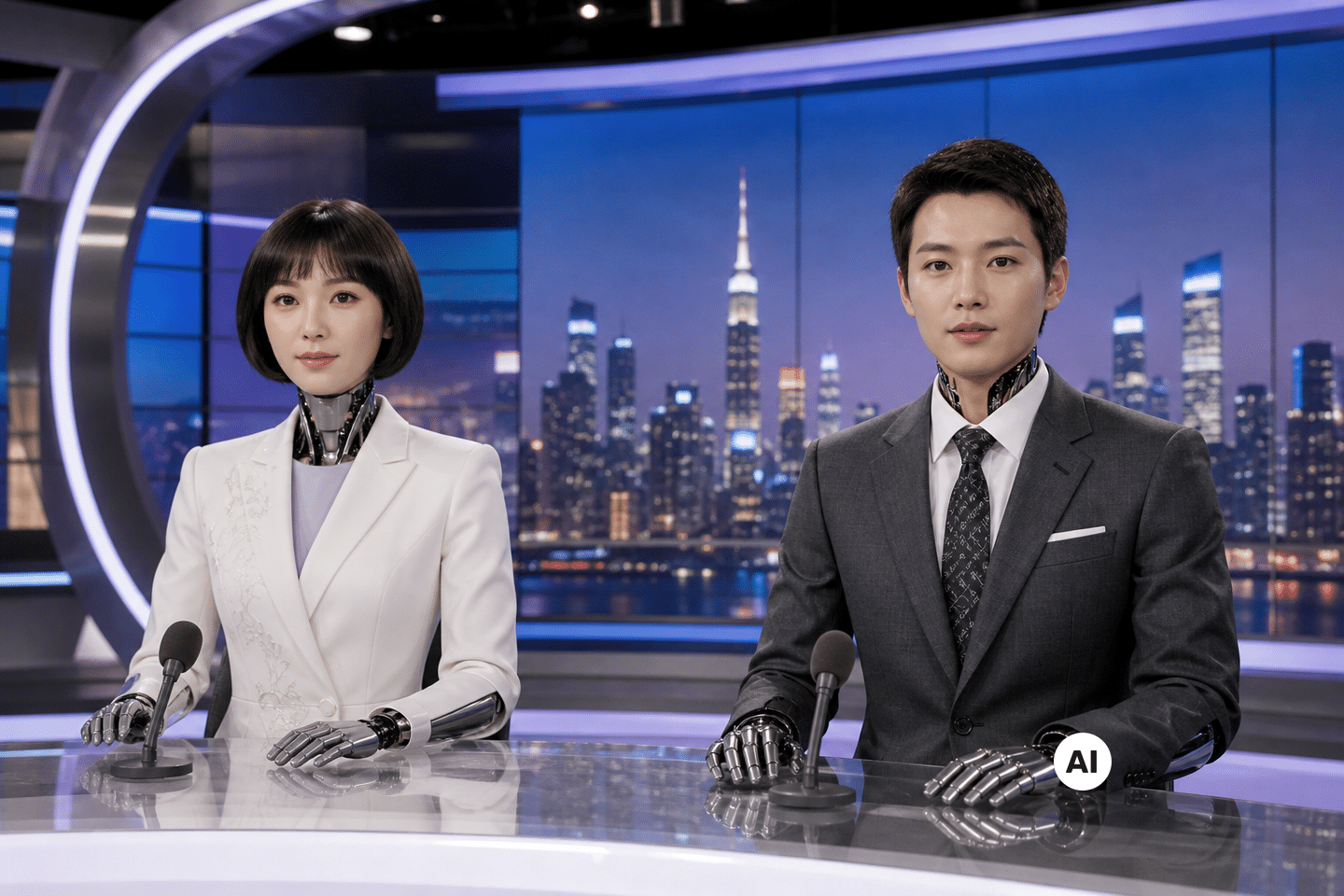
A news anchor opens the bulletin with a “Hello.” Nothing extraordinary, except that she is not human. In China, two humanoid robots with a bionic skin have just presented a news program—a world first that deserves serious attention.
- The Xinhua News Agency unveiled at the World Media Summit in Beijing two humanoid robots with bionic skin, including Xinyan, created by UBTECH Robotics
- Director Zhang Yimou designed the visual and physical appearance of the robots to align with television aesthetics
- Linked to the Xinhua Yudian platform, these robots present information and interact with the audience, but they do not write anything themselves; editorial oversight remains in human hands
- Xinyan and her teammate, the new faces of China’s newscast
- Zhang Yimou at the controls: when a filmmaker shapes robots
- Augmented journalists or mere mouthpieces: the real role of these machines
Xinyan and her teammate, the new faces of China’s newscast
The state news agency Xinhua chose a high-profile venue for its announcement: the World Media Summit in Beijing. On stage, two life-sized humanoid robots, a man and a woman named Xinyan, spoke before the audience. It was she who opened the proceedings with this simple greeting.
What strikes first is their appearance. Their bionic skin mimics both the look and texture of human skin, a detail that changes everything in the viewer’s perception. We are far from the metallic, angular robots that still populate the collective imagination.
Behind this feat lies a clearly identified duo: the Chinese robotics maker UBTECH Robotics handled all production, while Xinhua retains all ownership rights to the project. UBTECH developed the synthetic skin, the operating system, a language model with an emotional component, and the entire embodied AI hardware required for these machines to operate.
Another piece of the technical puzzle: the robots are connected to Xinhua Yudian, a news platform and AI-powered intelligent assistant launched in June. According to Xinhua, this connection makes the broadcast content traceable, secure, and controllable—three terms that say a lot about the concerns surrounding such a device.
Zhang Yimou at the controls: when a filmmaker shapes robots
The name is surprising in this tech context: Zhang Yimou, a renowned Chinese filmmaker, was hired as the chief image designer for the two robots. His role isn’t a marketing gadget; he actually directed the visual and physical design of the machines.
The stated objective was clear: to bring these artificial presenters closer to the aesthetic codes of traditional TV presentation. A filmmaker accustomed to composing images for the big screen thus found himself shaping features, postures, and a stage presence designed for the living-room screen rather than the cinema hall.
This collaboration illustrates an unexpectedly logical approach: to render a robot credible in front of a news camera, it isn’t enough to stack mechanics and artificial intelligence. One also needs an artistic gaze capable of thinking through body language and expressiveness—elements usually reserved for human actors and presenters.
Augmented journalists or mere mouthpieces: the real role of these machines
The central question remains: what exactly do these robots do once the lights are on? Their mission unfolds in three precise aspects. These humanoid presenters assist the editorial team, notably by presenting information, broadcasting multilingual content, and interacting with the audience in real time.
They write nothing on their own initiative. Zhou Jian, founder and president of UBTECH, details the internal workings: a system dubbed “brain-expression-control” draws verified and authorized information in real time. This architecture is specifically designed to limit the risk of hallucinations, the well-known flaw of generative AI that sometimes fabricates facts outright.
Qian Tong, director of Xinhua’s New Media Center, reinforces this point: journalists and editors remain the central editorial actors of the system. The robots execute; humans decide. Forum participants also stressed collectively that human judgment, field reporting, and fact-checking remain indispensable.
In other words, Xinyan and her teammate do not replace a newsroom; they extend its voice. The nuance is important: these are sophisticated broadcasting tools, not autonomous authors capable of deciding what deserves coverage.
This first global deployment of bionic newscasters paints an intriguing path for the future of media, without heralding the disappearance of human presenters. It is better understood as an additional tool, designed to relieve some repetitive tasks while leaving the heart of the profession—analysis and verification—in capable human hands.
