
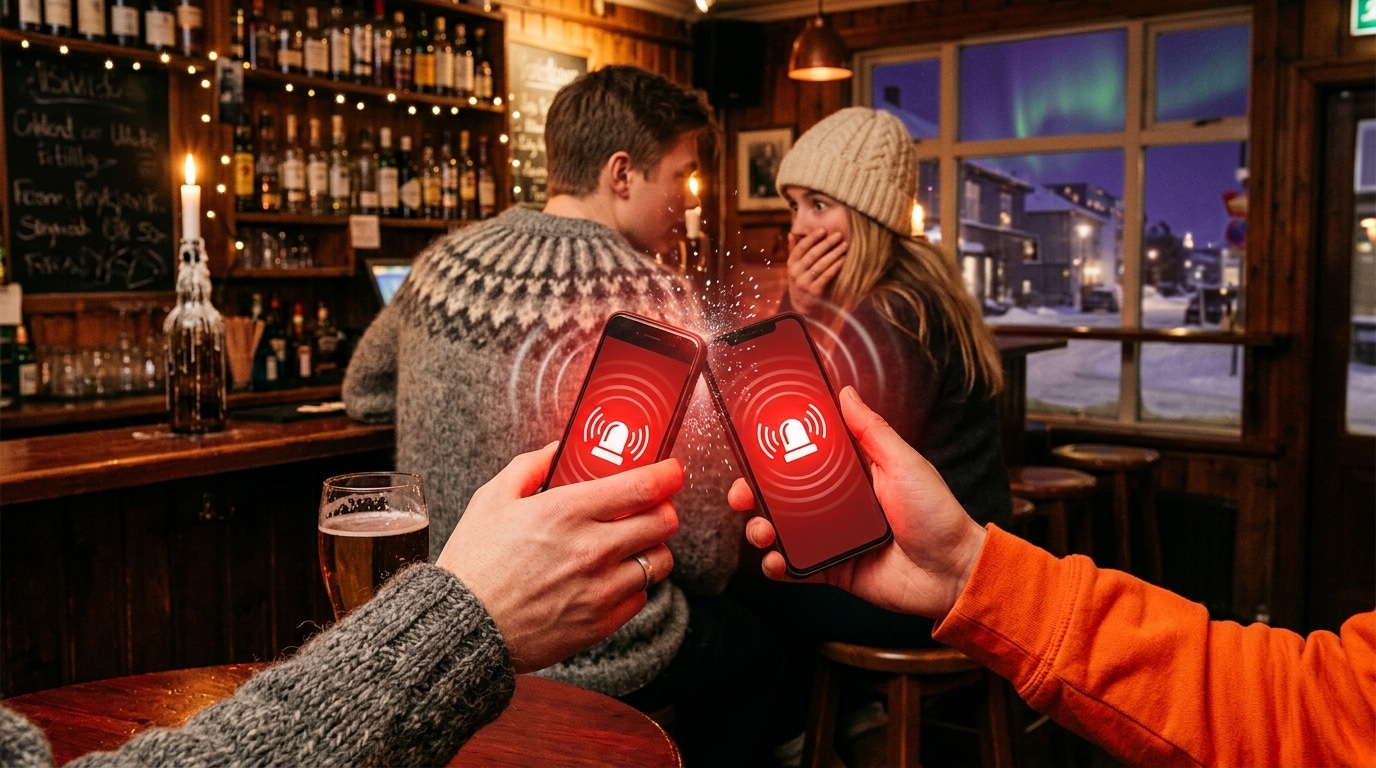
Barely 400,000 inhabitants, and yet a real demographic vertigo. In Iceland, the population is so small that kinship ties intersect faster than you might imagine. So, before taking things too far on a date, it’s wiser to pull out your phone—not to swap numbers, but to check that you do not already share a great-grandfather.
- The Íslendingabók genealogical database, created in 1997, traces 1,200 years of Icelandic family history and covers 95% of the islanders who lived in the last 300 years.
- The ÍslendingaApp, launched in 2013 by three students, enables two smartphones to come close together to instantly detect a too-close kinship.
- Despite international media attention, the app had only been downloaded 3,651 times on Android, a figure in line with Iceland’s small population.
- 400,000 inhabitants, a single genealogical tree: Iceland’s peculiarity
- ÍslendingaApp, the app that turns every smartphone into a cousins detector
- “Bump the app before you bump in bed”: when technology enters dating
400,000 inhabitants, a single genealogical tree: Iceland’s peculiarity
According to the latest figures from Statistics Iceland, the island counted 394,324 inhabitants at the start of the year, and around 396,500 by mid-2026. A population size comparable to that of a large French urban area, but spread across the entire country. This demographic rarity has a direct consequence: in a population this small, family trees inevitably intersect, sometimes across generations that are surprisingly close.
That is why the Íslendingabók genealogical database was created in 1997, a product of the collaboration between deCODE Genetics and the computer scientist Friðrik Skúlason. By compiling census data, parish registers, and family archives, the creators built a national genealogy that stretches back 1,200 years. A meticulous effort that verges on an archival feat.
On paper, the result is impressive: the database claims information on 95% of Icelanders who have lived in the last 300 years. It remains freely accessible to anyone who has an Icelandic national identification number, making it a publicly consultable tool for all citizens and legal residents of the country.
Íslendingaapp, the app that turns every smartphone into a cousins detector
In 2013, to celebrate the ten-year milestone of Íslendingabók, deCODE Genetics and Iceland University’s School of Engineering launched a student competition. The goal: imagine new, creative uses for this genealogical database, which until then had mainly drawn curiosity from families. Three software engineering students, working under the banner Sad Engineer Studios, came up with a simple yet effective idea.
Their app, named ÍslendingaApp, relies directly on the national genealogical registry to instantly identify kinship between two users. It targets a concrete objective: preventing accidental consanguinity within an island population of about 400,000, where two strangers who might be attracted to each other may unknowingly share a relatively recent common ancestor.
The mechanism is one simple, playful yet powerful gesture. The two users bring their Android smartphones close together; the app cross-checks their data from Íslendingabók and displays the result in a few seconds. If the kin is deemed too close, an automatic alarm fires, a kind of genealogical alert signal.
This student project did not stay merely anecdotal. The team won the competition, taking home a prize of one million Icelandic crowns. A reward that also validated the social utility of an app born from a real constraint rather than a mere technical exercise.
“Bump the app before you bump in bed”: when technology enters dating
The slogan chosen by the creators left no doubt about the intended use: “Bump the app before you bump in bed,” literally “tap the app before taking the plunge.” A line of direct humor that captures the playful yet practical spirit of the project, which was widely echoed by the international press from its 2013 release onwards.
In practice, adoption remained modest. According to figures shared with NBC News, the app had been downloaded 3,651 times at the time of its publicity, on Android alone, with an iPhone version being considered but with no guaranteed timetable. A figure that remains coherent with the size of the population involved.
Beyond the amusing anecdote, this initiative illustrates a well-documented scientific reality: Iceland has long served as a privileged test ground for population genetics. Proof that the topic remains timely, deCODE Genetics published in January 2025 in Nature a comprehensive map of human recombination, based on the same family databases that feed Íslendingabók.
ÍslendingaApp is therefore not merely a college-night gadget. It embodies, with a lightness that is self-aware, a real demographic challenge that Iceland has faced for centuries. Between playful humor and genealogical rigor, this application reminds us that in dating, a good kinship detector can sometimes be as useful as a traditional dating app.
