
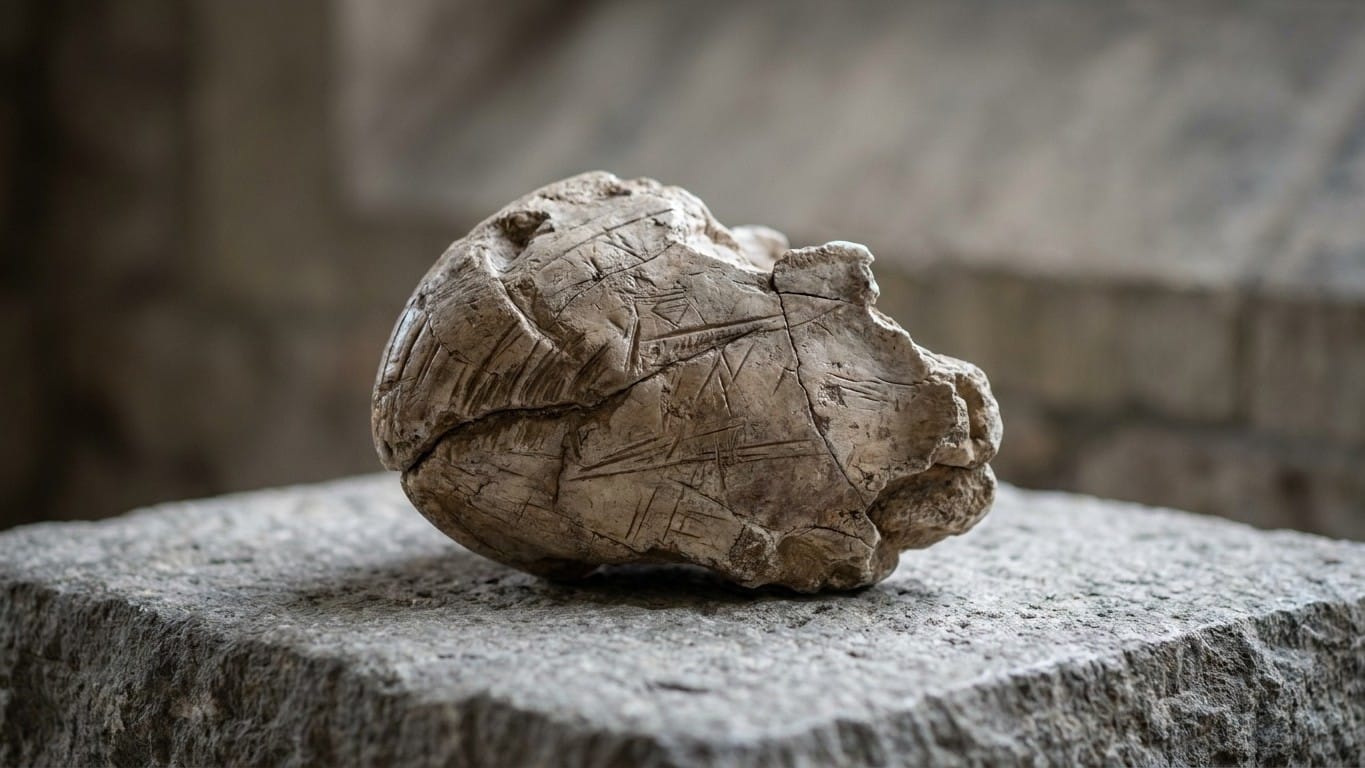
Approximately 100 million years ago, while the Tyrannosaurus rex ruled the terrestrial realm, there was another predator just as formidable ruling the seas. Without bones, without a shell, without a single skeleton to speak of, only arms, a beak, and a jaw power capable of crushing bone. Giant octopuses reaching up to 19 meters in length stood among the principal oceanic predators around 100 million years ago, according to new research that uncovered rare fossils hidden within solid rock. The study, published on April 23, 2026 in the journal Science, has enough evidence to rewrite our understanding of the marine ecosystems of the Cretaceous period.
Key takeaways
- A soft-bodied invertebrate may have dominated marine food webs for millions of years
- Fossil jaws reveal extreme wear: evidence of battles and carnivorous meals
- This prehistoric creature possessed brain lateralization, a sign of sophisticated intelligence
An unossified monster at the top of the food chain
The problem with octopuses is that their soft bodies, lacking shells or a skeleton, leave almost no trace in the geological record. This fossil silence has long biased our reading of the past. For decades, scientists assumed the apex of the oceanic food chain during the Cretaceous was exclusively occupied by large vertebrates. Mosasaurs, plesiosaurs, sharks with sharp teeth—these are the names typically associated with predators of that era. But a colossal competitor had been forgotten.
These large cephalopods could have been the largest marine animals of the Cretaceous and may be the biggest invertebrates ever to have lived. The species in question is Nanaimoteuthis haggarti. The researchers note that Nanaimoteuthis differed from today’s squids in having eight arms but lacking the two tentacles that contemporary animals use to capture their prey. So, an octopus, not a squid. A cephalopod the size of a six-story building, potentially surpassing even the Megalodon, which appeared much later and could reach 13 to 18 meters depending on estimates.
The evolution of octopuses toward a soft-bodied form represents a key innovation that improved their swimming ability and fostered the development of sight and intelligence. Abandoning the skeleton wasn’t a weakness; it was a winning strategy.
Des mâchoires qui racontent tout
Studying fossil octopuses is challenging because their soft bodies typically decay before fossilization. Only certain hard parts, such as beak-like jaws, survive as fossils. It is from these tiny fragments that the team from Hokkaido University, led by Yasuhiro Iba, reconstructed the portrait of a giant.
Fifteen jaws were already known, preserved in museum collections, and twelve new ones were retrieved from rock blocks using a method called “digital fossil digging.” The samples are ground very finely, layer by layer, and each stratum is photographed. With the help of artificial intelligence, the team built a detailed digital model of fossils too fragile to extract by traditional means. The result: 27 jaws analyzed, two species identified, and a staggering figure: 19 meters.
The largest lower jaw belonging to N. haggarti could hold a grapefruit and was about 50% larger than the jaw of today’s 12-meter giant squid. It is from this beak and the proportions observed in modern species that the researchers extrapolated the animal’s total size. Some scientists remain cautious about the upper limits of these estimates: body size is inferred from beak-to-body ratios, which can vary depending on the modern reference species used. Scientific prudence is warranted, but even at the lower end, the creature remains monumental.
Broyer des os sans avoir d’os
The most astonishing revelation of the study is not size but wear. The jaw wear observed is striking: reveals chips, scratches, cracks, and smoothing—signs of a powerful bite. Some jaws even lost up to 10% of their total length.
The researchers found that the jaws of the largest creatures showed substantial wear and damage, including scratches, chips, and rounded edges, suggesting that “these animals regularly ground hard prey such as shells and bones.” This changes everything. An invertebrate without armor, preying on prey with hard skeletons—fish, sea turtles, and perhaps even young marine reptiles. According to Iba, this indicates that Cretaceous marine ecosystems were more complex and included a greater number of top predators than previously thought. “Within this ecosystem, Nanaimoteuthis likely used its large body and long arms to capture prey, and its powerful jaws to process hard foods.”
A further intriguing detail puzzles paleontologists. Careful examination of the jaws revealed pronounced asymmetric wear, indicating precise feeding habits. This morphological detail proves the creature used a specific side of its jaw to grind its prey. This behavior, known as lateralization, is a sign of higher intelligence and a sophisticated hunting strategy. Modern octopuses are already renowned for their cognitive abilities—opening jars, solving mazes, recognizing human faces. Their prehistoric ancestor appears to have inherited that sophistication, albeit on a far grander scale.
What we thought we knew, and what has changed
According to Iba, “this study provides the first direct evidence that an invertebrate could evolve into a large intelligent predator in an ecosystem largely dominated by vertebrates for around 400 million years.” It represents a major conceptual reversal. Vertebrate dominance in marine food chains was not a universal rule; it was a default hypothesis, due to a lack of fossils proving otherwise.
The authors note that superpredators—whether among cephalopods or vertebrates—emerged through convergent evolution, acquiring powerful jaws while shedding their external skeletons. Two branches of life, separated by hundreds of millions of years of evolution, converged on the same solution: a flexible body, formidable jaws, and intelligence serving the hunt.
This scientific advance also pushes back the dating of octopuses: the oldest known species are now dated about five million years earlier than previously thought. The story of giant cephalopods is thus longer, and probably more populous, than imagined. According to Iba, the digital fossil-digging method can raise fossil discovery rates by more than 10,000 times compared with traditional approaches, suggesting how many other forgotten giants lie waiting, concealed within rock.
Sources: observatoiredeleurope.com | pacte-climat.eu
