
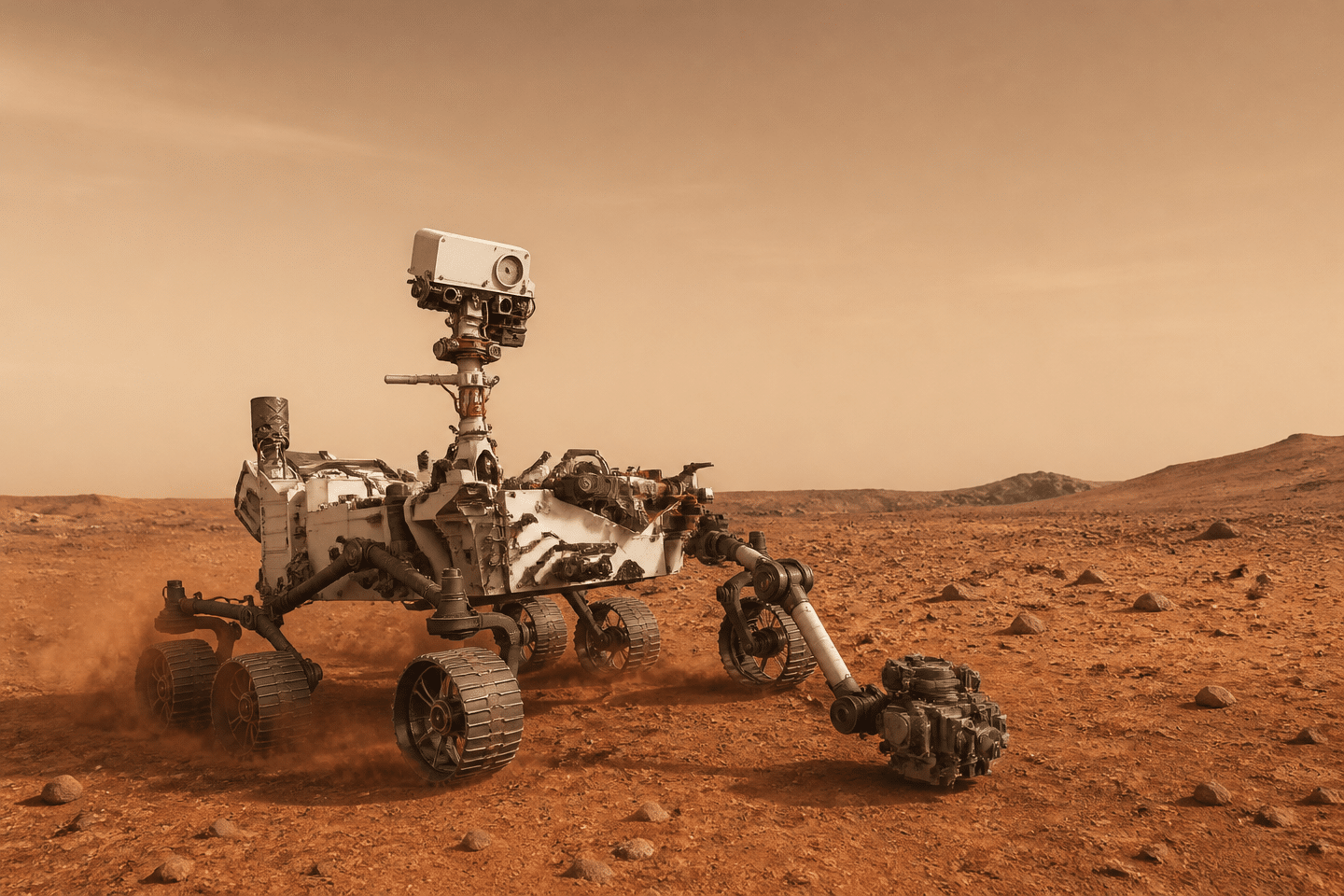
A grain of dust so fine that it could slip past the barrier meant to protect the human brain. That is what a study conducted with the Perseverance rover has just revealed. Following the relatively reassuring news that Martian dust is less abrasive than lunar dust, we now face a much more worrying assessment for future crews.
- The Perseverance PIXL spectrometer detected Martian dust particles descending to 100 nanometers, small enough to cross the blood-brain barrier
- This dust contains toxic perchlorates, iron, sulfur, and roughly five times more silica than coal dust
- If Martian dust proves less abrasive to hardware than lunar dust, NASA published this year a report recommending an initial health standard for inhalation risks
- A dust gentler than lunar dust, but don’t celebrate too soon
- When microscopic particles take a shortcut to the brain
- The chemical cocktail that worries far more than NASA will admit
A Dust Gentler Than the Moon’s, But Don’t Celebrate Too Soon
Let us begin with the positive side, because there truly is one. On the Moon, the regolith is made of irregular, nearly cutting fragments that have accumulated without ever being eroded due to the lack of an atmosphere. Result: during the Apollo missions, this dust scratched visors, wore down outer layers of suits, and damaged the bellows at the glove-jacket joints.
On Mars, the scenario is different. The atmosphere is thin, certainly, but it exists, and the wind has been blowing for billions of years. The consequence: dust grains have had a long time to round off, a bit like pebbles polished by a river current, explains Scott VanBommel, a researcher at Washington University in St. Louis and the study’s lead author.
That is precisely what Perseverance has been able to verify in practice. Since 2021, the rover has carried small fabric samples from its space suit, each measuring barely about twenty millimeters. After 1,645 Martian days of exposure, these fabric scraps show almost no visible wear, a result that is fairly reassuring for the durability of future astronauts’ suits.
Yet this optimism concerns only the mechanical aspect—the abrasion and wear of equipment. It tells us nothing about what happens once that very dust penetrates the body. And this is exactly where the study published in the Proceedings of the National Academy of Sciences becomes markedly more troubling.
When Microscopic Particles Take a Shortcut Toward the Brain
For the first time, researchers could measure directly on Mars the true size of the finest particles, thanks to the PIXL spectrometer aboard Perseverance. This instrument, fully named the Planetary Instrument for X-ray Lithochemistry, provided in-situ data that until now had only been predicted on paper.
The result is unequivocal: some particles reach down to 100 nanometers. At this scale, dust no longer merely adheres to the surface of the lungs; it can traverse tissues and enter the bloodstream directly.
Even more troubling, these nanoparticles would have an even more direct route to the brain. Once inhaled, they could bypass the blood-brain barrier, this biological sentinel designed to shield the central nervous system from unwanted substances circulating in the blood.
VanBommel sums up the situation with a vivid image. The large dust accumulations, these so‑called Martian bales, gradually disperse over time. But the tiniest particles cling to the environment and persist, representing, in his view, the greatest challenge to the life-support systems of future astronauts.
The Chemical Cocktail That Worries Much More Than NASA Will Admit
Particle size is only half the problem. Their chemical composition worries the study’s authors just as much. The dust includes perchlorates, compounds already known for their toxicity, alongside iron, sulfur, and other reactive elements.
Another striking finding: this Martian dust, rich in silica, would contain roughly five times more silica than coal dust, long dreaded for its effects on miners’ lungs. The researchers describe this ultrafine dust as a genuine pathway for direct accumulation of neurotoxins in the blood and in the tissues of the central nervous system.
This conclusion does not come from nowhere. A study published last year in GeoHealth had already established that prolonged exposure to Martian dust could trigger chronic respiratory problems as well as thyroid diseases. The new study thus adds a neurological dimension to an already grim picture that had been only rarely documented before.
In response to these findings, NASA published this year a report recommending an initial health standard for inhalable Martian dust, a task to which Shaunna Morrison of Rutgers University contributed, as a member of NASA’s working group dedicated specifically to this issue. It remains to be seen whether technical solutions—such as self-cleaning suits or decontamination systems using liquid nitrogen jets—will be ready before humans actually step foot on the Red Planet.
Mars will undoubtedly continue to draw attention and ambition, that much is certain. Yet between the fascination it inspires and the harsh reality of its toxic soil, the path ahead remains long. Until this ultrafine dust is better controlled, every step on Mars will be a gamble with the health of those who dare to tread it.
Source: NASA
