
If you’re passionate about science, you already know that some museums are more than just cultural visits. They tell the story of major discoveries and leave a lasting impression. Some world-class science institutions around the globe are well worth the journey and deserve a premier place on your bucket list. Here is a selection of the most cherished by science enthusiasts, with practical tips to prepare your trip under the best possible conditions.
What to Remember Before You Go
Visiting a world-renowned science museum requires some planning:
- Take the time to check entry requirements for the country you will visit. Some destinations require a specific visa. Others have particular health or customs rules. It’s important to research ahead of departure to avoid any trouble on site.
- Big science museums are often vast. A single day may not be enough to explore them. Identify the priority collections in advance and find out about the schedule of temporary exhibitions. Be aware these are often fully booked well in advance.
- Cultural norms vary from country to country. For example, in Japan, removing your shoes is customary in certain spaces. In the United States, tipping is expected even in museum cafeterias.
- For your trip, don’t hesitate to opt for an international eSIM. It guarantees constant access to plans, translations, and last‑minute bookings, without having to rely on local Wi‑Fi.
The Must-See Science Museums Around the World
Some science museums stand out as global benchmarks. Here are the ones that truly deserve a detour.
In Europe
When it comes to science museums, Europe certainly has enough to impress enthusiasts. In Paris, the Cité des Sciences et de l’Industrie is one of the continent’s largest science museums. Spanning over 30,000 m², it covers diverse themes such as life sciences, mathematics, light, and the digital universe. The permanent exhibitions are regularly refreshed. Not to mention that its planetarium remains among the most impressive in Europe.
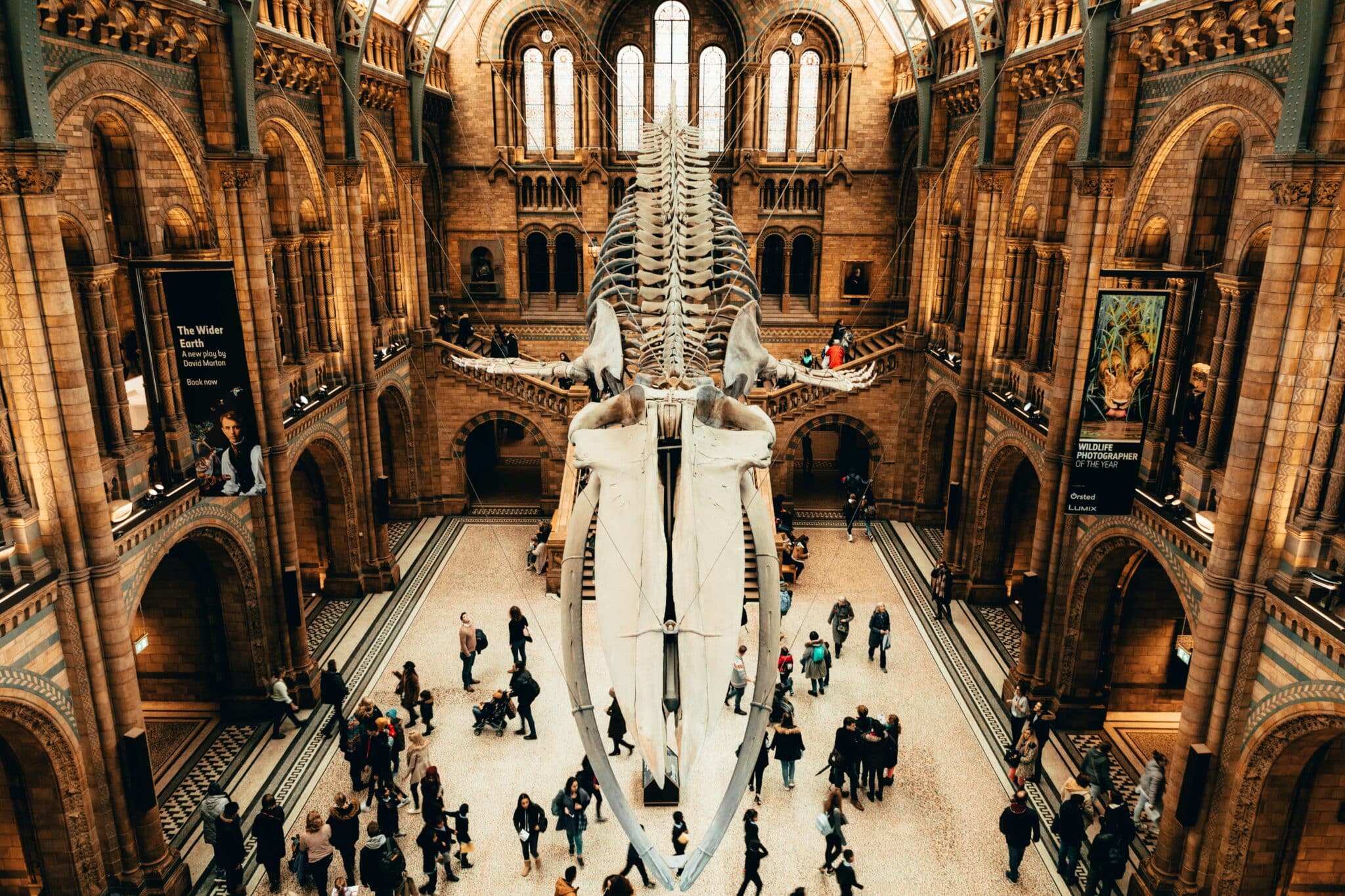
In London, the Natural History Museum is an essential institution. Its grand dinosaur gallery, dominated by the Diplodocus skeleton, attracts visitors from all over the world. Admission is free, making it a landmark accessible to every budget.
In Germany, the Deutsches Museum in Munich is simply the largest science and technology museum on the planet. With more than 73,000 objects on display across 14 kilometers of galleries, you’ll need more than a day to see everything.
Outside Europe
In the United States, the Smithsonian Institution in Washington is the ultimate reference. It is even recognized by UNESCO as one of the largest museum and research complexes in the world. It isn’t a single museum, but a collection of nineteen museums and galleries. This includes notably the National Museum of Natural History and the National Air and Space Museum. Entry is free, which is a considerable advantage.
Also in the United States, but in San Francisco, the Exploratorium is a must. Its approach is totally different. Here, everything is designed to be touched, manipulated, and experimented with. With more than 600 interactive installations, it appeals to both adults and children and challenges us to rethink how we view the world in an authentically original way.
In Japan, the National Museum of Science in Tokyo, located in Ueno Park, traces the country’s natural and scientific history across several buildings. Its permanent collection comprises millions of specimens, and its exhibits on evolution and biodiversity are particularly well designed.
Questacon: An Original and Unmissable Museum
Less known in Europe, Questacon in Canberra (Australia) deserves special attention. This national center for science and technology was designed from the outset as an interactive space. For this museum, scientific discovery mainly happens through direct experimentation. You’ll find more than 200 permanent exhibitions, distributed across thematic galleries exploring physics, technology, natural phenomena, and the human body.
What sets Questacon apart from the other museums on this list is its distinctly playful approach, which will delight both adults and children. Visitors particularly enjoy live demonstrations conducted by science mediators. Canberra remains a destination underrated by European travelers. Yet Questacon alone is a compelling reason to stop there.
Still on the fence? These various science museums have plenty to sway you. Each offers a unique experience. Yet they all have the power to surprise you. Visiting them can be a great reason to stray off the beaten path and plan a travel experience a little out of the ordinary. All that remains is to decide which one you will start with.
