
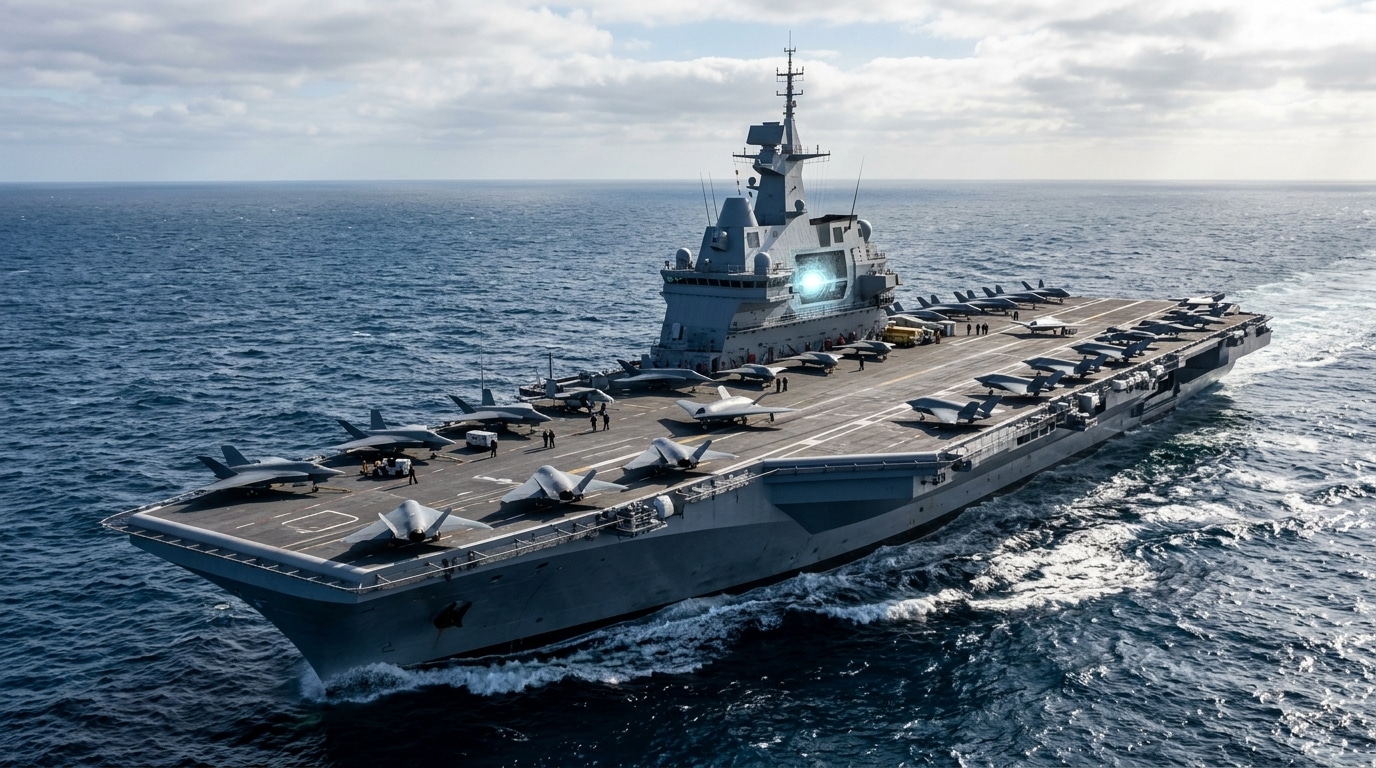
Imagine a warship as long as a skyscraper laid down, able to traverse the oceans for decades without refueling, and whose deck would be designed not only for fighter aircraft piloted by humans but also for combat drones. This colossus isn’t science fiction: it carries a name, the PANG, for a Next-Generation Aircraft Carrier. Behind this somewhat technical acronym lies one of the most ambitious military projects ever undertaken by France. A flagship vessel that will embody, for the first half of the 21st century, French naval power. So, what makes it so extraordinary? Let’s delve into the inner workings of this future giant of the seas.
Two K22 Reactors: The Nuclear Core That Changes Everything
At the heart of the PANG will beat not one, but two nuclear reactors named K22. To grasp the scale of this feat, one must understand what such a power source represents. Where a conventional ship relies on fuel oil and must be refueled regularly, a nuclear-powered aircraft carrier enjoys near unlimited autonomy. The onboard fuel can sustain the vessel for extended periods, allowing it to project power to the far corners of the globe without ever needing a port call.
These K22 reactors mark a dramatic upgrade from the ones on the Charles de Gaulle. More powerful, they must not only propel a ship that is far heavier, but also feed a multitude of energy-hungry systems: electromagnetic catapults, state-of-the-art radars, and electronics that keep demanding more and more power. Think of a colossal reactor that doubles as both engine and floating power plant. It is this extraordinary energy that will make everything else possible.
A Flight Deck Engineered for the Era of Combat Drones
If the PANG captivates as much as it does, it is also because it looks squarely toward the future of aerial warfare. Its flight deck will not merely be designed to house piloted fighter jets: it is built to integrate combat drones. These unmanned aircraft, capable of performing reconnaissance missions as well as attacks, represent a genuine tactical revolution. They enable risk-taking without putting human lives in danger and can operate for unprecedented durations.
To launch these vehicles, the PANG will rely on electromagnetic catapults, a technology that replaces the old steam-based systems. Smoother, more precise, they also protect both heavy aircraft and lighter drones. The deck thus becomes a true hybrid platform, able to blend humans and machines in an aerial choreography of unprecedented complexity. It is this flexibility that will make the ship a tool adapted to the threats of tomorrow.
2038: Why the Charles de Gaulle Is Replaced
The Charles de Gaulle, the only nuclear-powered aircraft carrier outside the United States, has been delivering valuable service to the French Navy for years. But no ship lasts forever. By 2038, it will have to bow out, and the PANG will take up the mantle. This handover is far from incidental: it ensures the continuity of France’s ability to operate a carrier strike group, a strategic asset that very few nations possess.
Building such a vessel does not happen overnight. It stretches across many years, mobilizing thousands of workers and a cutting-edge industrial know-how. Planning the replacement of the Charles de Gaulle now means avoiding any capability gap, that is, a period when France would find itself without an operational aircraft carrier. A scenario unthinkable for a power that prides itself on its standing.
What the PANG Reveals About France’s Naval Power of Tomorrow
Beyond its technical feats, the PANG tells of a certain vision France holds on the international stage. Owning an aircraft carrier means possessing a mobile airbase capable of deploying anywhere in the world, autonomously. It is a tool of deterrence, but also of presence and influence, enabling France to weigh in on the great geopolitical balances.
By betting on extraordinary energy and on the integration of drones, France is making a forward-looking wager. It anticipates tomorrow’s conflicts, where automation and global reach will play decisive roles. The PANG is therefore not merely a ship: it is a statement of intent, the pledge to remain a major maritime nation for the decades to come.
Between its incredibly powerful nuclear core, its deck tailored for drones, and its mission to succeed the legendary Charles de Gaulle, the PANG embodies, in one vessel, the changes reshaping modern naval warfare. One intriguing question remains: to what extent will artificial intelligence and autonomous machines transform these sea giants, perhaps enough to someday rethink the very place of humans on board?
