
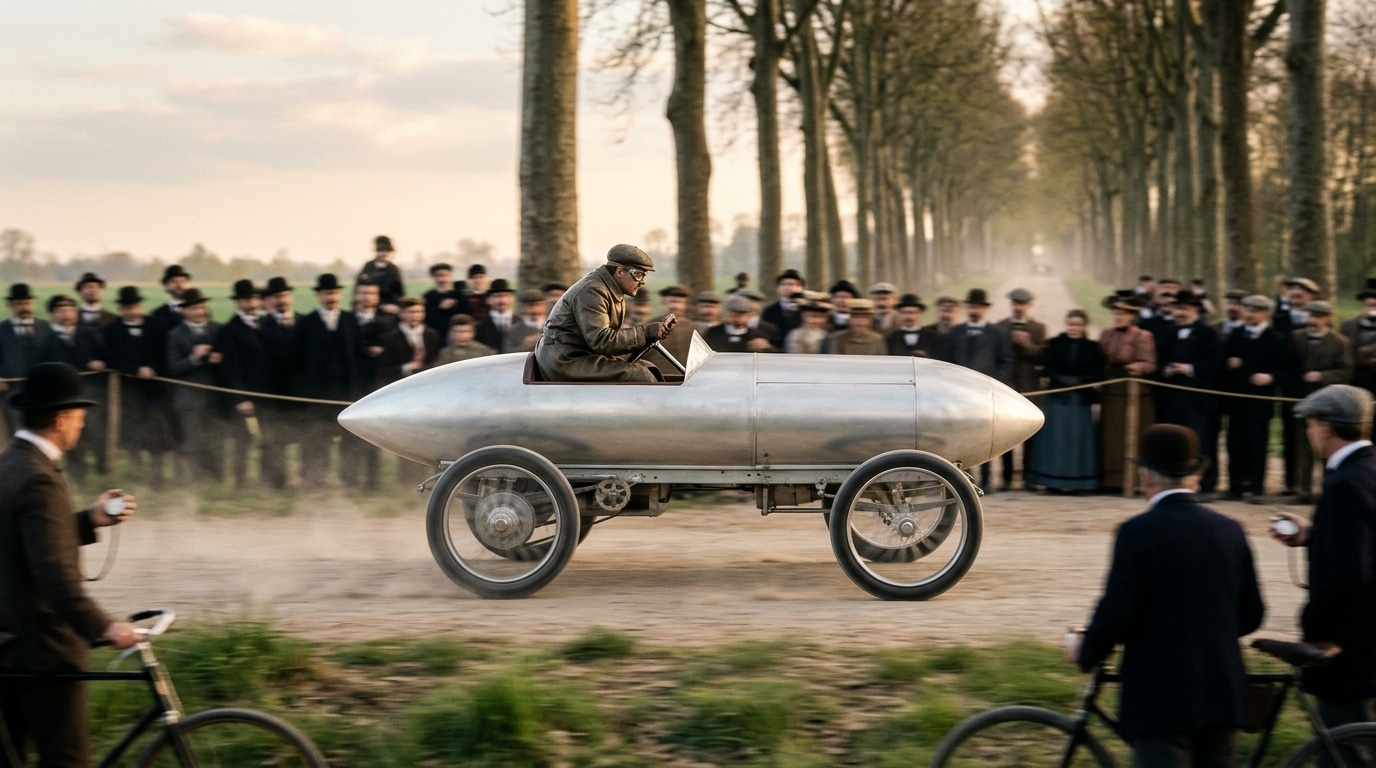
105.882 km/h. This figure was attained by a Belgian driver aboard an electric car, not a gasoline-powered speed machine. The Jamais Contente thus becomes the first automobile to surpass 100 km/h. But steam, and then the internal combustion engine, would quickly steal that title from it.
- In 1899, at Achères, Belgian Camille Jenatzy becomes the first to exceed 100 km/h behind the wheel of Jamais Contente, an electric torpedo-shaped car.
- In 1902, engineer Léon Serpollet usurps the record with a steam-powered vehicle reaching 120.805 km/h in Nice, before American Vanderbilt surpasses it the same year at 122.438 km/h on a Mors with an internal-combustion engine.
- Since that era, no electric car has reclaimed the absolute land-speed record, which, since 1997, has been held by the Thrust SSC at 1,227.985 km/h.
- An electric torpedo launches an assault on the chronometer
- Steam takes its revenge and erases the record in three years
- More than a century later, electric has never reclaimed the absolute crown
At the very end of the nineteenth century, automotive speed jousted in an unexpected arena: electricity. Internal-combustion engines were already in use, but they still lacked the power and reliability to target a record. Consequently, electric vehicles battled for the crown of pure speed in a Franco-Belgian rivalry that was as technical as it was sporting.
A torpedo-shaped electric car launches its assault on the chronometer
It all starts with a duel. Count Gaston de Chasseloup-Laubat held the record with his Jeantaud electric, achieving 92.69 km/h. A remarkable feat for the era, but it did not satisfy his main rival, the Belgian driver Camille Jenatzy. He began to prepare a bold technical response for the time.
His creation bore a name that would endure in memory: Jamais Contente. Unlike the cars of the period, merely tuned for speed, this vehicle was designed from the outset to break a record. Its torpedo-shaped body measures 3.60 meters in length, weighs 1,450 kilograms, and rests on an alloy that was still little known then, the partinium, whose exact composition remains uncertain.
That lightweight alloy was chosen to minimize the car’s mass without sacrificing stiffness. But the shape alone isn’t everything. The driver’s elevated position and the chassis visible beneath the body offset some of the aerodynamic gains engineers were seeking. Despite these compromises, the result arrives: in Achères, in the Yvelines, Jenatzy reaches 105.882 km/h over a launched kilometer. It is the first time a car crosses the symbolic 100 km/h barrier.
Steam takes its revenge and erases the record in three years
The reign of the Jamais Contente, however, does not last forever. Three years later, another propulsion type enters the scene: steam. Léon Serpollet, an engineer passionate about this technology, presents a vehicle with a name just as poetic as that of his electric predecessor, the Jamais Contente.
On the Promenade des Anglais in Nice, Serpollet achieves a turning point. After a 600-meter run-up, he covers the kilometer launched in 29.8 seconds, translating to a speed of 120.805 km/h. Jenatzy’s record falls, along with electric’s apparent supremacy in pure speed.
Serpollet thus becomes the first driver of a non-electric vehicle to hold the record. His car, later sold to London, would be remembered for its ability to surpass a technology that had dominated up to that point. Yet the steam era’s supremacy lasts only a few months. On August 5 of the same year, American William K. Vanderbilt reaches 122.438 km/h in a Mors equipped with an internal-combustion engine. It marks the dawn of a new era, one dominated thereafter by the internal-combustion engine, which would never again relinquish the top spot.
More than a century later, electric has never reclaimed the absolute crown
Since that early shift at the dawn of the twentieth century, no electric car has managed to reclaim the absolute land-speed record. Between 1898 and 1902, the fastest vehicles were electric—a fact recalled today by the Compiègne museum, where Jamais Contente holds a prominent place as a centerpiece of its collections.
The world land-speed record has since taken on a radically different scale. It has been held since 1997 by the Thrust SSC, driven by Andy Green in the Black Rock Desert, Nevada. This jet-powered machine reached 1,227.985 km/h, becoming the first car to break the sound barrier. A figure that dwarfs Jenatzy’s 105.882 km/h, yet it sits within the same pursuit: pushing the limits of land speed.
Between the Jamais Contente and the Thrust SSC, the history of propulsion technologies unfolds in rapid succession. Electricity opened the door, steam briefly eclipsed it, then the internal-combustion engine and finally the jet engine took the lead. A century later, electricity is making a strong return to everyday automobiles, but in the realm of the absolute speed record, it remains, for the moment, in the rearview.
