
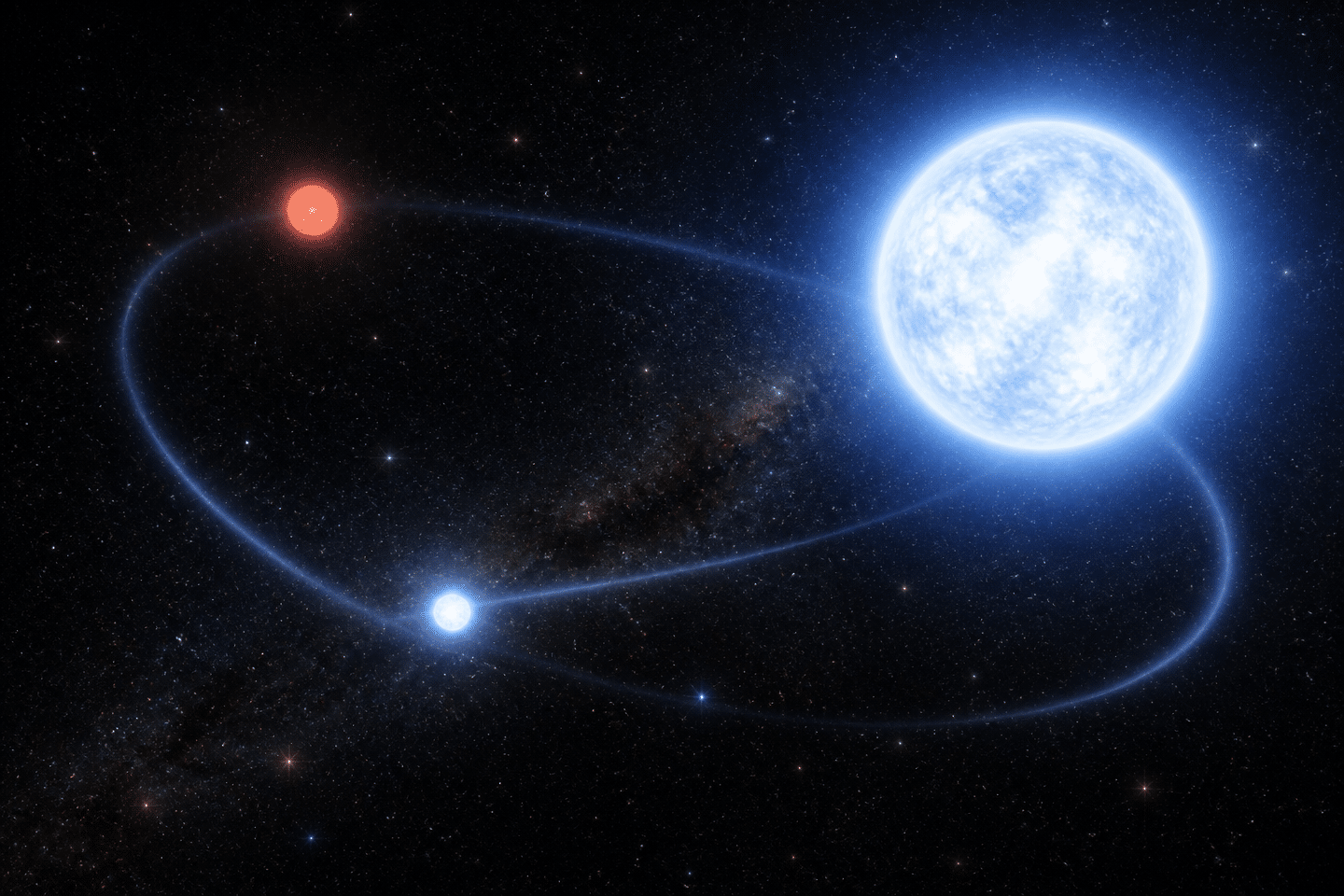
At a distance of 54 light-years from Earth, a subdued stellar system hides an explosive mechanism. Wolf 1130 brings together three gravity-bound stars, including a white dwarf that gradually siphons material from its neighbor. It is approaching a fateful threshold, the one that transforms a dead star into a Type Ia supernova.
- Wolf 1130 is a triple-star system located 54 light-years away, with two central stars orbiting very close to each other.
- A white dwarf from the central pair steadily siphons matter from its companion star by accretion, increasing its mass.
- Approaching the Chandrasekhar limit (1.44 solar masses), this white dwarf is driven toward a Type Ia supernova explosion.
- A barely visible stellar trio hiding a gravitational trap
- The vampire white dwarf nibbling quietly at its neighbor
- The countdown to 1.44 solar masses and the looming explosion
A barely visible stellar trio hiding a gravitational trap
Credit: © unWISE / NASA/JPL-Caltech / D. Lang (Perimeter Institute) via Wikimedia Commons
Wolf 1130 does not catch the eye in the night sky. This system lies 54 light-years from our planet, a distance that renders it invisible to the naked eye. You need a telescope to discern its components, and even then, not just any telescope.
The system brings together three stars bound by gravity for billions of years. Two of them form a very tight pair, orbiting one another at a minuscule distance by astronomical standards. The third, more distant, circles this duo like a distant satellite observing a planet.
Such a multiple-star configuration is more common than we might think in our galaxy. But here, the closeness of the two central stars changes the game. It creates the perfect conditions for a transfer of matter, a phenomenon that will gradually arm a genuine stellar bomb.
Because behind this quiet appearance lies a binary pair undergoing transformation. One of the two stars in the central duo is no longer a normal star. It is a white dwarf, the compact remnant of a star that has already lived its life.
The vampire white dwarf quietly nibbling away at its neighbor
A white dwarf is what remains of a star like the Sun once it has exhausted its nuclear fuel. It has shed its outer layers and retains only an extremely dense core, about the size of Earth yet as heavy as an entire star. Normally, this object would cool quietly for billions of years, without doing anything remarkable.
But in Wolf 1130, this white dwarf is not alone. It orbits close to its companion, a star still active that possesses what the extinguished star no longer has—a plentiful supply of matter. And gravity, unyielding, takes advantage.
Gradually, the white dwarf tears gas from its nearby star. This transfer of matter occurs continuously, like a siphon draining the contents of a reservoir. The companion star loses mass imperceptibly, while the white dwarf grows larger with every passing moment.
This mechanism has a name in the jargon of astrophysicists: accretion. It is not exceptional in itself; many binary systems operate in this way throughout the universe. What makes Wolf 1130 particularly interesting is the trajectory that this accretion is drawing.
The countdown to 1.44 solar masses and the looming explosion
A white dwarf cannot grow indefinitely. There exists a precise physical limit, called the Chandrasekhar limit, fixed at 1.44 solar masses. Beyond this threshold, the pressure from electrons that kept the star stable is no longer enough to contain gravitational collapse.
It is precisely this limit that the Wolf 1130 white dwarf is about to cross. By continually siphoning matter from its companion star, it is approaching this tipping point. Every gram of captured gas pushes it a little closer to the critical threshold.
When the mass nears the Chandrasekhar limit, carbon fusion reactions will ignite and race through the star’s core in a matter of seconds. The result will be a Type Ia supernova, an explosion so powerful that it could, for a time, rival the brilliance of an entire galaxy.
This type of supernova fascinates astronomers because its brightness can be standardized thanks to the shape of its light curve. It thus serves as a reference for measuring distances across the universe, a valuable tool that researchers call a standard candle.
Wolf 1130 embodies, on a modest scale, one of the most spectacular mechanisms in stellar astrophysics. This discreet system, located a mere 54 light-years away, reminds us that a star’s death can take millions of years to prepare before playing out in just a few seconds.
