
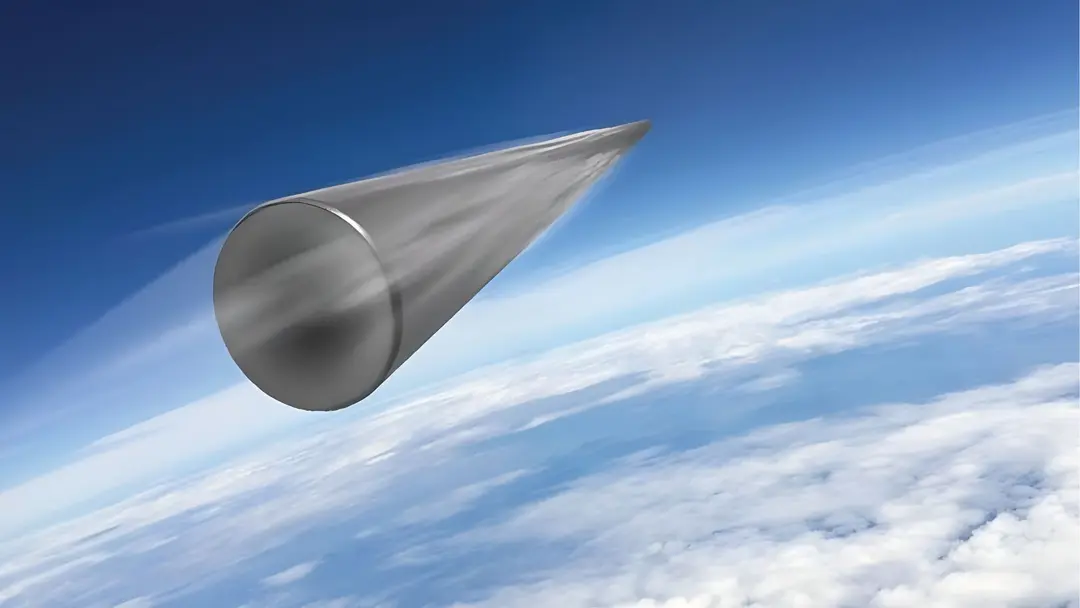
24,000 kilometers per hour. That is the speed the future American nuclear missile Sentinel will reach as its engines shut down. To withstand such a thermal shock, the U.S. military has just tested an unprecedented reentry vehicle, without a warhead, over the Pacific. The aim: to safeguard the most sensitive weapon in the American arsenal.
- Lockheed Martin and the U.S. Air Force conducted a flight test of the Mk21A, a warheadless reentry vehicle, from Vandenberg Space Force Base over the Pacific Ocean.
- This vehicle is designed to protect the future W87-1 warhead during the Sentinel missile’s atmospheric reentry, which will reach about 24,000 km/h.
- The Sentinel, developed under a contract exceeding one billion dollars, is meant to replace the Minuteman III in service since 1970, and the next milestone will be the Critical Design Review.
- A shield designed to survive at 24,000 km/h
- Why the Pentagon is betting more than a billion dollars on a warheadless vehicle
- Sentinel, the successor anticipated for more than fifty years
A shield designed to survive at 24,000 km/h
Lockheed Martin and the U.S. Air Force have just carried out a flight test of a device named Mk21A. The launch took place from Vandenberg Space Force Base in California, and the vehicle crossed the Pacific Ocean without carrying any nuclear warhead.
This Mk21A is not a weapon by itself. It is a protective capsule designed to carry the future W87-1 warhead during atmospheric reentry. Think of a heat shield that must endure extreme thermal and mechanical stresses in a matter of minutes during reentry.
The challenge lies precisely in that dizzying speed. The Sentinel missile, for which this vehicle is intended, is expected to reach roughly 15,000 mph, about 24,000 km/h, as its engines shut down. At that speed, every electronic component must withstand extreme thermal and mechanical stresses.
This test, conducted without a nuclear payload, was specifically aimed at validating the overall architecture of the vehicle and the technologies it comprises. A way to verify that the shield holds up before ever placing the weapon it will someday protect inside it.
Why the Pentagon is betting more than a billion dollars on a warheadless vehicle
The Mk21A is not a wholly new creation. It borrows the design of the Mk21, an older model, but with an updated configuration to accommodate the W87-1 and meet the specific requirements of the Sentinel.
Inside this hull lie specialized electronic systems, tasked with both delivering the payload and ensuring the weapon’s safety. They are not merely inert heat shields but integrated electronic systems.
The division of labor is clear. Northrop Grumman leads the development of the missile itself, a three-stage device powered by solid propellant. Lockheed Martin, for its part, exclusively handles the next‑generation reentry vehicle.
To speed things up, Lockheed Martin relies on high‑fidelity simulations and digital engineering, combined with data from previous tests. The program sits under a military contract exceeding one billion dollars.
Sentinel, the successor anticipated for more than fifty years
To understand the stakes, one must look at what the Sentinel is meant to replace. The intercontinental ballistic missile LGM-35A Sentinel is to succeed the Minuteman III, in service since 1970 as a cornerstone of the United States’ land-based nuclear deterrent.
More than fifty years of service is a long time for a military technology. Replacing this land-based component of nuclear deterrence therefore represents a major strategic project for the United States, far beyond the reentry vehicle itself.
The next key milestone for this program is the system-level Critical Design Review. The data gathered during this test will be used to determine whether the vehicle meets the required performance specifications.
In plain terms, this flight test is only one step among many, but a decisive one. It conditions the schedule moving forward for when the Sentinel might someday officially take over from the venerable Minuteman III.
Behind this technical test over the Pacific lies much more than a mere demonstration of thermal resilience. It is the entire architecture of the United States’ land-based nuclear deterrent being prepared, piece by piece, for the decades to come.
👉 A small gesture for Space Group? Follow us on Google, bookmark us, and find us on Google News so you don’t miss any discoveries.
