
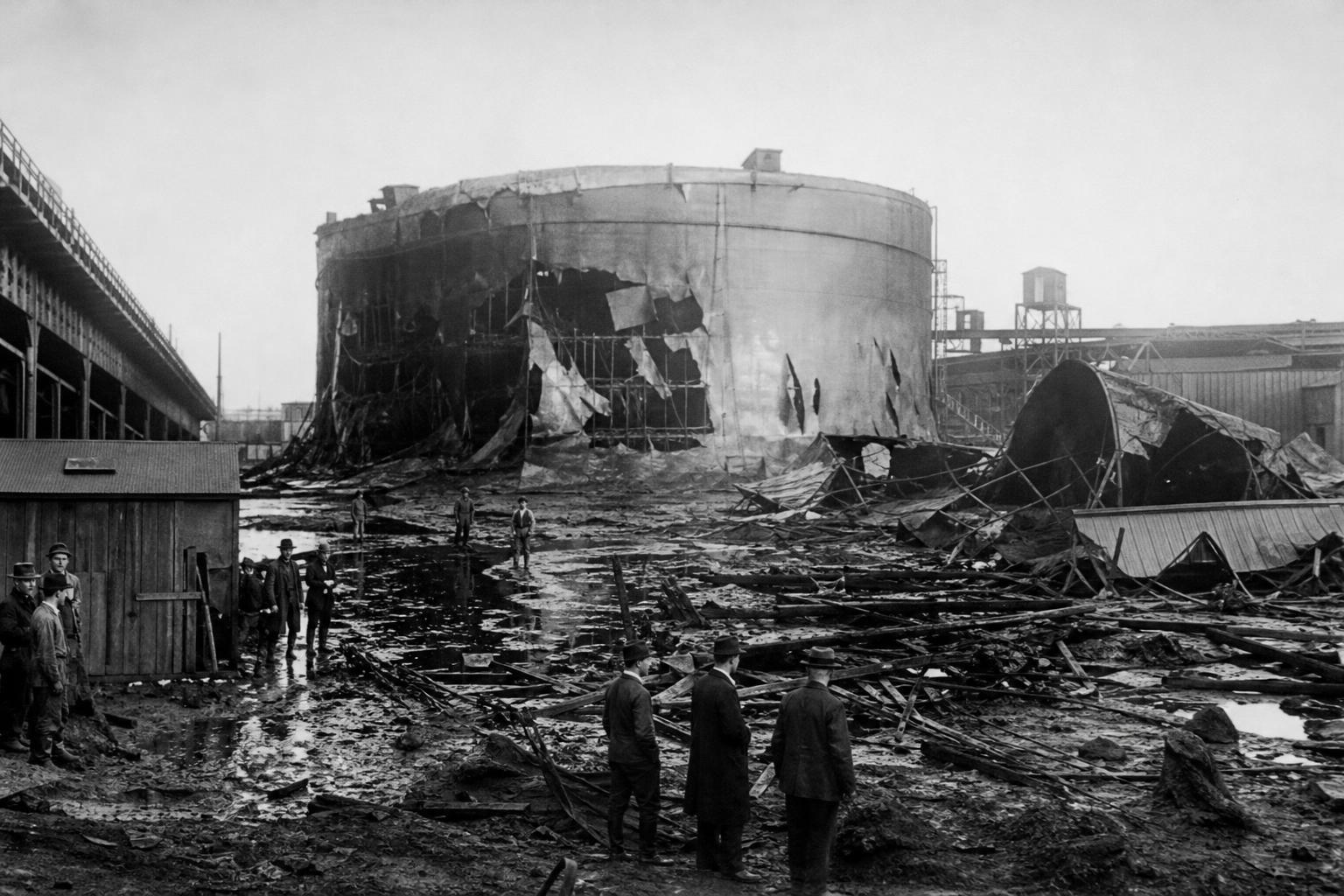
Boston’s North End once learned, in the most visceral way, how a sweet commodity can turn lethal. On a winter afternoon in 1919, steel surrendered, syrup surged, and a neighborhood was remade in seconds. Residents spoke of a sudden roar, a crack, then a dark, fast-moving mass that smelled like candy and carried the weight of a freight train.
The Day the Syrup Turned Deadly
A towering steel reservoir, roughly fifty feet high, ruptured without mercy. In a blink, a wave taller than a two-story house rolled across Commercial Street like a glossy, brown avalanche. Witnesses later said it moved “like water,” but thicker, faster, and far less forgiving.
“Molasses, waist deep, covered the street and swirled and bubbled about the wreckage,” a contemporary account described. People were knocked off their feet, horses trapped and suffocated, and structures ripped from their foundations. In that compressed moment, the ordinary rhythms of a waterfront neighborhood were swallowed by a sticky tide.
Why the Tank Failed
The company that owned the container had reason to rush; wartime demand had made industrial alcohol a lucrative trade. But haste and hubris proved a toxic pairing. The steel was too thin, the rivets too brittle, and the tank reportedly leaked for months—so much that workers painted it brown to hide the seepage.
Investigators, engineers, and courts later pieced together a chain of causes:
- Poor construction and weak rivets, aggravated by temperature swings and fermenting molasses that built up internal pressure.
People had complained of ominous groans, metallic creaks, and the sour smell of fermentation. “It shook like a drum,” one resident remembered, hinting at a structure more sound in theory than in practice.
Human Cost and Heroism
The flood left families shattered: twenty-one dead, scores more injured, and a community coated in a substance that turned rescue into a nightmare. Responders fought not just a disaster, but a medium that resisted every motion. To wade was to sink; to push forward was to tire. Boots stuck, gloved hands slipped, and every second mattered in the cold January air.
Despite it all, neighbors rescued neighbors. Police, Red Cross teams, sailors, and firefighters formed lines, cut through debris, and searched by voice when sight failed. “We could hear them, but couldn’t reach them fast,” one rescuer later said. The sound of calling across a sweet, suffocating slick remains one of the disaster’s most haunting echoes.
The Mess That Wouldn’t Leave
Cleanup was its own slow siege. Crews used seawater, sand, and shovels, turning streets into streams that carried syrup into the harbor. The water ran brown for days, and the scent lingered in doorways, on docks, and in woolen coats. Streetcars were gummed, gears jammed, and storefronts lacquered in a caramel sheen that resisted ordinary effort.
Foot traffic tracked the residue through the city, spreading tacky footprints into distant neighborhoods. In the papers, Boston became a cautionary parable of modern industry—how a single failed container could aerosolize risk across jobs, streets, and families.
Courts, Codes, and Accountability
Lawsuits churned as relentlessly as the cleanup. Families and businesses sought damages, arguing not act of God, but act of negligence. After lengthy legal wrangling, the company was found liable, and settlements were paid—money that could mend some losses, but not restore what the wave had taken.
The legacy rippled far beyond the docklands. Building codes grew teeth. Municipal authorities demanded engineering oversight, stress testing, and documented inspections. The event became a case study in risk, cited in lecture halls and boardrooms as a reminder that prevention is cheaper than aftermath.
What the Syrup Revealed
Strip away the spectacle, and the story is about systems: incentives that reward speed over safety, organizations that treat warnings as nuisances, and communities that pay when the invisible math of risk goes wrong. The tank didn’t just burst; so did the myth that industrial progress is frictionless and inevitable.
“Listen to your leaks,” the disaster seems to say. A rivet’s ping can be a message, a stain a quiet red flag. Every overlooked creak is a small vote for catastrophe, cast in the language of metal and pressure.
Memory, Sticky and Sharp
Walk the North End today and you’ll find little syrup, but plenty of story. Locals pass down fragments: the roar, the smell, the way the street looked when the light hit the brown tide just so. History is adhesive; it clings to brick, to policy, to the civic nerve that insists on asking “Could this happen again?”
We often measure disasters by their size, but this one endures because of its texture—thick, sweet, irresistible until it wasn’t. In a city built on tides, it was not seawater that taught the hardest lesson, but sugar turned against the people it was meant to serve.
