
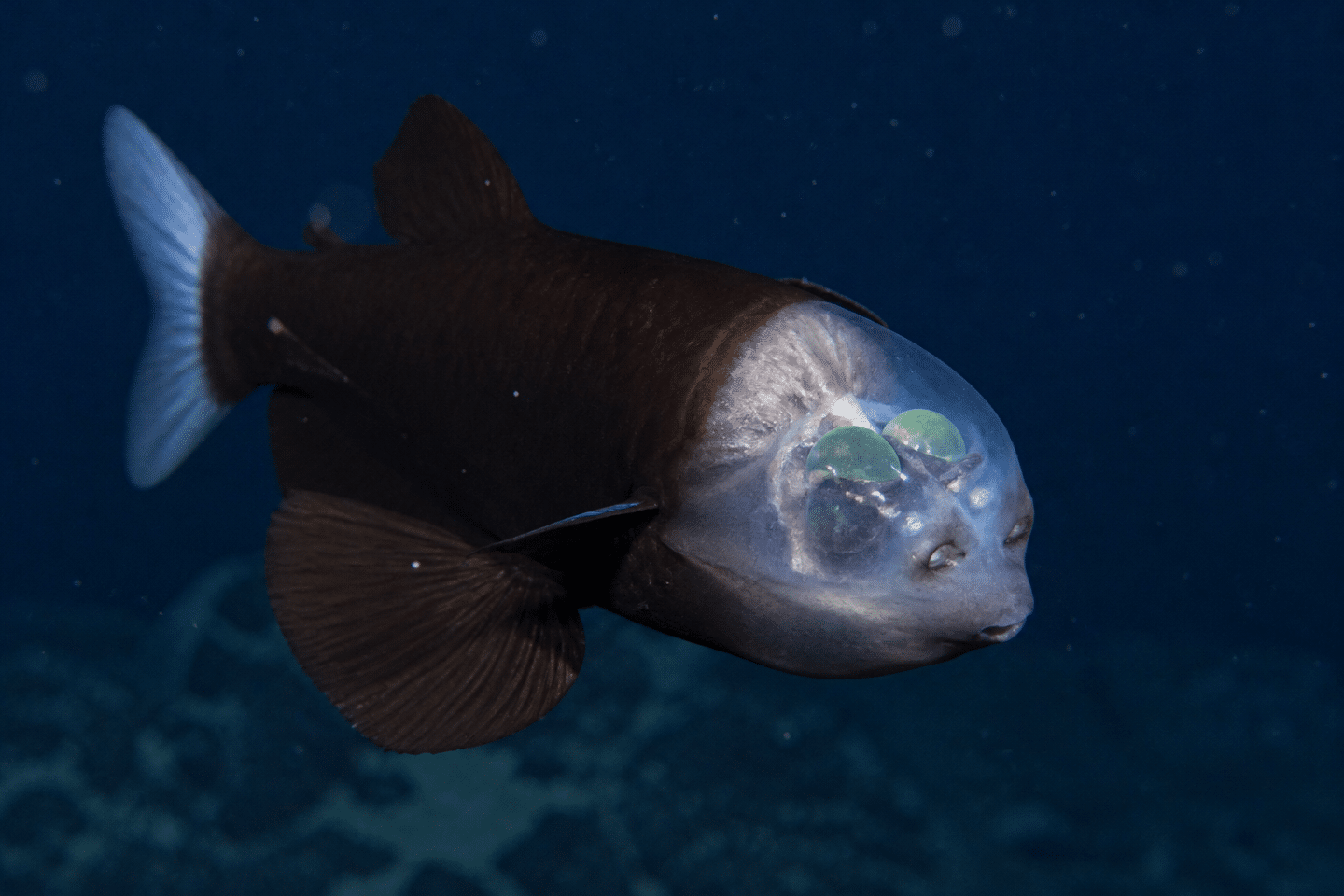
How can a fish look through its own skull? Off the coast of Monterey Bay, a team of researchers were surprised to cross paths with the barreleye, that deep-sea creature with a transparent head. The scientists were “fascinated” by observing Macropinna microstoma at a depth of 600 meters.
- MBARI researchers observed a barreleye (Macropinna microstoma) at 600 meters depth in Monterey Bay during a mission initially focused on gelatinous animals.
- This fish has a dome-shaped transparent head housing two green, rotating eyes, allowing it to orient its gaze to spot prey in the dim depths.
- The animal remained motionless in front of the camera for about 20 minutes, an exceptional duration that allowed scientists to photograph it from every angle, while the mystery of the exact function of its eyes remains unresolved.
- A Glass Head and Pivoting Eyes: The Barreleye’s Unusual Anatomy
- Twenty Minutes in Front of the Camera: The Encounter That Surprised Seasoned Researchers
- Seeing Without Being Seen: The Still Unresolved Mystery of Its Fluorescent Green Eyes
A Glass Head and Pivoting Eyes: The Barreleye’s Unusual Anatomy
The barreleye, scientifically known as Macropinna microstoma, is one of those creatures you never forget once you have seen them. Its head is covered by a transparent dome, like a glass bubble resting on its skull. Inside this capsule, two large green, globular eyes can rotate freely.
This particular anatomical feature would allow it to aim its gaze as needed, a trait that contributes to its singular appearance among deep-sea creatures.
The species lives in the twilight zone, a band of water spanning roughly 200 to 1,000 meters in depth. There, sunlight fades quickly, giving way to a cold, dark realm where every adaptation matters for survival.
In response to these extreme conditions, Macropinna microstoma has developed flat fins that help it stay motionless for long periods, waiting for prey to come within reach of its rotating eyes.
Twenty Minutes in Front of the Camera: The Encounter That Surprised Seasoned Researchers
It all began during a mission dedicated to an entirely different topic. Scientists from the Monterey Bay Aquarium Research Institute (MBARI) were exploring offshore waters aboard the research vessel David Packard to study gelatinous animals such as jellyfish, siphonophores, and ctenophores.
This eight-day expedition, dubbed “Deep Dive for Fragile Derivants,” took them about 90 kilometers offshore, with the remote-operated vehicle Doc Ricketts at their disposal. The objective was to understand how gelatinous creatures adapt to life in the deep.
But as the team prepared to surface, at around 600 meters depth, a very different face appeared on the ROV’s cameras. The news took everyone by surprise, to the point that several team members were already back in the laboratory cataloging their samples.
“It’s always a pleasure to stumble upon a fish as rare and unique as this one,” said Kyra Schlining, a research scientist at MBARI, to IFLScience. She notes that the last observation of the genus dated back to 2021, before ROVs were equipped with 4K cameras.
Usually, these fishes let themselves be observed for only a few minutes before disappearing into the darkness. This one lingered about 20 minutes in front of the lens, giving researchers the opportunity to photograph it from every angle.
Seeing Without Being Seen: The Still Unresolved Mystery of Its Fluorescent Green Eyes
The distinctive green hue of the barreleye’s eyes has intrigued scientists for a long time. The prevailing hypothesis is that it helps distinguish natural light from bioluminescent light, enabling it to better spot prey against the backlight.
But for Steven Haddock, senior scientist at MBARI, this explanation does not account for everything. “There are hypotheses about the function of the transparent dome and its rotating tubular eyes, but I think we still do not know exactly what it looks for to detect its prey,” he told IFLScience.
He also questions the precise role of the green pigmentation of the lenses, and poses a question that sums up the mystery surrounding this creature: “What does the world look like from its eyes?”
What particularly struck Haddock during this encounter was the fish’s calmness. “I love the calm of the fish, almost as if it were filmed in slow motion,” he explained. He contrasts this behavior with that of other deep-sea predators, such as dragonfishes, which pause for a few seconds before darting away.
This time, the 20 minutes of presence allowed the team to test different lighting angles, and even position the animal in front of a virtual reality camera, a luxury rarely granted by this ghostly face of the deep.
👉 A small gesture for Space Group? Follow us on Google, add us to your favorites and find us on Google News so you don’t miss any discoveries.
Source: MBARI
