
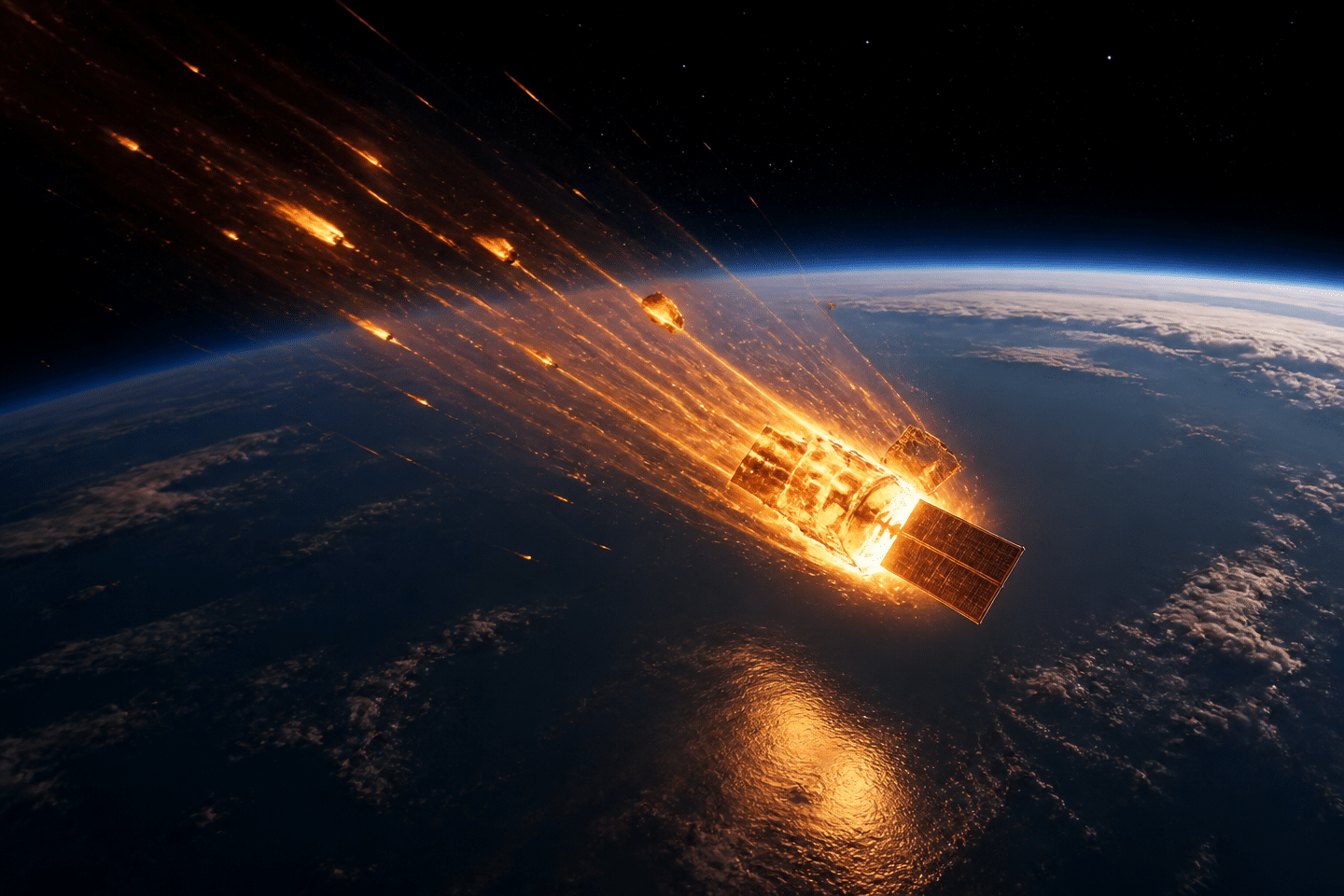
What if a satellite the size of a minibus crashed into you? It’s the unlikely yet real scenario NASA faced with the Swift telescope. After twenty-two years of faithful service, the observatory disintegrated in the atmosphere, and no rescue could reach in time.
- The Swift telescope, launched in 2004, disintegrated in the atmosphere on November 4 above northern Sumatra after 22 years of service.
- Devoid of onboard propulsion, Swift could not be saved despite a $30 million contract signed with Katalyst Space to attempt to raise its orbit.
- The observatory recorded more than 2,000 gamma-ray bursts and 1,400 supernovas during its mission.
- A 1,450 kg minibus disintegrated over Sumatra
- 22 years of tracking the universe’s most violent gamma-ray bursts
- $30 million spent on a rescue mission that never lifted off
A 1,450 kg minibus disintegrated over Sumatra
On November 4, the Neil Gehrels Swift Observatory plummeted into Earth’s atmosphere at 7:39 a.m. Eastern Time. According to Jonathan McDowell, an astronomer who relies on data from the US Space Force, re-entry occurred over northern Sumatra, Indonesia.
The device weighed roughly 1,450 kg, about the mass of a small bus. A sizeable profile that led NASA to anticipate the event, while estimating that the vast majority of the structure would burn up upon contact with the upper layers of the atmosphere.
The risk of a fragment injuring someone on the ground had been estimated at 1 in 2,100. A figure that may seem small, yet it underscores the uncertainty surrounding such an uncontrolled re-entry. Videos circulating on social networks reportedly show the telescope’s fiery plume, though their authenticity could not be independently verified.
22 years of tracking the universe’s most violent gamma-ray bursts
Swift, fully named Swift Gamma-Ray Burst Explorer, took off in November 2004. Its initial mission was meant to last only two years: to hunt gamma-ray bursts, these energy flashes among the most powerful observed in the universe, often tied to the collapse of massive stars or the merger of compact objects.
Its strength lay in its rapid responsiveness. The telescope could detect a gamma-ray burst, determine its position, relay it to other observatories, and reorient its instruments in under a minute. This agility allowed it to become a reference point for studying these fleeting phenomena.
Beyond gamma-ray bursts, Swift also observed supernovas, actively feeding black holes, as well as asteroids and comets. In 2018, it was renamed in honor of Neil Gehrels, its first principal investigator, who had died the previous year. Its most recent scientific observation dates to October 20, 2026, twenty years after the nominal end of its mission. In total, the observatory contributed to cataloging more than 2,000 gamma-ray bursts and 1,400 supernovas.
$30 million spent on a rescue mission that never lifted off
Aware of the scientific value of Swift, NASA attempted to anticipate its descent. In September 2025, the agency signed a $30 million contract with Katalyst Space, based in Arizona, to design and launch a robotic vessel capable of raising the telescope’s orbit.
The objective was straightforward on paper: delay the deadline by restoring some altitude to Swift, akin to re-inflating a slowly deflating balloon. Yet this rescue mission never materialized before the telescope’s re-entry.
The reason lies in Swift’s very design: launched in 2004 to chase gamma-ray bursts, the observatory did not carry any onboard propulsion to counter the atmospheric drag that gradually slowed it down. Without fuel or a propulsion system, no orbital-raising maneuver could be performed, and its fall, dictated by celestial mechanics alone, became inevitable.
Swift leaves behind a solid scientific record, with more than 2,000 gamma-ray bursts and 1,400 supernovas observed during its mission.
👉 A small gesture for Space Group? Follow us on Google, add us to your favorites, and find us on Google News so you don’t miss any discoveries.
Source: Space.com
