
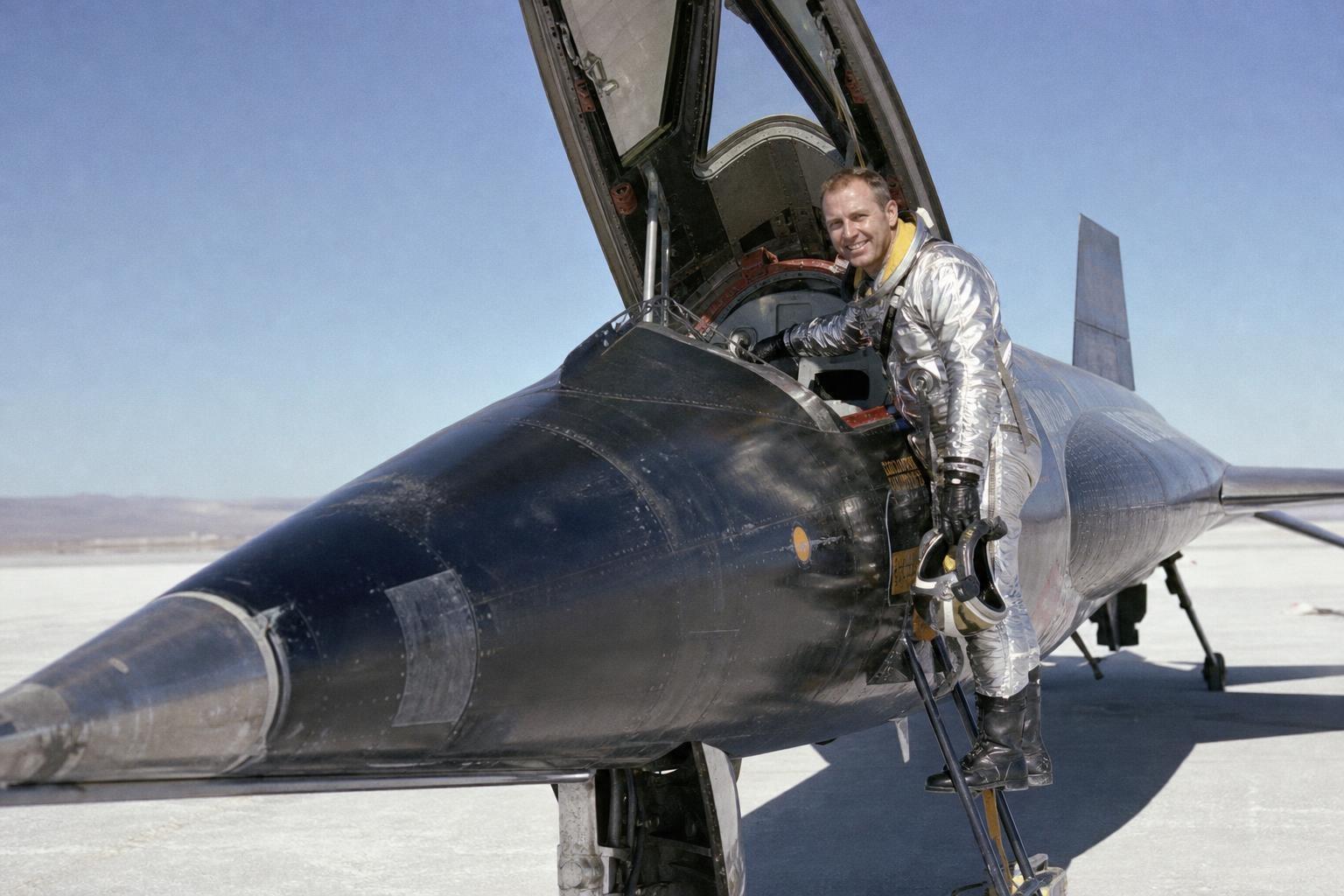
A summer day in 1963 bent the limits of what wings could do. A sleek black rocketplane clawed skyward, soared past the blue, and coasted into a realm where airplanes traditionally cannot go. For a few electric minutes, a test pilot became a spacefarer, riding a ballistic arc above a curving, radiant Earth.
A rocket plane that kept its promise
The North American X-15 was a machine built for extremes: stainless steel and Inconel-X, a single roaring engine, and bold pilots trained to parse chaos at hypersonic speed. It launched from under a B-52, lit its XLR99, and sprinted into the thin dark with furious, controlled intent. In that era of slide rules and courage, the X-15 was a bridge between aircraft and spacecraft, with just enough of both to be dangerous.
The climb that turned into a coast
Dropped high over the desert, the vehicle knifed upward on fire, then pitched for a zoom climb that traded speed for altitude. When the engine quit, the silence was immense, and inertia did the rest across a clean, parabolic arc. “At the top, the world seems wide, and time feels very thin,” a line that captures the strangeness many pilots later described.
Where does space begin?
Ask ten experts, get twelve answers: the Kármán line often sits at 100 kilometers, while U.S. agencies mark space at 50 miles. That 1963 ascent cleared the higher threshold, an achievement that satisfies both history’s lawyers and its poets. “Boundaries in the sky are ideas, not fences,” as one engineer liked to say.
Flying on thrusters, not air
Up near apogee, air is too thin for normal control; tiny nitrogen thrusters nudge pitch, roll, and yaw. The cockpit becomes a capsule, and the horizon a curved, luminous line draped against black. In that hush, the planet is blue, the Sun is harsh, and your speed is a secret only the instruments truly know.
Heat, load, and the long fall home
Coming back is where the work really begins: a steep, high-angle dive builds brutal heating and loads that press cockpit and pilot into tight margins. You “fly the numbers,” hitting energy gates to arrive over the lakebed with just enough lift left. No engine, no second chance—only glide, grit, and a long white runway of dust.
Numbers that still feel impossible
- About 108 kilometers above sea level—beyond the widely cited boundary
- More than Mach 5 during climb, with temperatures that could glow
- A rocket burn of roughly minutes, followed by a silent coast
- Touchdown on Rogers Dry Lake, unpowered and precisely planned
Why this mattered then—and now
That flight proved a concept: that a winged, reusable craft could sample the edge of space and come back to tell the tale. It fed data into aerodynamics, materials, guidance, and life-support systems that would later shape shuttles and lifting bodies. When commercial suborbital rides became real, they were following maps the X-15 had already drawn.
The human factor behind the myth
Behind the canopy sat a pilot managing seconds that arrived like fast-moving weather. Checklists were crisp, but judgment was art, and tiny hands-on corrections were the difference between a clean profile and a story nobody wanted to tell. “You don’t fly the X-15,” veterans liked to say, “you manage events and try to stay ahead.”
Rewriting the shape of the possible
Milestones live on because they change language: altitude becomes apogee, airplane becomes spaceplane, pilot becomes astronaut. The program’s careful risk bought knowledge that spreadsheets still spend today. Every modern boundary push—reentry tiles, reaction controls, energy management—whispers with echoes of that black, brilliant climb.
A silhouette we still recognize
Look at any vehicle meant to dip a toe into space and you’ll see inheritance—in materials, control strategies, and the quiet assumption that wings can go higher than we once dared. The X-15 wrote that assumption in contrails and plasma, line by demanding line. In the ledger of audacity, 1963 remains a boldface entry—lean, precise, and astonishingly high.
