
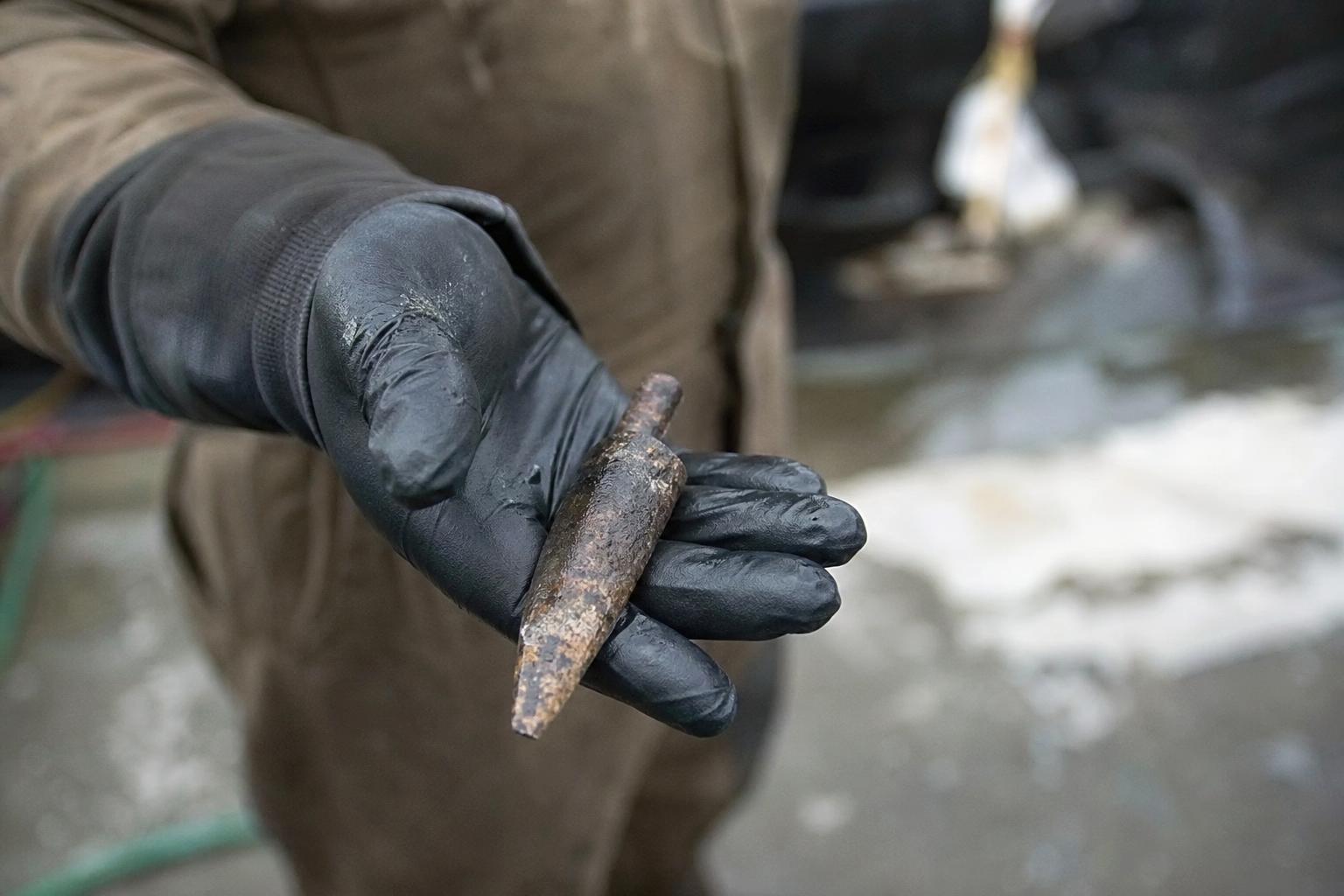
The discovery felt like a door opening between centuries and currents. In the cold waters off northern Alaska, a living giant carried a hidden artifact and an ache. When people finally saw what was buried deep within, they realized the animal had survived not just the Arctic, but also a weapon from another age. “It was like a time capsule with a heartbeat.”
An Unexpected Artifact in Living Flesh
While processing a legally harvested bowhead, whalers noticed a small, weathered shard of metal lodged in thick tissue near the shoulder. Experts later identified the piece as part of a 19th‑century bomb‑lance, a type of harpoon projectile once used by commercial fleets. The metal’s style matched equipment mass‑produced in the 1880s by New England manufacturers.
The whale had apparently been struck a lifetime earlier, healed around the fragment, and kept on migrating. “The ocean keeps its receipts,” one observer remarked, stunned by the persistence of flesh and story.
A Whale Older Than Memory
Bowhead whales are legends of longevity, with some estimated to live well over 150 years. Their lives unfold at an icebound pace—slow growth, late maturity, and vast reserves of blubber that buffer extreme seasons. Researchers have proposed adaptations in DNA‑repair and cell‑cycle pathways that may support unusually durable tissues and low cancer rates.
Such lifespans turn individuals into archives, carrying scars from storms, predators, and people. A single animal may remember routes that ancestors traced when wooden ships still chased oil and baleen.
Traditional Knowledge Meets Science
Modern Iñupiat whaling is bounded by quota, ceremony, and care, guided by elders who know sea ice like kin. Community crews treat each whale as a gift, honoring it with shared labor and shared meals. Their observations—winds, currents, ice edges, and animal behavior—complement satellite tags and lab work.
In this case, practical skill revealed a story that instruments might have missed. “Time doesn’t pass in a straight line out on the ice,” a hunter once said, capturing the spiral of seasons and memory.
Echoes of a Vanished Whaling Era
In the late 1800s, Yankee whaling ships pushed into the Arctic, firing explosive projectiles at surfacing bowheads. Some shots killed; others maimed, leaving fragments behind that whales literally outgrew with scar tissue. The industry collapsed as petroleum rose and profits fell, but pieces of its violence drifted on in living bodies.
Those fragments are more than metal; they are residues of global markets that once ran on animal oil. The find ties a breathing mammal to the clatter of distant factories.
What the Harpoon Tip Reveals
A single shard can teach many lessons about time, biology, and responsibility:
- Animals endure injury and still thrive, rewriting pain into living scar.
- Wildlife carries our history in literal flesh, not just in books.
- Survival depends on healing, patience, and the slow alchemy of time.
- Science and tradition see more together than they do alone.
- Stewardship means facing legacy harms while protecting futures.
The Ethics of Reading a Scar
It is easy to marvel at the drama and forget the duty. A fragment from the 1880s is not a trophy, but a testimony—proof that what we do persists far beyond our lifetimes. Today, bowheads navigate new hazards: warming seas, shifting ice, ship traffic, noise pollution, and entanglement in floating gear.
If the past left metal in muscle, the present leaves heat in water and carbon in the air. “We inherit the aftermath, and we shape the afterward,” a line worth repeating when policies meet the ocean.
How Do Bowheads Live So Long?
Part of the answer seems physiological: a slow metabolism, cold environments, and low, steady heart rates that reduce cumulative wear. Part appears ecological: few natural predators in adulthood and long grazing seasons on rich Arctic zooplankton. Part may be genetic, with tweaks that favor robust repair and tempered cellular division.
Their skin renews under ice, their bones thicken against pressure, and their blubber stores energy like a living bank. These features together sketch a blueprint for resilience, though many details remain under study.
A Story That Keeps Swimming
The 2007 discovery stitched a bright thread through Arctic time, binding a whaling pier in the 19th century to a modern shoreline. What lasted was not a machine or a ledger, but a will to move forward with a shard in the shoulder. “Some stories hide beneath the skin,” the moment seemed to say, “until the right hands set them free.”
We are left with a living lesson: history is not behind us, it swims beside us. To honor that truth, we owe the future clean seas, quieter routes, and decisions that place long lives above short‑term gain. The whale found a way to heal; our work is to make that healing easier.
