
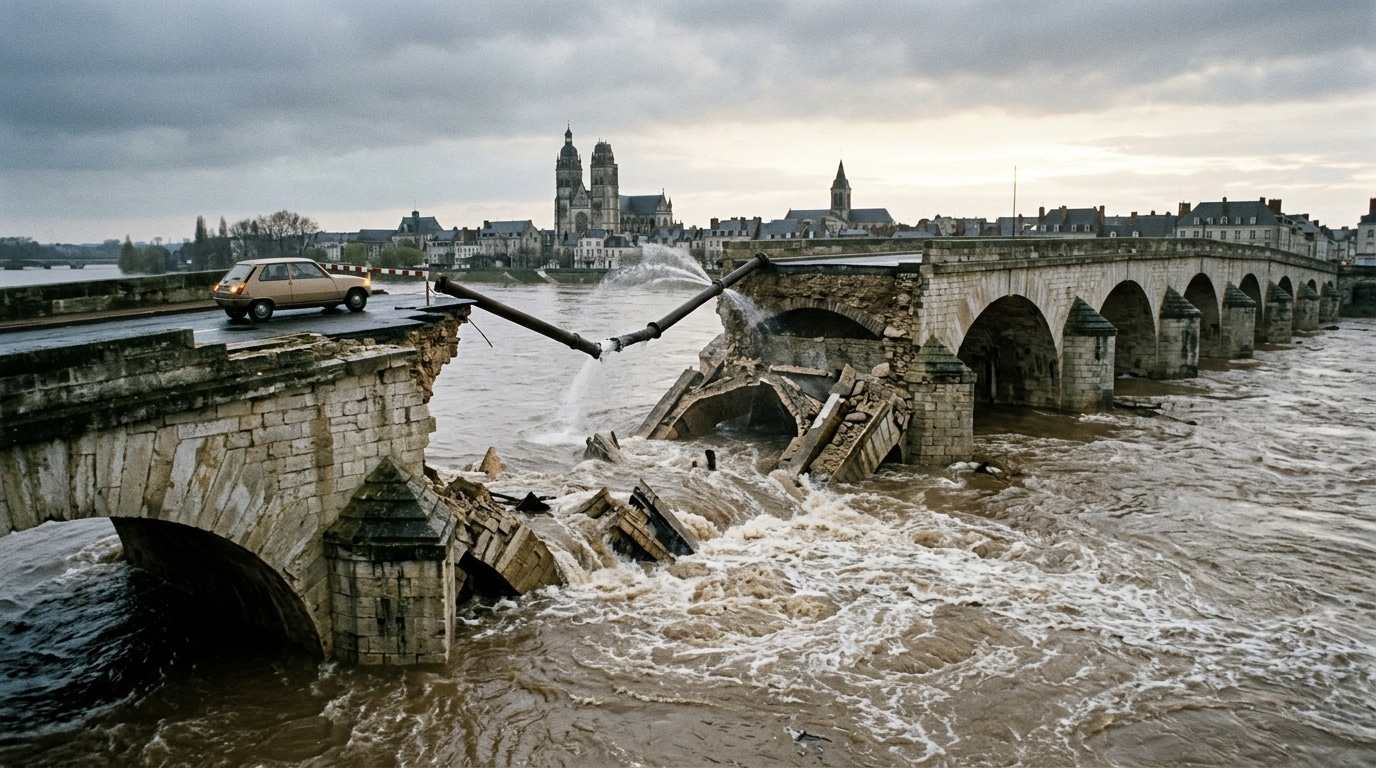
Two centuries. That is the span the Wilson Bridge held out before giving way in a matter of hours, on a spring morning in April 1978. No exceptional flood, no earthquake, nothing to justify such a collapse. The real cause lay beneath the water, invisible, patient: decades of sand extraction had simply hollowed the Loire of its foundations.
- On April 9, 1978, four arches of the Wilson Bridge collapsed abruptly, depriving water supply to around 110,000 residents of Tours.
- The massive sand extraction in the Loire (about 70 million cubic meters since 1900) lowered the riverbed and undermined the bridge’s piers.
- The prohibition of extractions in the lower riverbed did not arrive until 1994, sixteen years after the collapse.
- Two hundred years of endurance before the collapse
- The sand extracted for decades, a river emptied of its foundations
- 1994, the prohibition that came sixteen years too late
Two hundred years of endurance before the collapse
Built at the end of the 18th century, the Wilson Bridge had been part of the Tours landscape since 1778. It had withstood changing regimes, wars, and floods. A sturdy, familiar structure that nobody imagined would vanish overnight.
Yet, on April 9 and 10, 1978, four arches on the southern side collapsed dramatically into the river. A few weeks later, on May 3, the southern abutment failed as well. In total, five piers and six arches disappeared before the astonished people of Tours.
The collapse was not merely symbolic tragedy. A pipeline housed in the bridge deck ruptured during the fall, cutting off the drinking water supply for about 110,000 inhabitants of Tours. The city found itself confronted with the very real consequences of an accident once deemed unlikely on a monument as old as this one.
Facing the scale of the damage, the question of rebuilding quickly arose. The mayor at the time, Jean Royer, chose an unusual approach for the era: he consulted the public directly. A referendum was held from December 4 to 23, 1978, allowing the people of Tours to vote on the future of their bridge.
The sand mined for decades, a river emptied of its foundations
To understand why a two-hundred-year-old bridge suddenly collapsed, you have to look beneath the water’s surface, where trouble was not expected. For decades, the Loire served as an open quarry.
In the estuarine part of the river, aggregate extraction stretched from 1960 to 1994, with a peak in the 1970s. In total, around 70 million cubic meters of sand and gravel were taken since 1900. A volume hard to grasp, but equivalent to millions of trucks loaded directly from the riverbed.
This massive withdrawal had an inevitable mechanical consequence: the Loire’s bed sank. Since the early 20th century, the low-water line has lowered by about two meters in Tours, three meters in Ancenis, and as much as four meters in Bellevue, upstream of Nantes. A river that carves itself like this eventually destabilizes everything resting on its banks and bed.
That is precisely the phenomenon that struck the Wilson Bridge. By deepening the bed, the extractions eventually undermined the bridge’s piers, eroding the soil that kept them firmly in place. Imagine a table whose legs gradually lose their footing as the sand disappears from beneath them: at some point, equilibrium becomes impossible to maintain.
1994, the prohibition that arrived sixteen years too late
The authorities did not discover the problem overnight. A report, known as the Foucaud Report, warned about the consequences of excessive extractions in the lower beds of the Loire and Allier. As early as 1980, the Minister of the Environment began a first reduction of these extractions.
In December 1984, a clear objective was set: to achieve a complete stop to extractions by the end of 1992. But on-the-ground reality told a different story. Between 1981 and 1991, extractions from the middle Loire’s main bed rose from 857,000 tonnes to over 3 million tonnes per year. Pressure on the river did not ease; it intensified.
It would take until the ministerial decree of September 22, 1994, for extractions of materials to be finally banned in the lower bed of watercourses and in bodies of water crossed by a river. Sixteen years after the Wilson Bridge collapsed, sixteen years after the scour around its piers, caused by the sinking bed linked to sand extraction, produced such spectacular and visible consequences.
The damage had been done well before the regulation. And the effects of these decades of extraction are still felt today: the Loire bed rebalancing program, run by Voies navigables de France between Les Ponts-de-Cé and Nantes, only concluded at the end of 2025, after five years of work and a budget of 60 million euros, partly funded by the Loire-Brittany Water Agency.
This Tours story is not unique. According to the United Nations Environment Programme, around 50 billion tonnes of sand and gravel are extracted every year worldwide, a volume that could double by 2060. Sand has become the second-most-consumed natural resource on Earth after water, and every river, every coastline pays a silent toll to this exploitation. The Wilson Bridge remains the concrete reminder of what can be lost when we mine a riverbed for too long without measuring what it truly holds in reserve.
👉 A small gesture for Space Group? Follow us on Google, add us to your bookmarks, and find us on Google News so you don’t miss any discoveries.
