
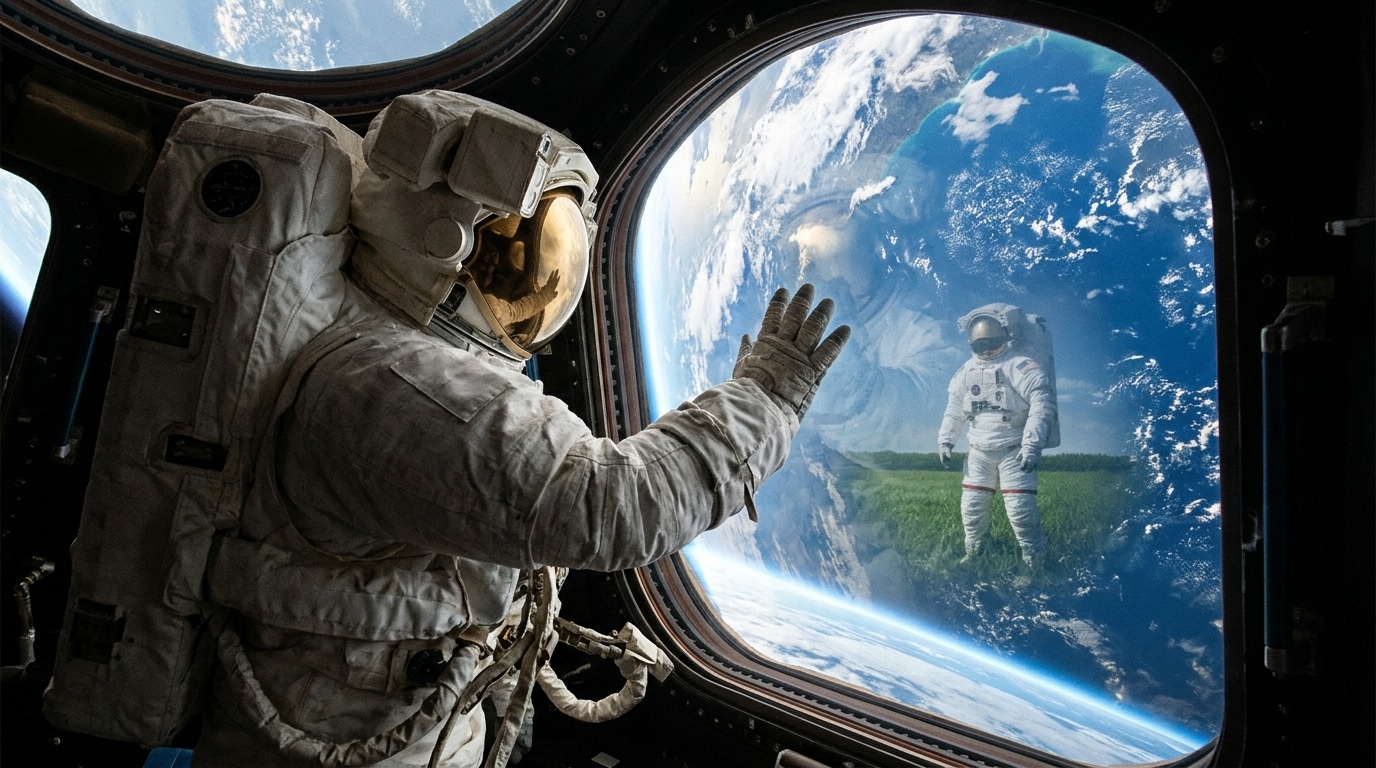
Two twin brothers, two biological destinies. One remains on Earth while the other circles the planet at 28,800 kilometers per hour for 340 days. The result on return: a real age gap between them, measured in milliseconds, thanks to the most precise instruments ever sent into space.
- Scott Kelly spent 340 days aboard the ISS while his twin brother Mark remained on Earth, as part of the NASA Twins Study published in Science in 2019.
- Upon his return, Mark Kelly was older by 6 minutes and 5 milliseconds than Scott, with a few milliseconds attributed to relativistic time dilation tied to the orbital speed of 28,800 km/h.
- The ACES mission, launched in April 2025, aims to measure these time offsets with tenfold greater precision thanks to the PHARAO cesium clock and SHM hydrogen maser installed on the ISS.
- Two brothers, two biological clocks: NASA’s extraordinary experiment
- 28,800 km/h: the speed that truly slows time
- 5 milliseconds of difference: what Scott Kelly’s body reveals upon returning to Earth
Two brothers, two biological clocks: NASA’s extraordinary experiment
Scott and Mark Kelly are not twins like any other. Both astronauts, they offered NASA a unique chance to test how spaceflight affects the human body. Between March 2015 and March 2016, Scott spent 340 days aboard the ISS, while Mark remained on Earth, serving as the reference baseline.
The idea behind this experiment, dubbed the NASA Twins Study, was almost a scientific gift. With two genetically identical brothers, researchers had a rare textbook case: comparing an organism exposed to space with its twin left on the ground, without worrying about the usual genetic variations.
The results were published in the journal Science in April 2019, the fruit of the work of more than 80 researchers. More than 300 biological samples were collected over 27 months, covering gene expression as well as the immune system and telomere length. But beyond biology, another phenomenon—purely physical—entered the equation: time itself did not pass in exactly the same way for the two brothers.
28,800 km/h: the speed that truly slows time
This temporal difference is not a science-fiction anecdote. It stems directly from Einstein’s theory of relativity, which predicts that time does not flow identically depending on how fast you move and the strength of the gravity you experience. The faster you go, the more time slows relative to a stationary observer. This is what is known as relativistic time dilation.
On the ISS, astronauts travel at about 28,800 kilometers per hour to complete an orbit around the Earth roughly every 90 minutes. This dizzying speed is enough to introduce a measurable offset, albeit tiny, but real. Add to that a second effect, inverse in nature: at an altitude of about 400 kilometers, Earth’s gravity is weaker than at the surface, which tends to speed up time slightly for the astronaut. The CNES summarizes this gravitational effect as roughly one second of difference every 300 years between an astronaut in orbit and his twin on Earth.
In Scott Kelly’s case, the velocity effect outweighed the gravitational one. To refine such measurements with unprecedented precision, the European Space Agency launched the ACES mission in April 2025. Installed on the exterior platform of the Columbus module, it combines the cesium PHARAO atomic clock, designed by CNES, with the hydrogen maser SHM, provided by the Swiss company Safran Timing Technologies. The stated objective is clear: measure the gravitational time offset with about ten times greater precision than before, thanks to a clock signal with a relative stability of 1 × 10⁻¹⁶, a drift of barely one second every 300 million years. A network of ground clocks, spread across France, Germany, the United Kingdom, the United States, and Japan, enables near real-time comparisons of these signals, with the satellite antenna installed by NIST on its Boulder campus serving as a prime example.
5 milliseconds of difference: what Scott Kelly’s body reveals upon returning to Earth
So, concretely, what was the actual gap between the two Kelly brothers? During a round table held in July 2016 at the ISS Research and Development conference in San Diego, Mark Kelly provided the exact figure: he was now 6 minutes and 5 milliseconds older than his brother Scott. An announcement that is surprising, given that it challenges the common intuition that twins age at the same rate.
In truth, most of this gap can be explained by a straightforward earthly phenomenon: normal biological aging accumulated while Scott was in zero gravity, during which his metabolism and body functioned differently. But a tiny portion of this offset, on the order of a few milliseconds, originates directly from relativistic time dilation due to orbital speed. Scott Kelly literally aged a little less quickly than his brother remained on Earth, for a physical rather than a biological reason.
This result beautifully illustrates the difference between a substantial biological effect and a minuscule yet perfectly measurable relativistic effect, detectable with the right instruments. The data to be collected by the ACES mission will further refine this type of measurement, achieving a precision that terrestrial clocks simply cannot reach. It demonstrates how fundamental physics can reside in details that only extremely sensitive instruments can reveal.
This adventure of the Kelly brothers remains, to this day, one of the most striking demonstrations of relativity applied to a concrete human case. Since then, other astronauts have undertaken long stays in orbit, such as Frenchwoman Sophie Adenot, who returned to Earth in October 2026 after 237 days, 5 hours, and 18 minutes of flight, a European record for a single mission. Each new long-duration mission thus enriches our understanding of these effects, however discreet they may be, reminding us that time, after all, is not absolute.
👉 A small gesture for Space Group? Follow us on Google, add us to your favorites, and find us on Google News so you won’t miss any discoveries.
