
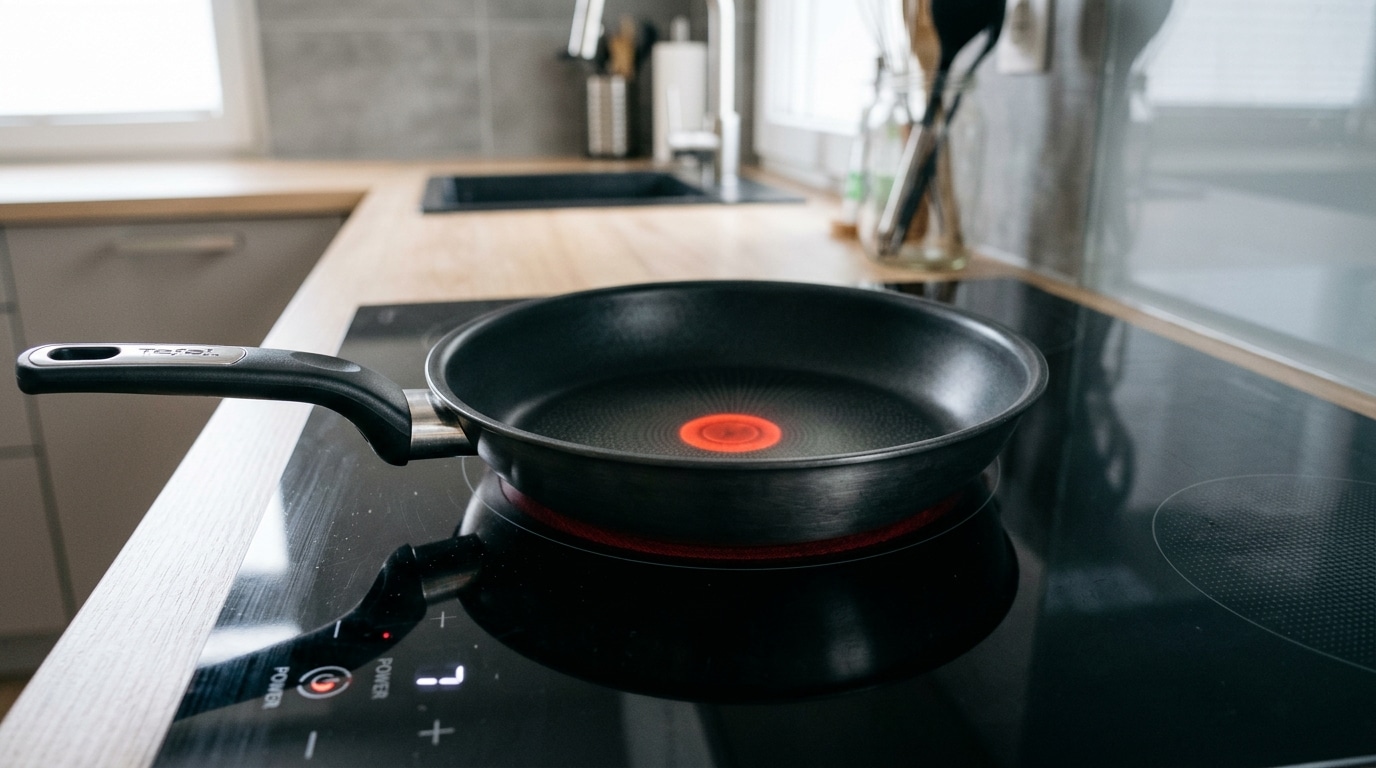
A nonstick pan left on the stove, still empty, while you’re busy peeling or chopping vegetables nearby: this seemingly harmless gesture, almost a habit for many cooks, hides a mechanism that most households completely overlook. We often assume the real danger comes from tiny scratches that appear over time when the spatula scrapes a bit too hard at the bottom of the coating. Yet toxicologists look elsewhere. Their focus is on a much more subtle phenomenon that has nothing to do with the pan’s cosmetic state, but everything to do with temperature.
- The real risk comes from overheating an empty PTFE-coated pan above roughly 360 degrees, not from scratches.
- Never use a PTFE-coated pan directly over the flames of a gas or charcoal grill.
- PTFE is an inert material; swallowing a coating fragment or using a slightly scratched pan does not present a proven health risk.
- PTFE, a polymer with little-known properties
- Empty overheating, the real danger identified by the BfR
- Normal use with no proven health risk
- What to remember to cook with confidence
PTFE, a polymer with little-known properties
Behind the acronym PTFE lies polytetrafluoroethylene, a polymer belonging to the large family of per- and polyfluoroalkyl substances, better known as PFAS. It is this material that gives pots, pans, and other kitchen tools their smooth, nonstick surface, resisting both water and grease. Other compounds with similar properties exist, such as ETFE, PFA, or FEP, but PTFE remains the most widespread in kitchens. Its manufacture is also worth knowing: the polymer is blended with various additives, emulsifiers, colorants, and fillers, some of which also belong to the PFAS family in non-polymeric form. The final step, called sintering, involves heating the coating under pressure. This process removes a large portion of these auxiliary substances or binds them tightly to the coating, which greatly limits their capacity to release into daily life afterward.
Overheating empty, the real danger identified by the BfR
That is precisely where the real point of vigilance lies. The German risk assessment institute, the BfR, notes that intense overheating of PTFE coatings can release harmful fumes, especially above roughly 360 degrees. This threshold is not purely theoretical: it matches exactly the situation of a pan left empty on a flame that’s too high while you calmly prepare ingredients nearby. Without food or liquid to absorb the heat, the coating’s temperature can rise quickly and reach this critical level. The institute even goes further by warning against using PTFE-coated utensils directly over the flames of a grill, whether gas or charcoal, where temperatures can be much higher and harder to control. The takeaway is simple: it’s better to wait until you have oil, butter, or food in the pan before placing it on the heat, rather than letting it heat up empty in an attempt to save time.
Normal use with no proven health risk
And what about scratches? This is precisely where expert narratives often surprise. In normal use, small amounts of fluorinated substances may migrate into the food, but according to available data, these quantities are too small to cause health problems for consumers. As for the tiny particles that sometimes flake off a damaged coating, they do not appear to pose a health concern in case of accidental ingestion, as PTFE is considered inert. In other words, accidentally swallowing a small coating fragment is not comparable—in terms of risk—with heating a pan empty to white-hot. That said, this does not mean all scratched pans are inherently safe or that one should cling to a badly degraded utensil: a pan that is near the end of its life should be replaced, but not for the commonly imagined reason.
What to remember to cook with confidence
In short, the precaution hierarchy in many kitchens deserves recalibration. Here are the essential points to keep in mind:
- Avoid letting a PTFE-coated pan heat up empty on the stove, even for a few minutes
- Never use this type of utensil directly above the flames of a gas or charcoal grill
- Don’t panic at the first visible coating flake; PTFE is considered inert
- Replace a utensil that is too degraded as a general precaution, without waiting for a specific health warning
The nonstick skillet remains a very practical everyday ally, provided you follow a few simple reflexes. Monitoring temperature rather than the coating’s appearance ultimately changes the perspective on this topic. One thing is certain: the next time the pan sits on the heat, it’s better to slide in a little oil first before resuming your vegetable chopping.
👉 A small gesture for Space Group? Follow us on Google, add us to your favorites, and find us on Google News so you won’t miss any discoveries.
