
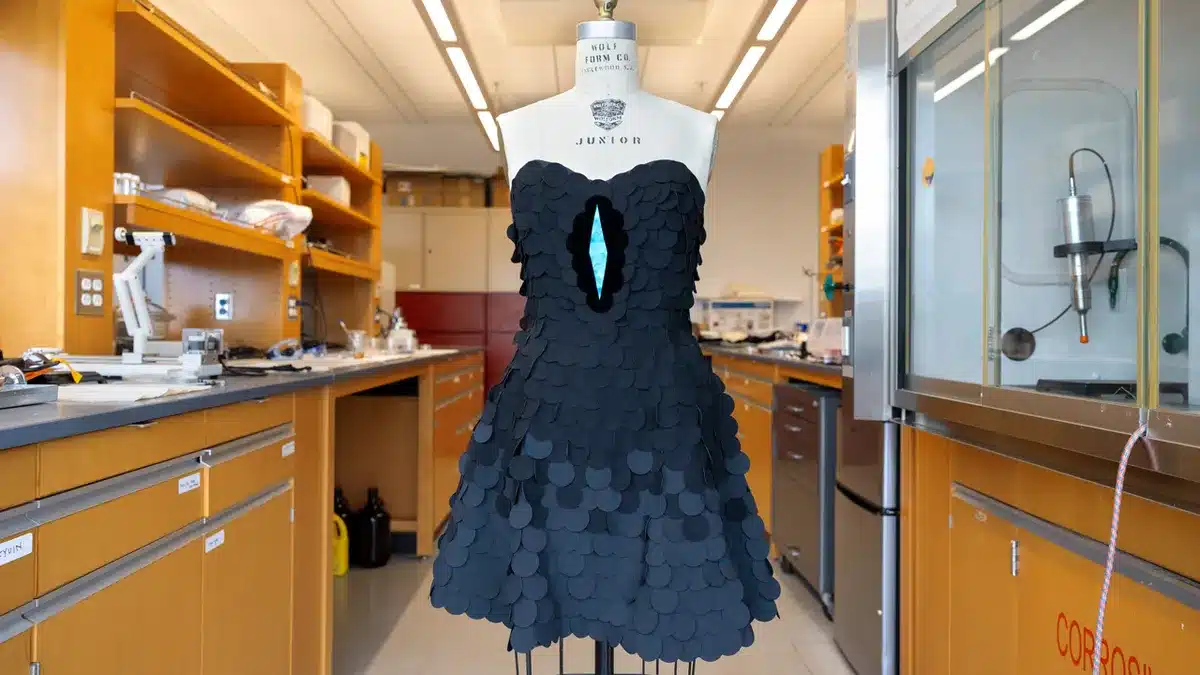
We thought fashion had exhausted its possibilities. Yet a team of researchers unveiled a garment so black that it makes the contours it covers vanish. This dress, crafted from an ultra-dark textile inspired by the birds of paradise, absorbs up to 99.87% of incoming light. More than a mere aesthetic feat, it marks a striking milestone at the crossroads of materials science, optics, and design.
When fashion draws on extreme biology
The birds of paradise use their plumage as a visual stage. Some species possess an area of such deep black that the brain interprets it almost as a void, heightening the brightness of the surrounding colors. Intrigued by this extreme biological darkness, researchers studied the structure of these feathers. They uncovered a sophisticated arrangement of micro-barbules forming a light trap: a three-dimensional geometry that amplifies the effect of melanin through a multitude of internal reflections.
This photon-trapping principle provided the basis for designing a textile capable of rivaling this natural performance. The aim was not merely to imitate black, but to reproduce the sensation of a “visual void” that strikes anyone who looks at these birds. Fashion becomes here a captivating pretext: using a garment as a scientific demonstrator to materialize an optical property that seems almost unreal.
The dress that erases volumes: an optical and textile feat
To achieve a truly absolute black usable in clothing, the researchers combined two major innovations: a polydopamine treatment – a synthetic analogue of melanin – and a plasma-etching process capable of sculpting the fabric’s surface. The result: a microscopic forest of fibrils where light enters… and never exits.
This microscopic geometry disrupts conventional reflections. Whether light comes straight on, at an angle, or in diffusion, it is captured and dissipated within the structure. The dress thus never “shines,” even under spotlights. Better still: it erases the mannequin’s contours. Folds, volumes, and curves dissolve into a striking optical uniformity. One no longer perceives a garment, but a silhouette etched from the void.
Unlike other ultrablack materials that are typically rigid or fragile, this textile is flexible, breathable, and robust enough for real-world use. The robe prototype is not a fragile laboratory artifact but a tangible demonstration: fashion as an interface between the public and a high-tech innovation.
Beyond the runway: why this dress could change more than fashion
If this dress captivates, it is because it embodies a physical phenomenon rarely visible to the naked eye. Yet the innovation extends far beyond style. A stable, durable, non-toxic textile capable of absorbing nearly all light could find applications in optical instrumentation, precision sensing, astronomy, or solar energy.
In these fields, even a single stray reflection can distort a measurement or reduce efficiency. A flexible, washable, inexpensive ultrablack material thus opens a new pathway. One can envision coatings to enhance the performance of scientific cameras, to reduce optical aberrations in telescopes, or to optimize the active surfaces of solar collectors.
The dress thus serves as a visual manifesto for a technology that could tomorrow appear in industrial, scientific, or energy contexts. It embodies the successful fusion of biomimicry, advanced engineering, and artistic exploration.
Another proof that innovation travels best when it can captivate as well as explain.
The details of the study are available in the journal Nature Communications.
👉 A small gesture for Space Group? Follow us on Google, add us to your bookmarks, and find us on Google News so you don’t miss any discoveries.
