
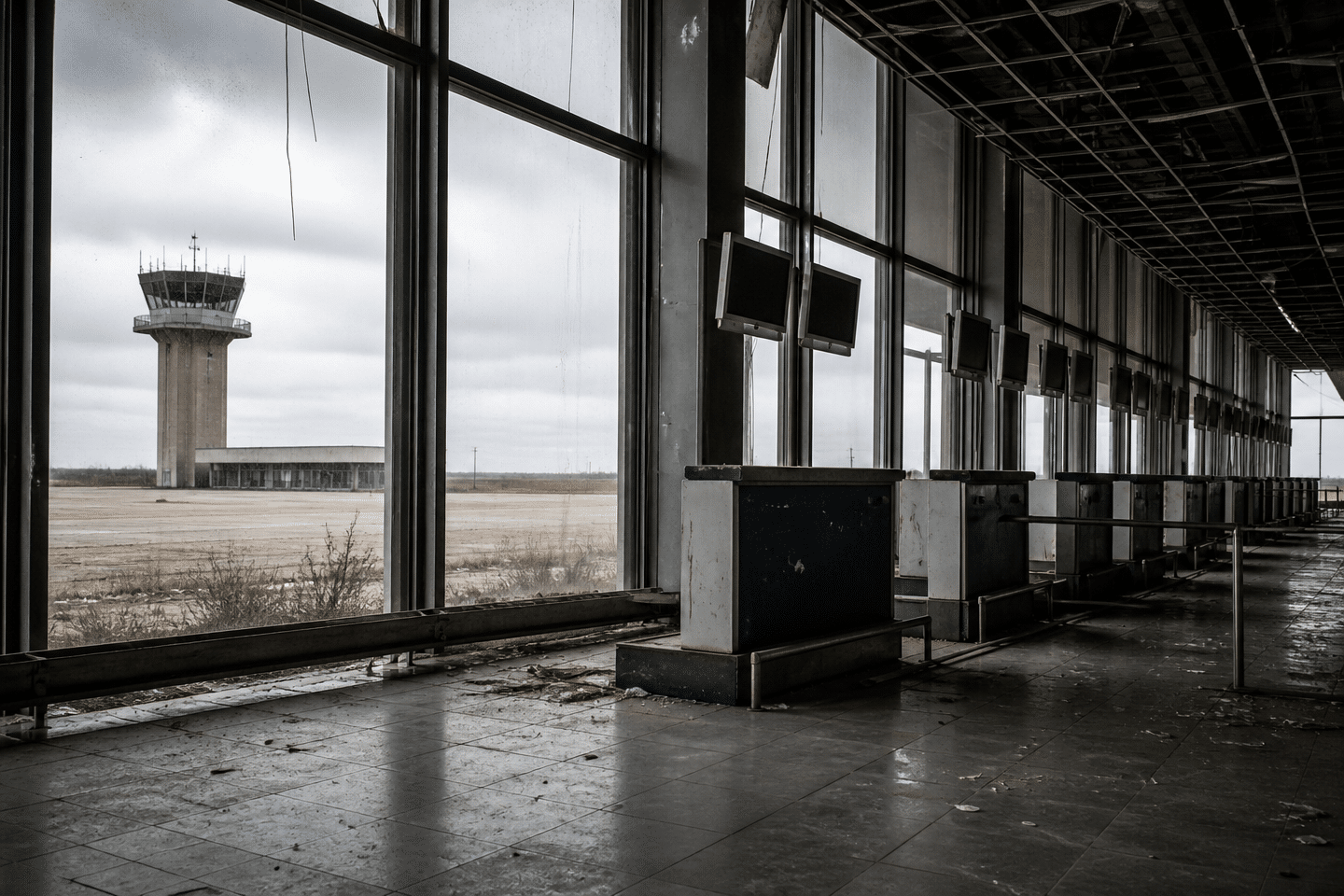
An airport designed to handle two and a half million passengers a year, with a runway among the longest in Europe, capable of accommodating an Airbus A380. Closed after only three years of operation. Sold later for a pittance compared with its construction, Ciudad Real’s story alone sums up the excesses of the Spanish real estate boom.
- Open in 2008, the airport goes bankrupt by 2010 due to insufficient traffic, embodying the excesses of the Spanish property bubble
- After an initial unsuccessful bid, it is finally sold in 2015 for only 10,000 euros to the Chinese group Tzaneen International
- Since early 2026, the site has reopened for limited use, mainly devoted to general aviation a few hours per week
- A ghost airport in the heart of Castile
- The abrupt fall of a symbol of the Spanish property bubble
- 10,000 euros for an entire airport: the incredible auction sale
A ghost airport in the heart of Castile
About 235 kilometers south of Madrid, right in the center of Castile, lies an infrastructure that would make many of Europe’s great capitals envious. Central Ciudad Real Airport was Spain’s first private international airport, a rare ambition for a rural and sparsely populated region. Its opening in 2008 was meant to inaugurate a new era for air travel in central Spain.
The numbers are dizzying. Its runway, four kilometers long, ranks among Europe’s longest and can easily accommodate an Airbus A380, the largest passenger aircraft in the world. The terminal building boasted a passenger traffic area of 65,000 square meters and a cargo area of 55,000 square meters. The whole complex had been scaled to absorb up to 2.5 million passengers annually.
Such a project could not be financed alone. The regional savings bank Caja Castilla La Mancha carried most of the investment. A choice that would prove costly for the institution, as in 2010 it would become the first Spanish regional bank to be bailed out by the state.
The abrupt fall of a symbol of the Spanish property bubble
The timing was already questionable. The airport opened its doors in 2008, the very year the global financial crisis exploded and Spain’s construction bubble collapsed violently. The country, which had built housing, infrastructure, and facilities at a feverish pace for years, suddenly found itself with oversized assets and little demand to fill them.
Ciudad Real quickly became the starkest illustration of this. Traffic never truly took off. Airlines abandoned the site one after another, lacking enough passengers to make their routes profitable. In 2010, barely two years after its opening, the airport’s operator went bankrupt.
The site then turned into what Spanish media dubbed a ghost airport. Desolate runways, an empty terminal, pristine equipment that no longer served any purpose. The image gradually became a national symbol of the lavish public and private spending of the era of the real estate boom.
10,000 euros for an entire airport: the incredible auction sale
What to do with such a gigantic yet unusable airport? The Spanish judiciary first attempted to sell it directly in December 2013, with a starting price set at 100 million euros. No buyer stepped forward. The court administrator then lowered the ambitions and set a new minimum price at 28 million euros, with the sale becoming final only in the absence of a better offer.
It would finally be July 2015 before an offer arrived. It came from the Chinese investment group Tzaneen International. The amount left many speechless: 10,000 euros for a complex whose construction was valued at more than a billion euros. With no other bidders, this lone proposal won the auction organized by a central-Spain court.
Tzaneen International’s stated ambition at the time was to transform this ghost airport into a true European hub for Chinese companies. Some sources mention a later resale of the asset in 2016 to a structure named CR International Airport for a little over 56 million euros, a detail that would deserve further confirmation.
Since the beginning of 2026, the site has entered a new chapter, far more modest than its original ambitions. The airport reopened in a mixed, incremental model, after more than a year of technical and regulatory preparation. It now operates on a restricted basis, Monday to Friday, from 10:00 to 17:00, supplemented by public use on demand, primarily oriented toward general aviation.
From the ambition of an international hub capable of rivaling Europe’s largest platforms to a handful of light aircraft taking off for a few hours each week, the contrast alone sums up Ciudad Real’s entire trajectory. A financial abyss that, unintentionally, became one of the most frequently cited case studies illustrating the excesses of easy credit and oversized infrastructure projects. The story of this runway, once capable of hosting an A380, now nearly silent, continues to fascinate as much as it prompts questions about how we plan major public infrastructures.
👉 A small gesture for Space Group? Follow us on Google, add us to your bookmarks, and find us on Google News so you don’t miss any discoveries.
