
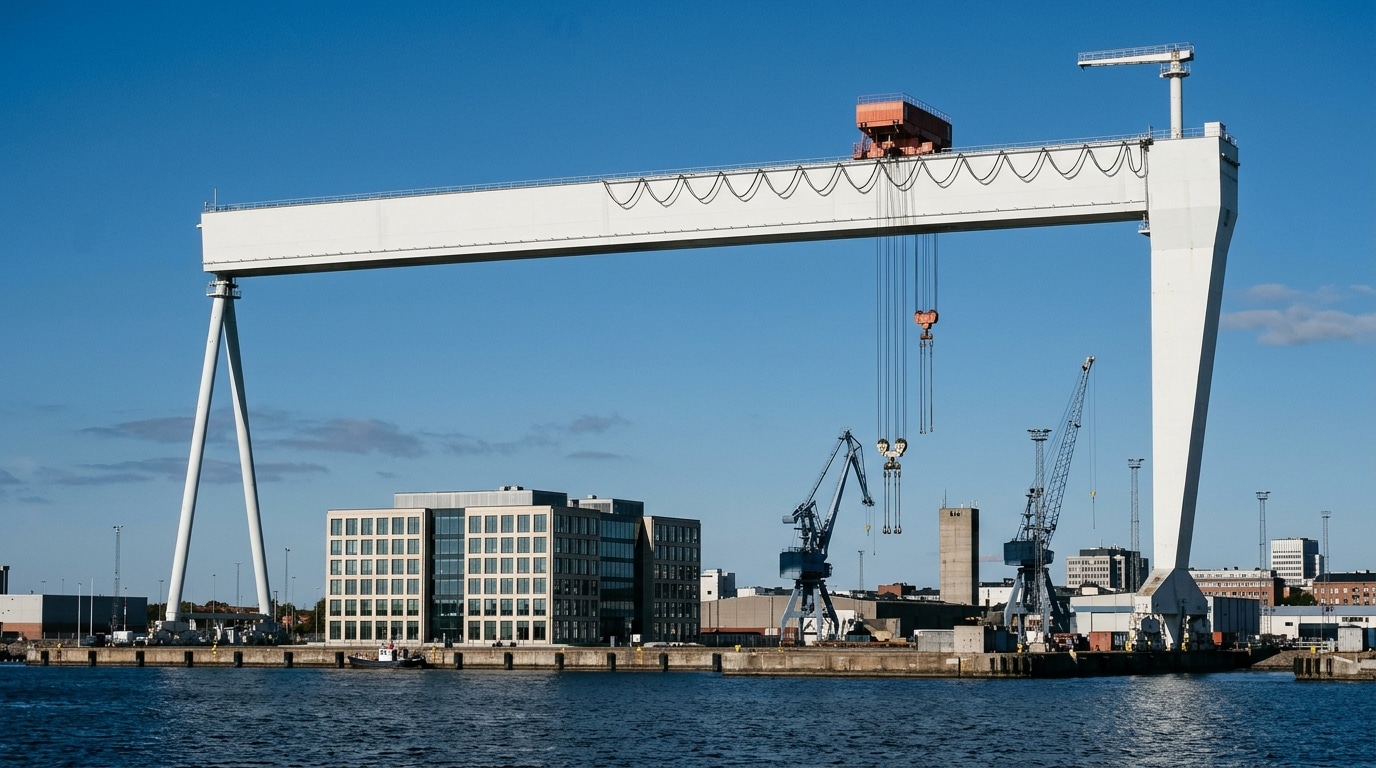
A 138-meter-tall gantry crane, capable of lifting 1,500 tonnes in a single lift, was sold for a symbolic one dollar. This Swedish steel colossus, a witness to the heyday of European shipbuilding, travelled halfway around the world to be reborn in South Korea, where it remains in operation today.
- Built between 1973 and 1974 at Malmö’s Kockums shipyard, the crane stood 138 meters tall and could lift 1,500 tonnes, contributing to the construction of roughly 75 ships.
- Facing the decline of Sweden’s shipbuilding industry, it was sold for a symbolic dollar in 2002 to Hyundai Heavy Industries of South Korea.
- Dismantled and reassembled at the Ulsan site starting in 2003, it earned the nickname “Malmö’s Tears” and remains in active service, its capacity later increased to 1,600 tonnes in 2007.
- A crane sold for a symbolic dollar to a shipyard in its heyday
- When Sweden’s shipbuilding industry collapsed under Asian competition
- The improbable journey of 138 meters of steel to South Korea
A crane sold for a symbolic dollar to a shipyard at the height of its glory
Constructed between 1973 and 1974 at Kockums’ Malmö shipyard, this gantry crane was more than just a lifting tool. At 138 meters tall, according to widely cited figures, and with a 710-meter rail span, it literally dominated the industrial skyline of the Swedish city.
Its lifting capacity reached 1,500 tonnes, enough to hoist entire hull blocks without hesitation. Such a machine allowed the assembly of large ships with remarkable efficiency for its era.
For nearly a quarter of a century, it contributed to the construction of about 75 ships. A figure that gives a sense of the production pace at the Kockums yard, then one of the pinnacles of Scandinavian shipbuilding.
Its last major project in Sweden had nothing to do with ships. In 1997, it helped lift the foundations of the Öresund Bridge’s tall pylons, the structure that now connects Sweden with Denmark.
When Sweden’s shipbuilding industry collapsed under Asian competition
Like many European shipyards, Kockums eventually yielded ground to the rising giants of Asian shipbuilding. Production costs were far lower in Asia, making sustained competition difficult over the long term.
An initial attempt to sell the crane at the early 1990s to the Danish yard Burmeister & Wain failed; the buyer went bankrupt before beginning dismantling, leaving the structure on site.
It would take until 2002 for a solution to emerge. The South Korean group Hyundai Heavy Industries bought the whole package, crane included, for the symbolic sum of one dollar. The deal, disclosed by Sveriges Radio, also included three smaller cranes and spare parts.
Lennart Ottosson, managing director of Dockan Exploatering AB, the selling company, explained at the time that the large crane would first be used to dismantle its smaller sisters before its own dismantling. An almost ironic logic for a machine that was about to leave Swedish soil for good.
The unlikely journey of 138 meters of steel to South Korea
Dismantling began in the summer of 2002. Moving a structure of such size is no improvised task: each piece had to be carefully cataloged, cut, and packaged for a sea voyage spanning several thousand kilometres.
The crane was reassembled at Hyundai’s Ulsan yard, where it has stood since 2003. Repainted in red and bearing the HYUNDAI logo, it earned a nickname that speaks to the Swedish side’s sentiment: the Koreans call it “Malmö’s Tears.”
A modification in 2007 slightly increased its capacity, now listed at 1,600 tonnes by Hyundai. Asked by Swedish radio, the group confirmed that the crane remains in active service and is by no means for sale.
The Ulsan site has not lost its momentum. HD Hyundai Heavy Industries is to build two of the eight LNG-powered container ships ordered by the carrier HMM there, under a contract valued at 1.92 trillion won. Meanwhile, Saab integrated the Kockums unit into a newly formed division named “Naval,” marking the end of one chapter but not the story of Sweden’s industrial heritage.
There is something fascinating about the fate of this crane. Born to construct Swedish ships, it now, at the opposite end of the world, continues to contribute to the growth of an industry that had helped bring down the very one that birthed it. A quiet but powerful symbol of the industrial shifts that have redrawn the global economic map over decades.
👉 A small gesture for Space Group? Follow us on Google, add us to your bookmarks and find us on Google News so you don’t miss any discoveries.
