
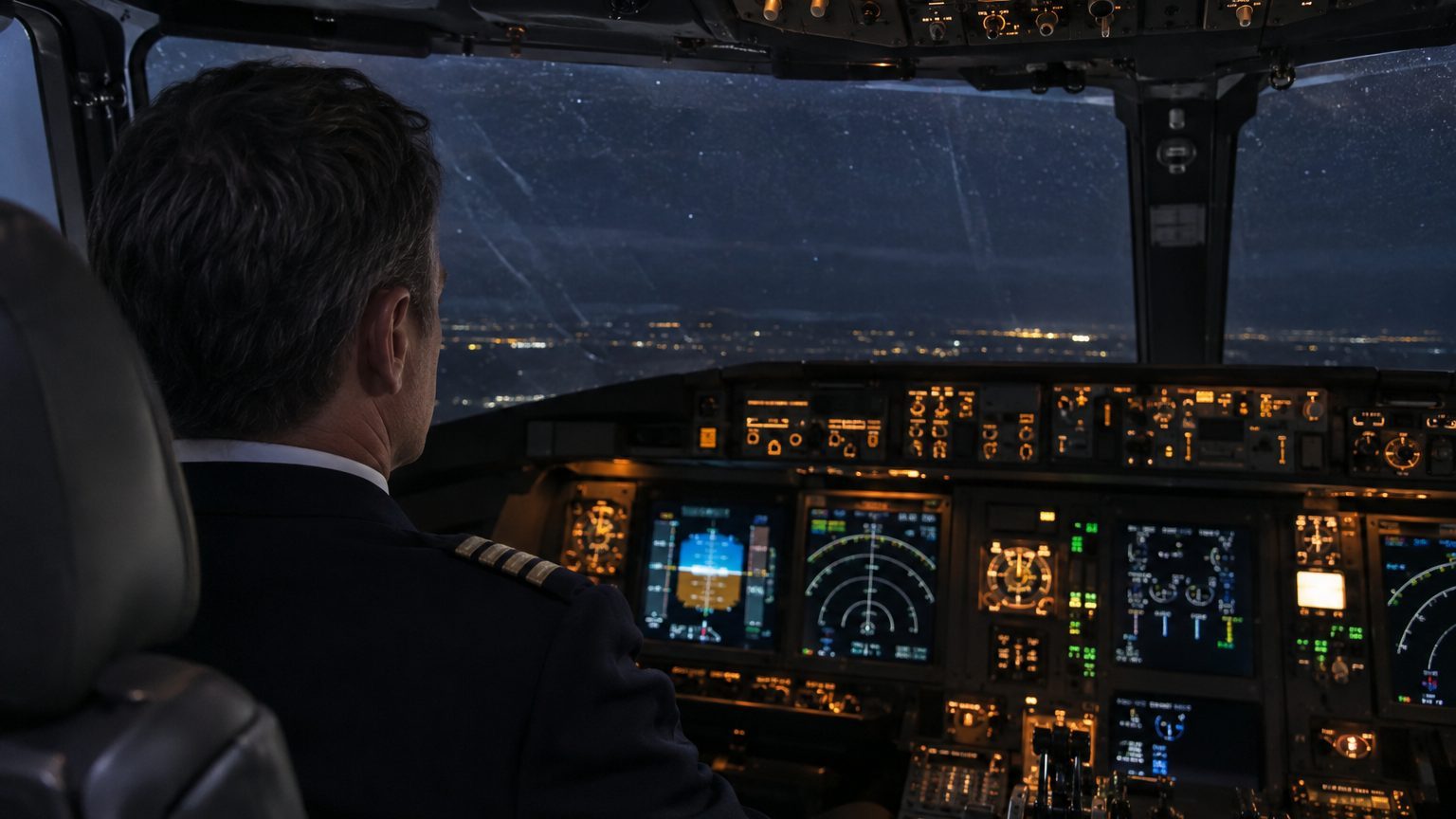
It is 8:42 p.m., local time, on June 24, 1982, when engine number 4 on a British Airways Boeing 747-200 begins to surge. In the minute that follows, the other three shut down in turn. At 37,000 feet above Indonesia, with the Indian Ocean in sight, Flight 9 from London to Auckland has lost all thrust and is about to glide for roughly fifteen minutes.
“We have a small problem,” announces Captain Eric Moody to the passengers.
This small problem was Galunggung, a Java volcano that had been spewing ash intermittently since April. These ash clouds are dry and leave no trace on the onboard weather radar, and no one in the cockpit yet understood the origin of the cloud.
- British Airways Flight 9 loses all four engines on June 24, 1982, above Indonesia.
- The ash from Galunggung volcano is not detected by the onboard weather radar.
- Engine No. 4 restarts at 13,500 feet, and the aircraft lands in Jakarta.
- The incident leads to the creation of a global ash-cloud monitoring system.
From Saint Elmo’s Fire to the Silence of the Engines
That evening, the 747 operated the London–Auckland relay, with several stops, cruising at night at flight level 370, or 37,000 feet. In the cockpit, luminous discharges danced on the windshield, a Saint Elmo’s fire whose source the crew did not yet understand. The displays remained unresponsive. At 8:42 p.m., engine No. 4 showed the first signs of surging before turning off.
Engines 1 and 3 failed almost simultaneously, followed by Engine 2. Less than a minute separated the first failure from the last.
At 8:44 p.m., the crew sent a distress message to local air traffic control to report that all four engines were shut down. Jakarta Control misinterpreted the situation and believed only engine 4 was affected. Inside the cabin, the pressure dropped, because the engines also served to pressurize the aircraft.
A 747 without power does not fall; it glides.
Fifteen Minutes to Choose Between Restart and Ditching
The descent lasted about fifteen minutes. From 37,000 to 13,500 feet, the aircraft lost approximately 23,500 feet of altitude, more than 7,000 meters—about one and a half times the height of Mont Blanc. That was an average of over 1,500 feet per minute. Throughout this period, the crew went through restart procedures repeatedly, receiving no response from the jets.
In the cabin, the captain’s voice remained steady. He spoke of a small problem, announced that all four engines were shut down, and assured passengers that every effort was being made to restart them.
At 13,500 feet, the crew reached the brink of ditching.
That is when luck changed. Engine No. 4 restarted at 20:56 Jakarta time, and Moody used it to brake the descent. The others followed suit, though one of them faltered shortly after.
The mechanism becomes clearer in hindsight. In the combustion chamber, the temperature was sufficient to melt the ash, which then settled as a glassy coat on downstream components, such as turbine blades. With the engines off, these deposits cooled during the glide, cracked, and partly peeled away. Once the aircraft left the cloud, the engines could breathe again. The crew then requested a higher altitude to clear the Indonesian high terrain before continuing toward Jakarta.
Jakarta, Then a Global Alert System
The airplane landed safely in Jakarta. The cockpit, battered by ash grains, limited visibility, and the approach was conducted under those conditions.
The episode had tangible consequences. It led to the creation of the International Airways Volcano Watch, a monitoring system designed to alert airlines and controllers to ash clouds. Operating manuals received guidelines on how to handle ash, and pilot training was enhanced.
The warning did not arrive too late for everyone, but it did not prevent a repetition. Nineteen days later, a Singapore Airlines 747 flew through the same Galunggung plume and lost three of its four engines. The British Airways aircraft, registered G-BDXH, was given four new engines and a new windshield in Jakarta. It then returned to London and resumed service.
Captain Eric Moody died in 2024. His announcement to the passengers remains one of the most cited examples of crisis communication in aviation.
The risk has not disappeared. Until April 2010, at the time of the Eyjafjallajökull eruption in Iceland, engine manufacturers still had not defined a precise particle threshold beyond which a reactor would be threatened. Icelandic authorities had, for several years, urged carriers to determine what ash density could be tolerated.
👉 A small gesture for Space Group? Follow us on Google, add us to your bookmarks, and find us on Google News so you don’t miss any discoveries.
Sources: rogerivester.com | simpleflying.com
