
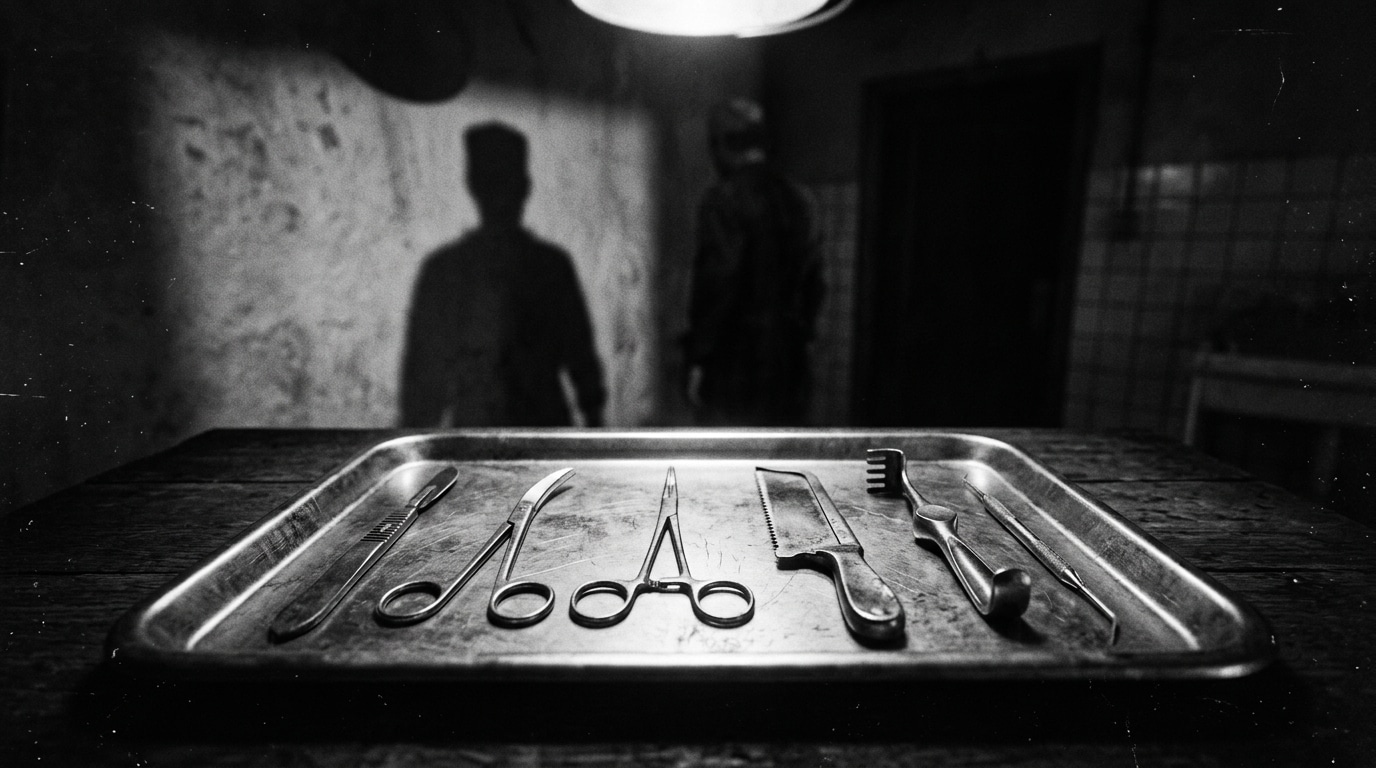
In Trenton, New Jersey, hundreds of patients hospitalized for mental illness had their teeth torn out, their tonsils removed, sometimes a kidney or an entire colon excised. Not to treat an infection. To cure their madness. The culprit: a psychiatrist convinced that mental illness lay in infectious foci hidden within the body.
- Henry Cotton, director of the New Jersey State Hospital from 1907, had the teeth, tonsils, and organs of his patients removed, convinced that hidden infections caused madness
- He claimed an 85% cure rate, but concealed a postoperative mortality rate of about 30%, higher still for colon resections
- A 1930s inquiry revealed that unoperated patients recovered more often than those who were operated on, undermining the septic-focus theory
- The theory that transformed an asylum into an operating room
- Teeth, tonsils, organs: the hunt for infectious foci spared no one
- A mortality rate of one third that the hospital had long concealed
The theory that transformed an asylum into an operating room
Henry Andrews Cotton was merely thirty-one years old when he assumed leadership of the New Jersey State Hospital in Trenton in 1907. A notably young age to run a psychiatric asylum, yet Cotton possessed ambition and a fixation. He sought to understand the true cause of madness, and above all, to cure it with medicine rather than confinement.
The turning point came in 1913, when studies confirmed that the spirochete responsible for syphilis can produce grave brain lesions, sometimes leading to dementia. For Cotton, the conclusion followed with almost mathematical certainty: if a bacterium can drive a person mad by attacking the brain, then other infections—much subtler—could do the same.
He devised what he called the bacteriological model of madness, built on the septic-focus theory. The idea is simple to state, almost alluring on paper: chronic infections, lodged in specific organs, would continuously release toxins that would poison the brain. Treating these foci, then, would amount to treating the mental illness itself.
The problem was that this theory never had solid scientific proof. It relied on a risky extrapolation, a reasoning by analogy that confuses correlation with causation. Yet Cotton believed wholeheartedly, to the point of gradually converting his entire psychiatric institution into a genuine operating room.
Teeth, tonsils, organs: the hunt for infectious foci spared no one
It all began modestly, so to speak, with the extraction of teeth. Cotton had fifty patients’ teeth pulled, convinced that dental caries and abscesses formed the primary gateway for toxins to reach the brain. The results disappointed him, but rather than question his theory, he broadened his scope.
Next came the tonsils, then the sinuses. Gradually, no organ was spared: stomach, spleen, colon, ovaries, gallbladder. Every corner of the body became suspect, every patient a surgical field to be explored. Cotton operated without always obtaining consent from families, arguing that sometimes action against the patient’s will was necessary to save them from themselves.
Among the most notable cases was Margaret Fisher, daughter of Yale economist Irving Fisher. Transferred to Trenton, she underwent multiple successive colon procedures before dying of a streptococcal infection in 1919. Her story illustrates a grim truth: even wealthy and influential families could not shield their relatives from these interventions.
In 1923, Cotton published results that impressed a portion of the medical community. He claimed an 85% cure rate among operated patients who survived, figures that The Lancet carried. These statistics, presented as compelling evidence, masked a reality far darker.
A mortality rate of one third that the hospital had long concealed
Behind the 85% cure rate lay a detail Cotton consistently downplayed: his postoperative mortality rates. They hovered around 30%, rising even higher for colon resections—one of the riskiest procedures conducted at Trenton.
In response to critics, Cotton offered a chilling justification: psychotic patients with old infections simply made poor surgical candidates. In other words, the deaths would not undermine his method but would instead confirm the patients’ inherent fragility.
Adolf Meyer, a respected figure from Johns Hopkins, eventually grew doubtful. In 1924, he commissioned his former student, Dr. Phyllis Greenacre, to seriously evaluate Cotton’s methods. Her report cast a chill over the practice, though it did not immediately end it.
It would take a hospital-board inquiry in the early 1930s to obtain clear figures. By comparing 645 operated patients with 407 who were never operated on, investigators established that the recovery rate was actually higher among those who had received no intervention. The septic-focus theory collapsed.
Cotton left his post in 1930 and died three years later, never publicly renouncing his methods. Even more troubling, the routine extraction of patients’ teeth remained common at Trenton until 1960, three decades after his departure. Sociologist Andrew Scull traced the entire affair in his book Madhouse: A Tragic Tale of Megalomania and Modern Medicine, published by Yale University Press. His work serves as a stark reminder of how a medical conviction, carried with confidence and bolstered by prestigious institutions, can cost hundreds of vulnerable people their lives, unable to defend themselves against the authority of a man convinced he was right.
👉 A small gesture for Space Group? Follow us on Google, bookmark us, and find us on Google News so you don’t miss any discoveries.
