
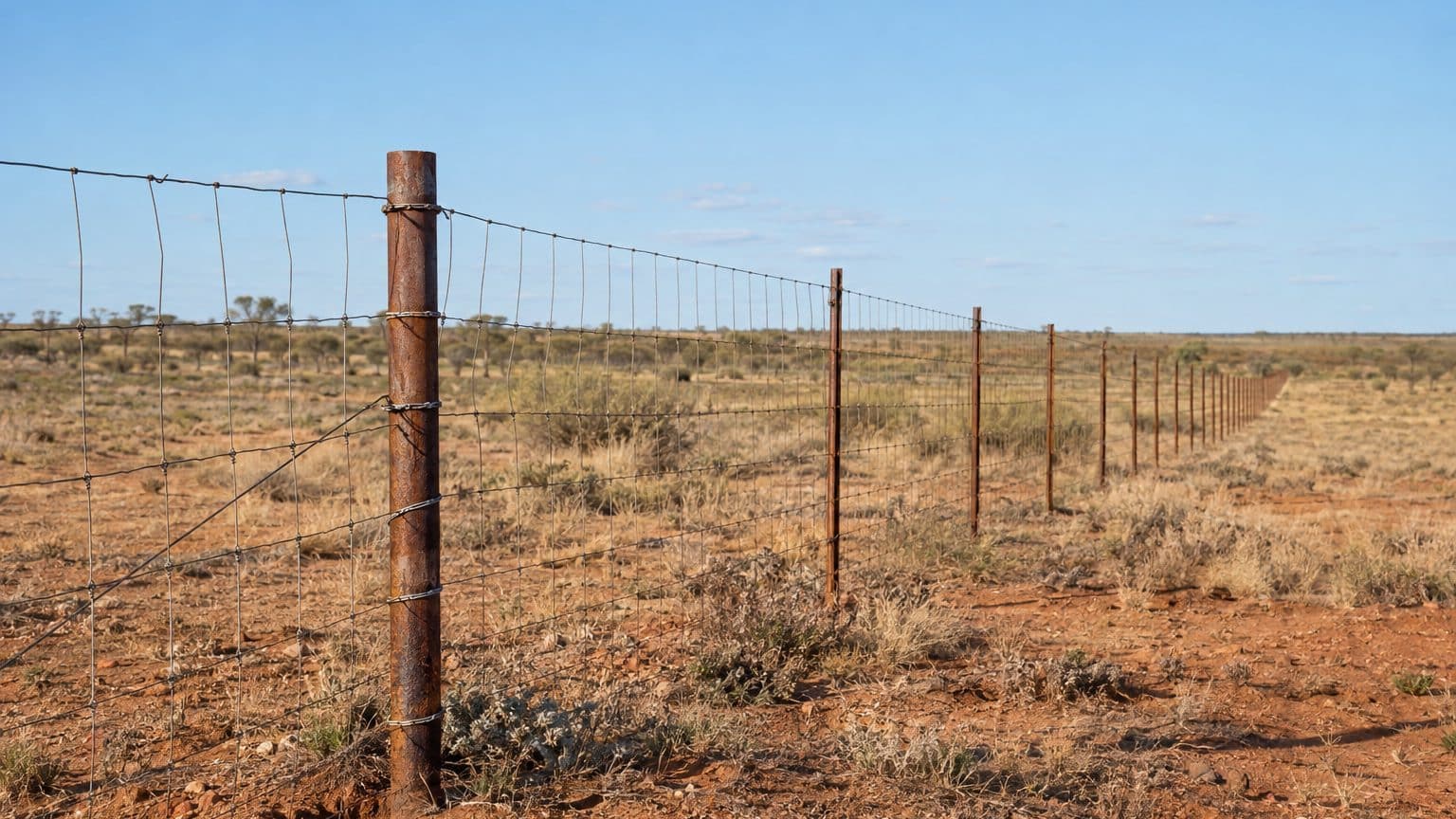
When the final segment of Fence No. 1 was connected in 1907, the project stretched 1,833 km of posts and lattice across Western Australia. It was at that time the longest uninterrupted fence in the world, almost twice the length of metropolitan France. The rabbits, however, had already crossed the line before the fence was completed.
- Twenty-four rabbits released in 1859 reached Western Australia in 37 years.
- Fence No. 1 measures 1,833 km and was built from 1901 to 1907.
- Rabbits were spotted west of the line before the structure was completed.
- A second fence of 1,166 km was added in 1905.
24 Rabbits, a Hunt, and a Continent
Everything begins in October 1859, when Thomas Austin released 24 wild rabbits from England to hunt them. Introduced in the state of Victoria in the 1850s, the animals spread faster than anyone had anticipated across the eastern part of the continent. By 1896, they were found as far as Eucla, then 200 km further west, at Twilight Cove near Esperance.
It took 37 years for the rabbits to go from Austin’s release to the gates of the West.
That same year, 1896, the Western Australian Lands Department dispatched surveyor Arthur Mason to investigate near the border with South Australia. He recommended a series of fences, one along the border, another farther west. A royal commission convened in 1901 sided with a barrier spanning the entire state. The surveyor Alfred Canning, future designer of a famed cattle trail, was given the task of laying out its route.
1,833 km on Camelback
The project began in 1901 and stretched over six years. Fence No. 1 linked the southern coast to the northwestern coast, following a line that passes north of Burracoppin, about 230 km east of Perth. This small town served as the main depot, and from there the gates and wells for the men who maintained the barrier were numbered.
The quality of the work soon posed a problem. After inspecting 748 km of fence already built, authorities judged the work substandard, and in 1904 the construction passed to the state’s Public Works Department. It first had to reinforce 233 km before resuming the project. Under the direction of Richard John Anketell, a team of 120 men, 350 camels, 210 horses, and 41 donkeys carried out the bulk of No. 1.
Twenty-five riders then patrolled sections of about 160 km each.
The Fence Arrives After the Battle
Chronologies differ on the exact date, ranging from 1902 to 1904, but the conclusion is the same: rabbits were spotted west of the line while No. 1 was unfinished. The government therefore ordered a second fence, built in 1905 a bit back from the first, at about 130 km, according to some accounts. Stretching 1,166 km, it began at Point Ann on the southern coast, passed through Cunderdin, about 150 km east of Perth, and joined No. 1 at Gum Creek in the Murchison region.
A third line, 257 km long, then connected No. 2 to the coast. The three fences together reached 3,256 km, and the entire system carried several names over time, including the State Vermin Barrier Fence. There were even discussions of an “emu-proof” fence, since the project also aimed at other agricultural pests.
The scenario repeated with No. 2. It was completed while rabbits had already penetrated inland, and the wear on the barrier almost always left a passage. Yet it delayed their advance for years: a public long-term loan program to buy fencing was never extended to farmers west of this line. An inspector named Crawford supervised four sub-inspectors, each responsible for about 800 km of fence, and was also tasked with eliminating rabbits that had crossed to the other side.
A Fence That Failed, But Not Useless
Should one call it a complete failure? The barrier slowed movements, served as the backbone of the pest-control effort, and formed part of a broader pest-management system. It simply never fulfilled the promise of its name. To put things in perspective, the dingoes fence in eastern Australia still spans more than 5,600 km.
The myxomatosis outbreak in the 1950s diminished the fence’s prominence.
Its story also took on a human dimension. In 1931, three Aboriginal girls—Molly, Daisy, and Gracie—escaped Moore River Native Settlement and walked home, over more than 1,600 km, following the fence like Ariadne’s thread. Their journey inspired Doris Pilkington’s 1996 book, which was later adapted into Phillip Noyce’s 2002 film. The work highlighted the policy of forced removal of children, which lasted roughly from 1905 to 1967 and whose victims are today known as the “Stolen Generations.”
Alfred Canning, who had traced the route of Fence No. 1, went on to open in Western Australia a 1,850 km cattle trail between Halls Creek and Wiluna, completed in 1910 and punctuated by 51 wells.
👉 A small gesture for Space Group? Follow us on Google, add us to your bookmarks, and find us on Google News so you don’t miss any discoveries.
Source: spacegroup.no
