
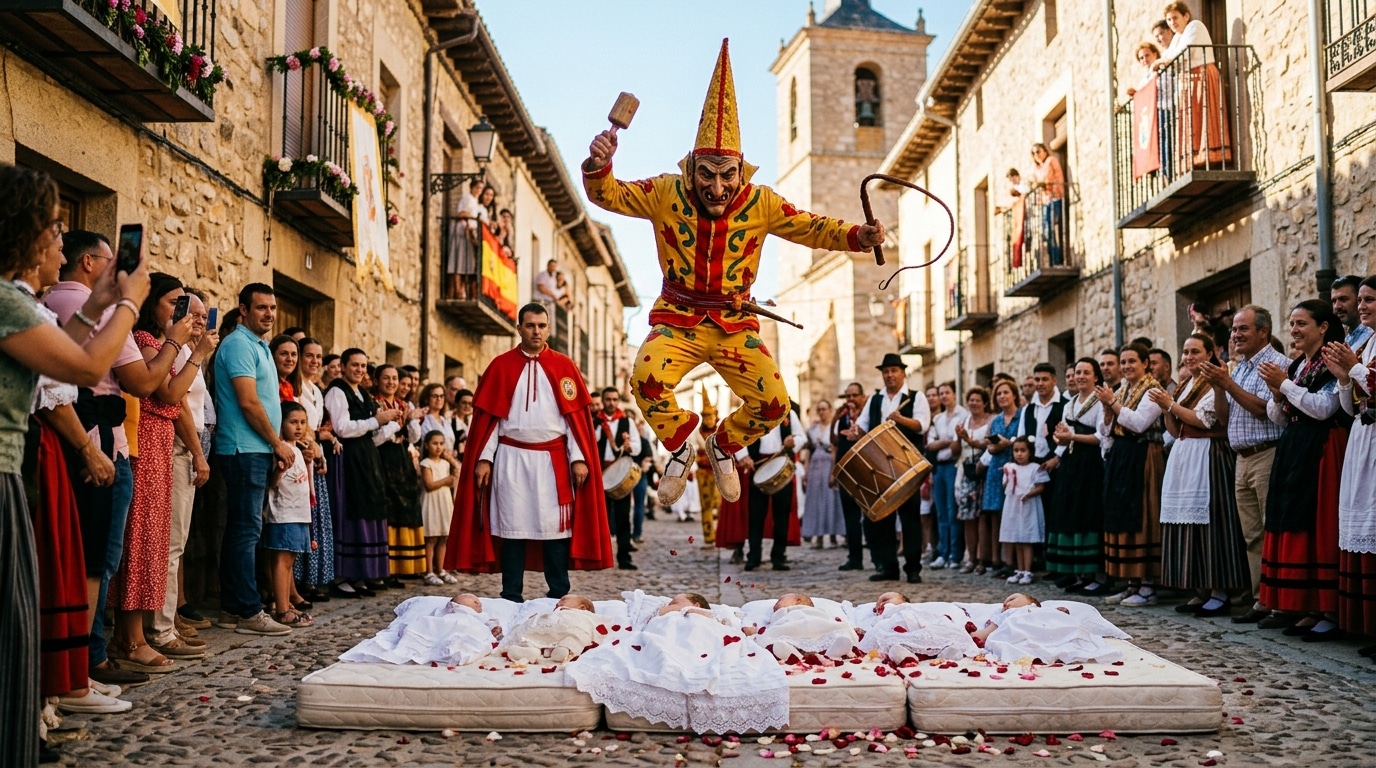
A man dressed as a devil, whip and castanets in hand, builds momentum and leaps over infants laid out on the ground. The scene seems straight out of a nightmare. Yet, this Spanish ritual is nothing random, and not at all the result of gratuitous provocation.
- In Castrillo de Murcia (Burgos), the El Salto del Colacho ritual consists of a man dressed as a devil jumping over infants to purge them of original sin during the Corpus Christi festivities
- The tradition, documented since 1749 and organized by the Confraternity of the Blessed Sacrament of Minerve, lasts a full week and is contested by the Catholic Church
- The next edition is scheduled for June 7, 2026, as part of celebrations planned from June 3 to 8
- A devil jumping over newborns: the scene that shocks visitors in Castrillo de Murcia
- Neither superstition nor spectacle: the true meaning behind the Colacho
- From the Middle Ages to today: how this ritual banned elsewhere survived in this Burgos village
A Devil Jumping Over Newborns: The Scene That Shocks Visitors in Castrillo de Murcia
Imagine a narrow street, lined with stone houses, in a small village in the province of Burgos. Mattresses are laid out on the cobblestones. On each rests a baby, sometimes only a few weeks old, sometimes merely a few days old.
Then appears a figure dressed in red and yellow, with a grotesque mask on the face. The man embodies the Colacho, the devil figure in this local tradition. He runs, leaps, and with a single bound clears each mattress and its tiny occupant.
In Castrillo de Murcia, a village attached to the municipality of Sasamón in Castile and León, this spectacle takes place every year during the Corpus Christi festival. For visitors unprepared for it, the initial reaction is often disbelief, or even worry. How can parents trust their child to such an undertaking?
In 2024, nearly 60 infants were laid along the village streets, despite the heat and record-breaking crowds. The leap typically occurs around six o’clock in the evening, at the very moment the blessing of the Blessed Sacrament takes place in the nearby church.
Neither Superstition nor Spectacle: The True Meaning Behind Colacho
This ritual, locally known as El Salto del Colacho, is neither a personal dare nor decorative folklore. According to a belief handed down for generations in the village, the devil’s leap has a purifying function: it would rid infants of original sin.
The idea may surprise a French audience accustomed to other forms of religious rites, often more discreet. Here, the symbolism is blunt. Evil, embodied by the Colacho, is literally chased away over the child’s body, as if the act of leaping carries away spiritual impurities.
The organization of this ceremony falls to the Confraternity of the Blessed Sacrament of Minerve, which has overseen it since the celebration’s origin. The festivities span an entire week, and do not reduce to the jump alone: on Sunday, the Colacho also traverses the village armed with a whip to frighten the inhabitants, who respond with insults, in a theatrical display of the battle between good and evil.
Lighter touches sometimes soften the ritual’s tension. During a June 2014 edition, village girls, for instance, tossed confetti onto the laid infants, adding a festive note to a moment otherwise highly codified.
From the Middle Ages to Today: How This Ritual Forbidden Elsewhere Has Survived in This Burgos Village
The oldest written trace of this tradition dates back to 1749. This means that generations of Castrillo de Murcia families have watched their children pass under the devil’s leap, in a ritual continuity that is quite rare for an event of this nature.
Such practices, blending demonic symbolism with real babies, could hardly take root today in many other contexts. Moreover, the Catholic Church itself challenges this celebration, deeming it too far removed from standard liturgical canons and difficult to reconcile with a peaceful image of the baptism sacrament.
Despite this institutional reluctance, the tradition endures, carried by local attachment and the desire to preserve a unique cultural heritage. The next edition is announced for Sunday, June 7, 2026, as part of festivities planned from June 3 to 8, proof that this ritual continues to shape village life without showing signs of waning.
What is ultimately striking, beyond the spectacle, is the resilience of such practices in the face of the homogenization of religious festivals across Europe. In Castrillo de Murcia, the past continues to jump, literally, over the present.
👉 A small gesture for Space Group? Follow us on Google, add us to your favorites, and find us on Google News so you don’t miss any discoveries.
