
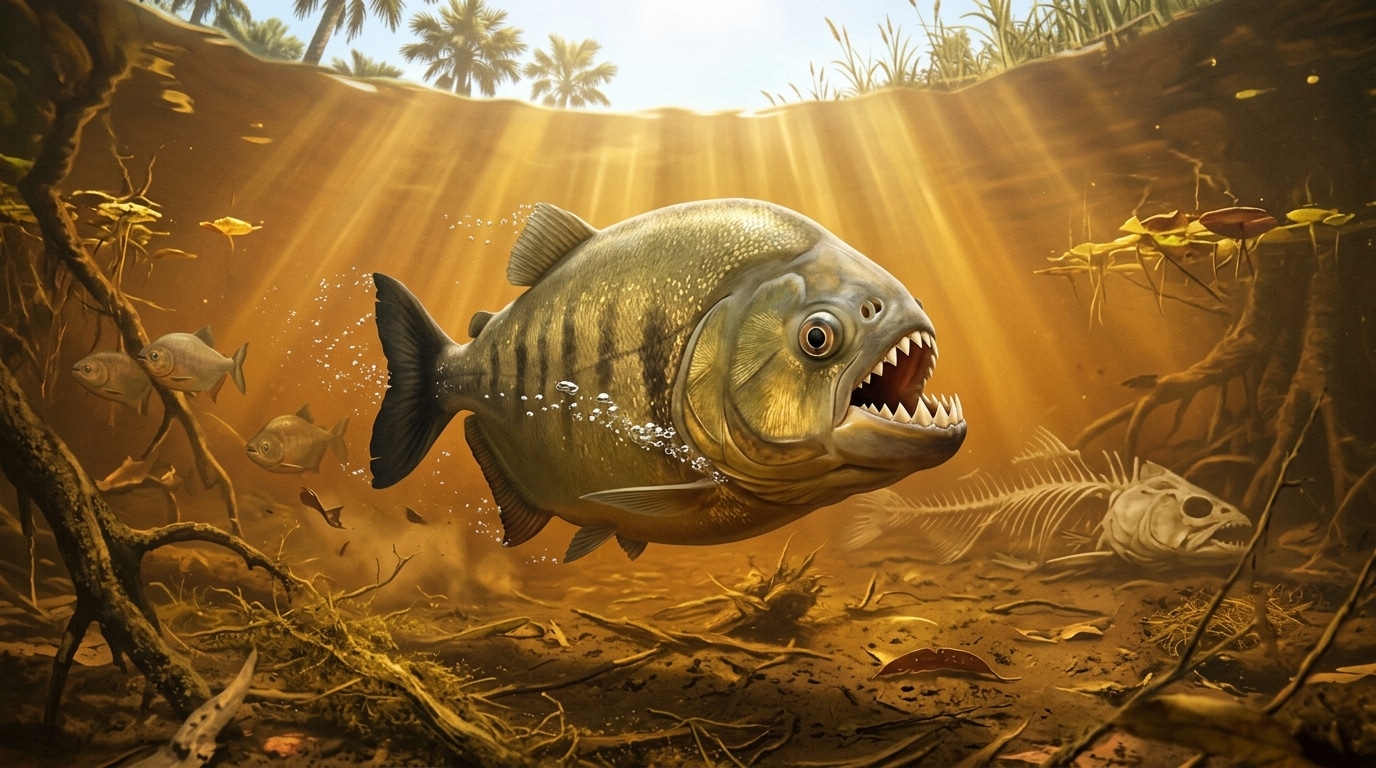
Imagine a fish no longer than an forearm, known from a single fossilized jaw fragment, yet capable of delivering a bite force comparable to that of a crocodile. Megapiranha paranensis never yielded its complete skeleton, but its teeth are enough to tell a vertigo-inducing story about the most effective bite ever measured in a fish.
- Megapiranha paranensis, described in 2009 from a fragment of premaxilla found in Paraná, measured around 71 cm in length and weighed about 10 kg according to recent allometric estimates
- According to Grubich et al. (2012), its bite force is estimated between 1,240 and 4,749 newtons, versus only 320 newtons for the modern black piranha
- Its dentition, intermediate between the herbivorous pacus and the carnivorous piranhas, was robust enough to crush bone, suggesting a bite power lost over the evolution of the lineage
- A fossil that fits in the palm of a hand, yet a bite worthy of a giant
- 1,240 to 4,749 newtons: how Grubich and his team calculated the impossible
- 320 N versus more than 4,000 N: the modern black piranha reduced to a mere nibble
A fossil that fits in the palm of a hand, yet a bite worthy of a giant
Everything begins on the banks of the Paraná River in Argentina, where cliffs dating from the Late Miocene protrude for millions of years. It is there that a fragment of premaxilla—the bone that forms the front part of the upper jaw—was unearthed, still bearing seven teeth, four of which were arranged in a zigzag. Nothing more. No complete skull, no vertebral column, no fins. Just this bone and its teeth, yet enough to overturn our understanding of piranha evolution.
The species was formally described in 2009 in the Journal of Vertebrate Paleontology by Cione, Dahdul, Lundberg, and Machado-Allison. The name Megapiranha paranensis essentially means “very large Paraná piranha,” a direct tribute to the river that yielded this paleontological treasure. But beware of the initial estimates: early analyses suggested a creature weighing about 73 kilograms and measuring 128 centimeters in length—a striking size for a close relative of the piranha.
More recent allometric work, which estimates an animal’s total size from the proportions of a bone fragment, has revised these figures downward. The species is now considered to be a fish of approximately 10 kilograms and about 71 centimeters in total length, which remains impressive compared with today’s piranhas. What especially intrigues researchers is the arrangement of its teeth, mid-way between the double row typical of herbivorous pacus and the single row of carnivorous piranhas. A true link that sheds light on the evolutionary transition between these two feeding modes.
1,240 to 4,749 newtons: how Grubich and his team calculated the impossible
How does one estimate the bite force of an animal that vanished millions of years ago from only a fragment of a jaw? This is the challenge tackled by Justin R. Grubich, Steve Huskey, Stephanie Crofts, Guillermo Orti, and Jorge Porto, whose work was published in Scientific Reports in late December 2012. Their method relies on comparative biomechanics, extrapolating from bone morphology and measurements taken from living related species.
The result is dizzying. Known from a single jaw fragment described in 2009, it bit at 1,240–4,749 N according to Grubich et al. (Scientific Reports, 2012), versus 320 N for the current black piranha. Even the conservative lower end of this estimate, as the authors labeled it, far surpasses anything known among modern bony fish.
This power did not come for free. The researchers point out that Megapiranha’s dentition was robust enough to crush vertebrate bone, a detail suggesting a diet far tougher than that of modern piranhas. One can imagine this river predator taking on prey protected by thick carapaces or heavy scales, where its modern cousins usually settle for flesh.
320 N versus more than 4,000 N: the modern black piranha reduced to a mere nibble
To fully grasp the scale of this fossil’s bite force, one must compare it with that of the black piranha, Serrasalmus rhombeus, which currently holds the record among living bony fish. A specimen weighing only 2.5 pounds, just over a kilogram, bit at 320 newtons in experimental measurements. Relative to its body weight, that equals about 30 times its own mass, a feat already remarkable that far surpasses the bite of an American alligator of similar size.
And yet, in comparison with Megapiranha paranensis, this modern champion looks pale. With an estimate climbing to 4,749 newtons, the fossil piranha literally shatters the capabilities of its modern descendant. To give a sense of scale, some studies have estimated Tyrannosaurus rex’s bite at about 13,400 newtons, though not achieving a 30-times body-weight ratio like the black piranha.
This comparison reveals something fascinating about piranha evolution. Far from gaining power over time, the lineage seems to have lost some of its most extreme grinding abilities. The black piranha remains a formidable hunter, but it is only a distant echo of what its Miocene ancestor could have accomplished lurking in the murky waters of today’s Paraná.
It is striking to note that a simple bone fragment, discovered on the Argentine shores, allowed the reconstruction of such mechanical power. This story nicely illustrates the patience and rigor required in paleontology, where every anatomical detail, even minute, can reveal entire facets of evolution. Megapiranha paranensis reminds us that South America’s freshwater waters once harbored predators whose bite likely rivaled the greatest terrestrial carnivores.
👉 A small gesture for Space Group? Follow us on Google, add us to your bookmarks, and find us on Google News so you won’t miss any discoveries.
