
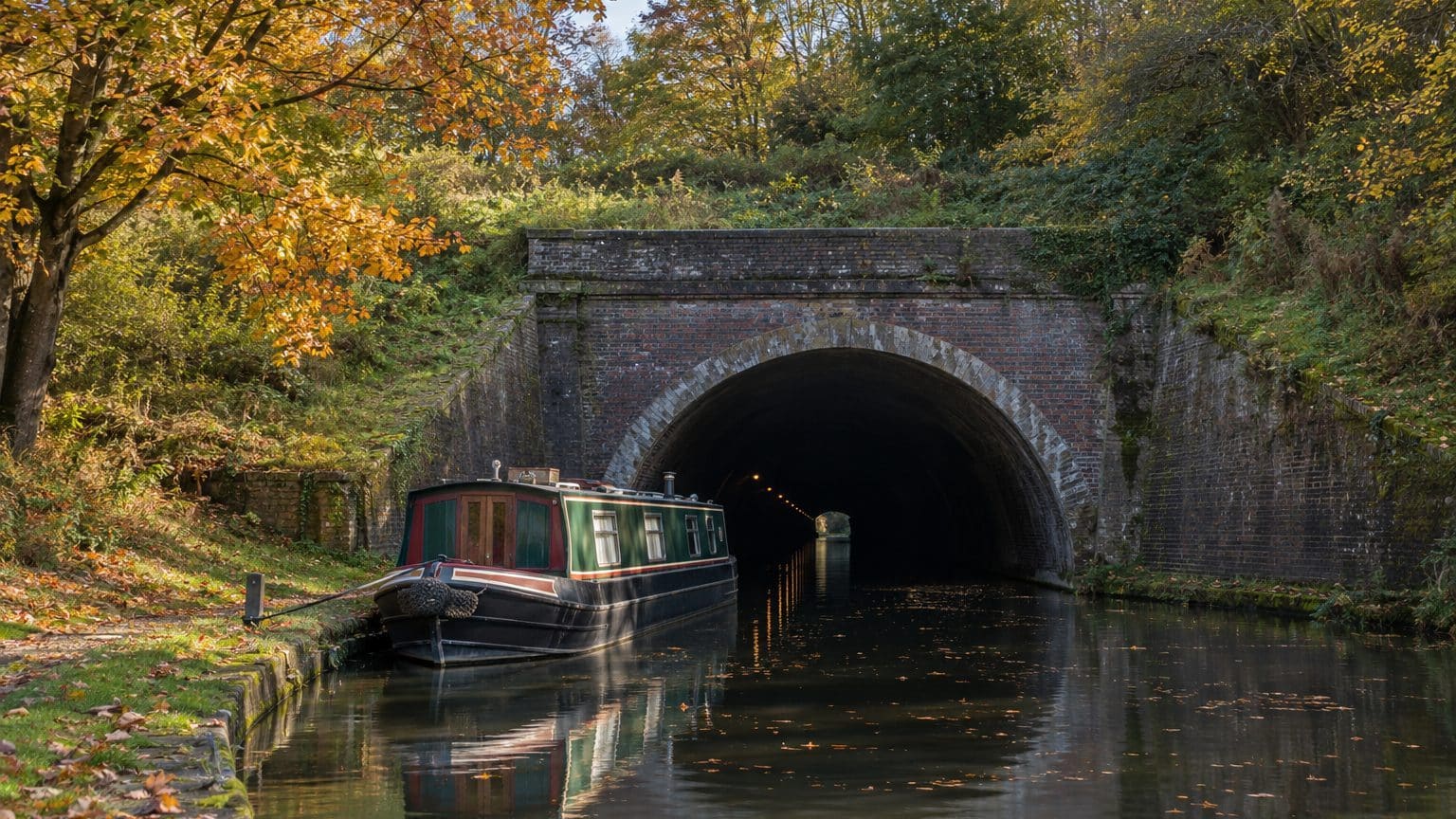
A chain laid along the bottom of the water, a boat gripping it to haul itself along in the darkness of a 3,333-meter underground tunnel: this is how the Bourgogne Canal carried its barges beneath Pouilly-en-Auxois (Côte-d’Or) starting in 1893. The electric towboat designed by engineer François-Marie Galliot pulled the boats, and the power came from the waterfall of nearby locks. The service lasted until 1987, a total of 94 years.
Without a foothold, horses could not pull the boats.
- A chain laid along the bottom of the canal allowed boats to be hauled through the vault.
- Electric power was generated by two small plants fed by the waterfall of the locks.
- This electric towage operated from 1893 to 1987, a span of 94 years.
A Vault Dug From 32 Shafts
Built from 1775, the Bourgogne Canal links the Yonne to the Saône over about 242 km. Between them, it must cross the watershed line, where one passes from the Seine basin to that of the Rhône. This crossing takes place at Pouilly-en-Auxois, in an underground tunnel that everyone calls “the vault,” at the canal’s highest point, around 378 m above sea level.
With 3,333 meters, the vault is the equivalent of about thirty football fields laid end to end, all beneath rock and without daylight. The construction lasted from 1825 to 1832. To meet this deadline, the workers did not excavate the rock only from the two ends: they dug from 32 shafts. Starting from only the two ends would have required more than 50 years.
These shafts also serve to aerate the tunnel, which matters in a passage this long. A shaft lies roughly every 100 m, and each provided an additional access point for the miners.
Seven years of work instead of more than half a century: the savings exceed a factor of seven. The canal owes its continuity to these vertical holes, which spared decades of construction. The tunnel is today managed by Voies navigables de France.
Without a Foothold, Another Form of Traction to Invent
On a conventional canal, the horse walks along the towpath, at the water’s edge. In the vault, the tunnel has no towpath, that is, no strip of firm ground where the hooves can rest. It was therefore necessary to find something other than animal traction to move the boats through.
A steam towboat had preceded it.
A towboat does not advance by pushing water: it winds around a chain laid freely along the bottom of the channel, thanks to a winch mounted on board. Each turn of the drum makes it slide a little farther, and the barges hitched behind follow the motion. In a narrow tunnel, the chain serves as the towpath. Galliot’s electric towage reused this principle, with a chain laid along the bottom of the canal.
In 1891-1892, engineer François-Marie Galliot planned to replace the steam towboat with a lighter electric towboat. The electric towage began in 1893.
Two Small Factories at the Foot of the Locks
Electricity was produced on site, in two small plants built in 1893. Each was driven by the waterfall from lock 1 on its side of the slope: one on the Yonne side at Pouilly, the other on the Saône side at Escommes. The turbines housed there were connected to Gramme dynamos, named after their Belgian inventor, Zénobe Gramme. The current then reached the boat using the tramway principle.
The power that pulled the boats came from the water of the locks.
The towing covered about 5.5 km, of which roughly 3.3 km were underground, the rest in the open air. It began and ended outside the vault, on either side of the canal’s summit. Two small factories, no more, were sufficient to run the whole operation.
94 Years of Service, Then a Hall Designed by Shigeru Ban
The electric towage operated from 1893 to 1987. This service spanned both world wars, from the late 19th century to the end of the 1980s.
The towboat is today exhibited in Pouilly, in the Towboat Hall, inaugurated in August 2004. It is the first building in France by the Japanese architect Shigeru Ban. The machine is visible just a few steps from the port, along the canal it served for almost a century.
The visitor can also cross the vault, now lit, aboard a sightseeing boat, in about 30 minutes. As for the 5.5 km towing distance, it is rounded according to an archival document: the exact measurements may differ by a few tens of meters.
👉 A small gesture for Space Group? Follow us on Google, add us to your favorites, and find us on Google News so you won’t miss any discoveries.
Sources: dijonbeaunemag.fr | matriarka64.eklablog.com
