
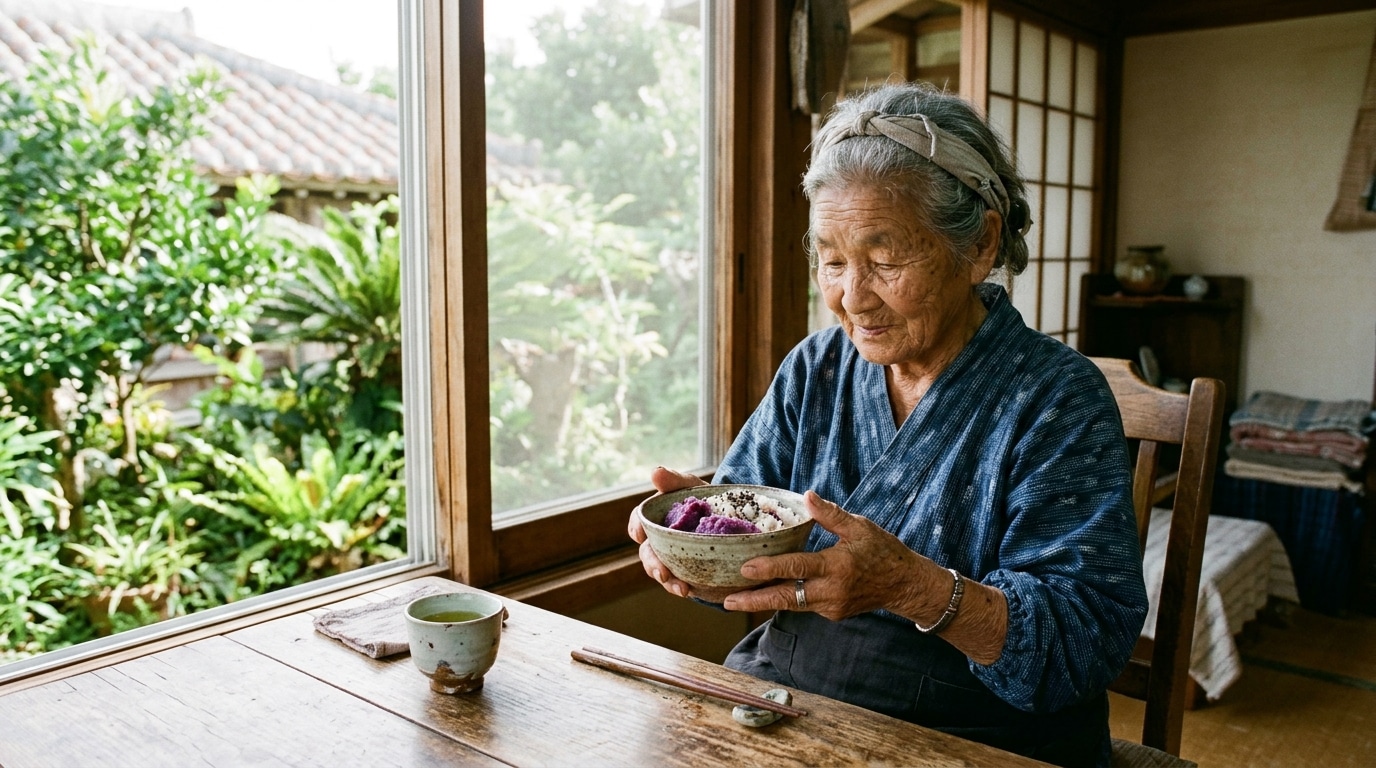
What if the secret to a long and active life lay simply in a bowl set on the table each morning, long before the sun has risen? On Okinawa, this act is no accident: it is handed down from childhood, unchanged, generation after generation. A ritual so deeply rooted in daily life that it becomes almost invisible, yet researchers around the world are looking at it very closely. For behind this apparent simplicity may lie part of the explanation for the extraordinary longevity of this region of Japan. The question remains: what exactly does this breakfast contain, and why does it fascinate so much?
- The traditional Okinawan breakfast centers on the purple sweet potato known as Beni-imo, rich in antioxidants, paired with Sanpin-cha green tea and sea vegetables such as wakame or kombu.
- As of September 2026, Japan counted 107,677 centenarians, a new record broken for the 56th consecutive year, but Okinawa’s “blue zone” status is nuanced by recent studies showing a decline in its ranking and potential civil registry errors.
- Apart from the food itself, this meal, eaten slowly and in a family setting, embodies a broader lifestyle that blends strong social ties with a calm pace, contributing to the longevity of its residents.
- A breakfast ritual handed down from childhood
- The purple sweet potato, the quiet star of the morning meal
- Green tea and seaweed, essential health allies
- Okinawa, between a world record and scientific controversy
A breakfast ritual handed down from childhood
In Okinawa, breakfast is not nibbled between doors while checking your phone. It is savored slowly, without hurry, like a suspended moment before the day truly begins. This meal is above all social: it is shared with family, elders are greeted, and it is almost never eaten alone. This collective dimension is not decorative; it structures daily life from childhood and instills habits that last a lifetime. It’s hard not to see a striking contrast with our rushed mornings, often swallowed standing in front of an open fridge. Here, the morning table resembles a small ceremony more than a mere dietary routine, and perhaps that is where everything begins.
The purple sweet potato, the quiet star of the morning meal
At the heart of this ritual sits a food one would hardly expect to wield such power: the local purple-fleshed sweet potato, called Beni-imo. This tuber with its violet flesh is far more than a simple side dish; it literally embodies the key to longevity among Okinawan centenarians. Rich in fiber, vitamins, and especially antioxidants, it stands as a formidable weapon against cellular aging. Its distinctive hue comes from anthocyanins, those antioxidant pigments also found in blueberries, red grapes, and red cabbage. The Beni-imo is usually eaten steamed or roasted, alone or with vegetables and grilled fish. Not spectacular in appearance, and yet this dietary consistency, repeated morning after morning for decades, could have unseen cumulative effects on cellular health.
Green tea and seaweed, essential health allies
It would be impossible to discuss this breakfast without mentioning green tea, specifically Sanpin-cha, the jasmine-scented tea that accompanies the meal. It provides polyphenols and antioxidants and fosters a sense of mental clarity without inducing jitteriness. Beside it, seaweeds complement the plate: wakame, kombu, or umi budo, that famous “grape seaweed” native to the region. These marine plants supply essential minerals, notably iodine, calcium, and magnesium. The power of seaweed is sometimes underestimated, yet they accumulate benefits with a quiet, almost disarming discretion.
Okinawa, between a world record and scientific controversy
The phenomenon of Japanese centenarians extends far beyond Okinawa. In September 2026, Japan’s Health Ministry announced that the country counted 107,677 people aged 100 or more, surpassing the 100,000 centenarian mark for the first time. This figure represents 7,914 additional centenarians in a single year and marks a record that has been broken for the 56th consecutive year. Women are far more numerous among them, with 94,298 centenarians identified versus 13,379 men. Shimane Prefecture even boasts the highest rate in the country, followed by Kochi and Tottori. By comparison, France counted roughly 37,000 centenarians according to INSEE, and life expectancy in Japan reached 84 years in 2024 according to the World Bank, a gap that can be dizzying. Japan’s Health Minister Kenichiro Ueno welcomed seeing so many people remain active and healthy for so long. Scientific interest in Okinawa is not new: in 1976, Japanese cardiologist Makoto Suzuki launched the Okinawa Centenarian Study, funded by the Japanese Health Ministry, to try to unravel this mystery. Yet the island’s mythic status as a “blue zone” deserves nuance. A 2024 study by demographer Michel Poulain notes that the prefecture moved from 4th to 26th in Japan for men’s life expectancy as of 2002. Even more troubling, demographer Saul Newman of Oxford University received an Ig Nobel in 2024 for work showing that some centenarian records may be inflated due to civil registration errors and pension fraud. All of this invites caution, without necessarily undermining the real benefits of a rich diet and a calm lifestyle.
What remains most evident: Okinawan centenarians probably do not owe their longevity to this single breakfast. This morning ritual is part of a broader lifestyle where balanced nutrition, strong social ties, and a gentle pace of life play an equally decisive role. It is precisely this harmony between what is on the plate and how it is eaten—slowly and in a family setting—that seems to constitute the true key to their exceptional longevity.
So, should you rush to hunt down Beni-imo at the nearest market? Not necessarily, but adopting this morning philosophy—taking time to share a meal with family and focusing on antioxidant-rich foods—remains an accessible path for everyone, well beyond Okinawa’s borders.
👉 A small gesture for Space Group? Follow us on Google, add us to your bookmarks, and find us on Google News so you won’t miss any discoveries.
