
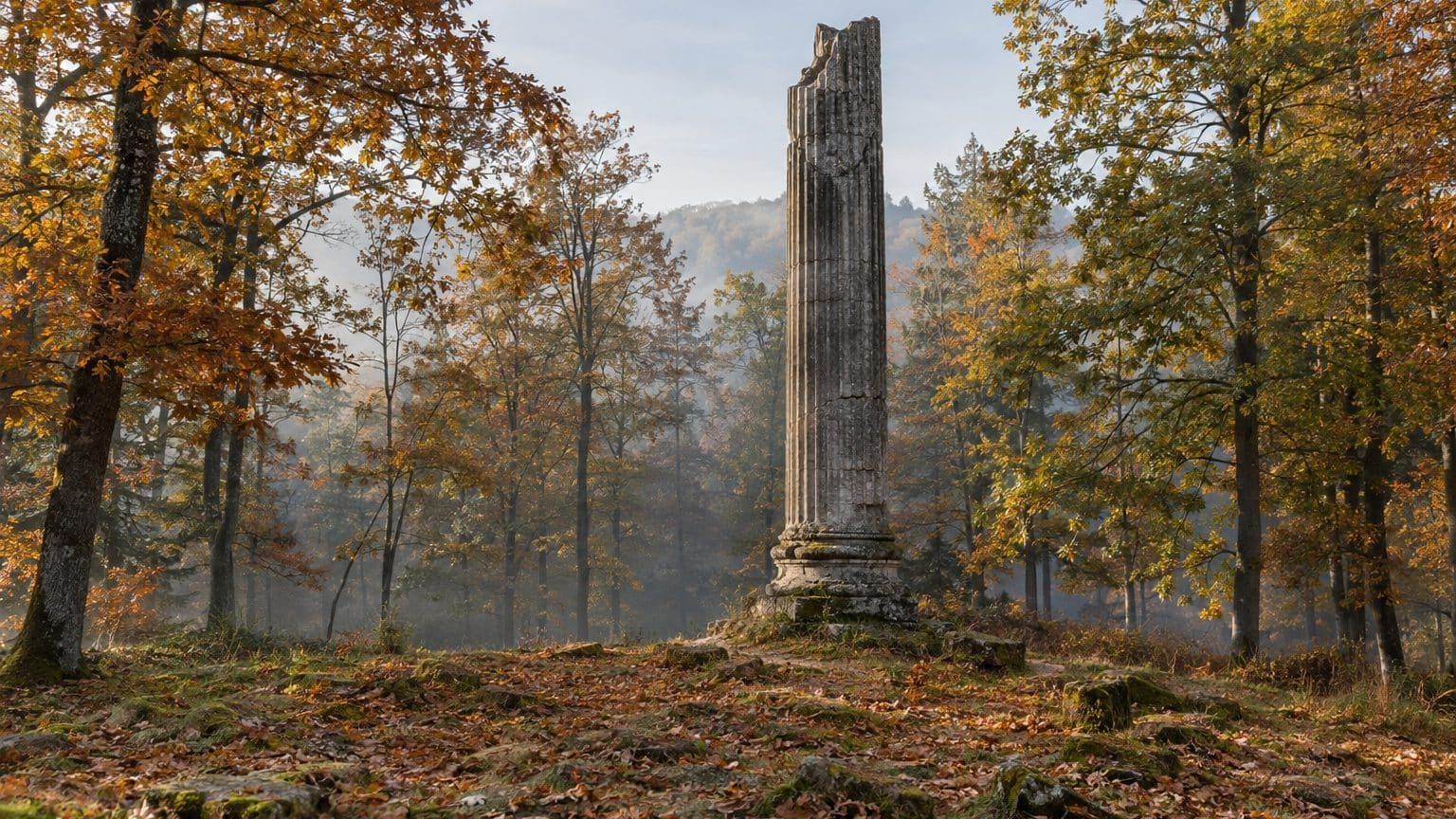
In Chambourcy, on the edge of the Marly Forest, a fluted column towering about 25 meters high appears to have been severed by a giant axe. This is not a ruin, but a house, built around 1781 for François Nicolas Henri Racine de Monville, who settled there in 1782.
The Desert of Retz, however, bears little relation to any desert.
- A Tuscan column of about 25 m looms over the Retz Desert at Chambourcy
- Monville built it in a truncated form and installed his residence there by 1782
- The estate fell into disrepair after the Revolution, then underwent restoration
A 38-hectare estate teeming with faux architectures
In the 17th century, the term referred to a secluded place suited to retreat and daydreaming, and Monville adopted it in that sense. On September 12, 1774, he purchased a country house on the edge of the Marly forest. He was in his forties (born in 1734, died in 1797), possessed by a passion for architecture, botany, and music, and had land to transform.
The country house was merely the starting point. Monville gradually expanded the estate to roughly 38 hectares, i.e., more than fifty football pitches. He scattered among them between 17 and 20 “follies”—ornamental constructs that define the signature of Anglo-Chinese gardens. About a dozen survive today, roughly half of the original ensemble.
The Anglo-Chinese garden turned its back on the symmetry of the French garden. The paths meander, viewpoints unfold one by one, and each folly emerges like a surprise: pavilions, fake ruins, and quotes of architectures borrowed from far away. The visitor does not merely traverse a park; they leaf through a travel album on a grand scale.
A column born truncated
Among all these follies, the destroyed column is the showpiece. It is a Tuscan column, the most austere of classical architecture, which Colette described as “born truncated and with the crown bevelled.” The choice of the Tuscan order, bare and unadorned, suits a fake ruin: nothing distracts the eye from the fracture.
It was never actually broken: it was built that way.
Across the pages, the figures place the height at about 25 meters and the diameter at about 15 meters. They should be read as rough orders of magnitude, since no single original document with precise measurements was consulted for this article. By comparison, 25 meters corresponds to the height of a modern eight-story building, with a base broader than most suburban pavilions.
The topmost floor is deliberately crenellated in an irregular fashion, as if the stone had chipped away over the centuries. Seen from the ground, the detail is minuscule, yet it sets up the illusion of collapse.
One can see here a caprice of an aristocrat, and that would be reductive. To live in a crafted ruin is to display one’s taste for the passage of time while enjoying contemporary comforts. In the 18th century, the fashion for fake ruins swept across Europe’s garden worlds, and Monville pushed it to the point of inhabiting one.
Living inside the column’s shaft
Inside, several stories of living space coil around a central spiral staircase. The exact number of levels and rooms varies depending on the account, hence the caution about precision. Light enters through windows pierced into the fluting, preserving the exterior appearance of a solid column. Some accounts even speak of mirrors that reflected the park’s greenery into the interior rooms.
Some guides read in it a reference to the Tower of Babel and to the lightning that punishes human pride. This interpretation remains one among many possible readings.
Local tradition credits Monville with visits by notable figures, among them Gustave III of Sweden and Thomas Jefferson. These visits are not independently verified for this article and should be treated with caution. What remains established is the fact that a proprietor confident in his taste used his residence as a manifesto.
Sequestration, abandonment, and genuine ruin
Monville later sold the estate to the Englishman Lewis Disney Ffytche. The year most often cited is 1792, a date that should be checked against sources. Local history reports refer to the buyer as an “Englishman of émigré background,” implying that he was the person considered as emigrant. His assets were placed under sequestration during the Revolution.
The estate fell into ruin.
In 1950, Colette visited it and found it in a state of ruin; this visit forms part of the text later included in Pour un herbier. More than 170 years after purchasing the country house, a park once designed to imitate ruin had itself become ruined. Monville, for his part, had died more than 150 years earlier.
Before you go, check the Chambourcy commune for visiting conditions. Also keep a critical eye on the numbers: height, diameter, number of floors and rooms circulate widely, but several figures do not rest on a primary document consulted for this article, and nothing beats an on-site visit to form your own impression.
👉 A small gesture for Space Group? Follow us on Google, add us to your favorites, and find us on Google News so you won’t miss any discoveries.
Sources: cdi-garches.com | culturezvous.com
