
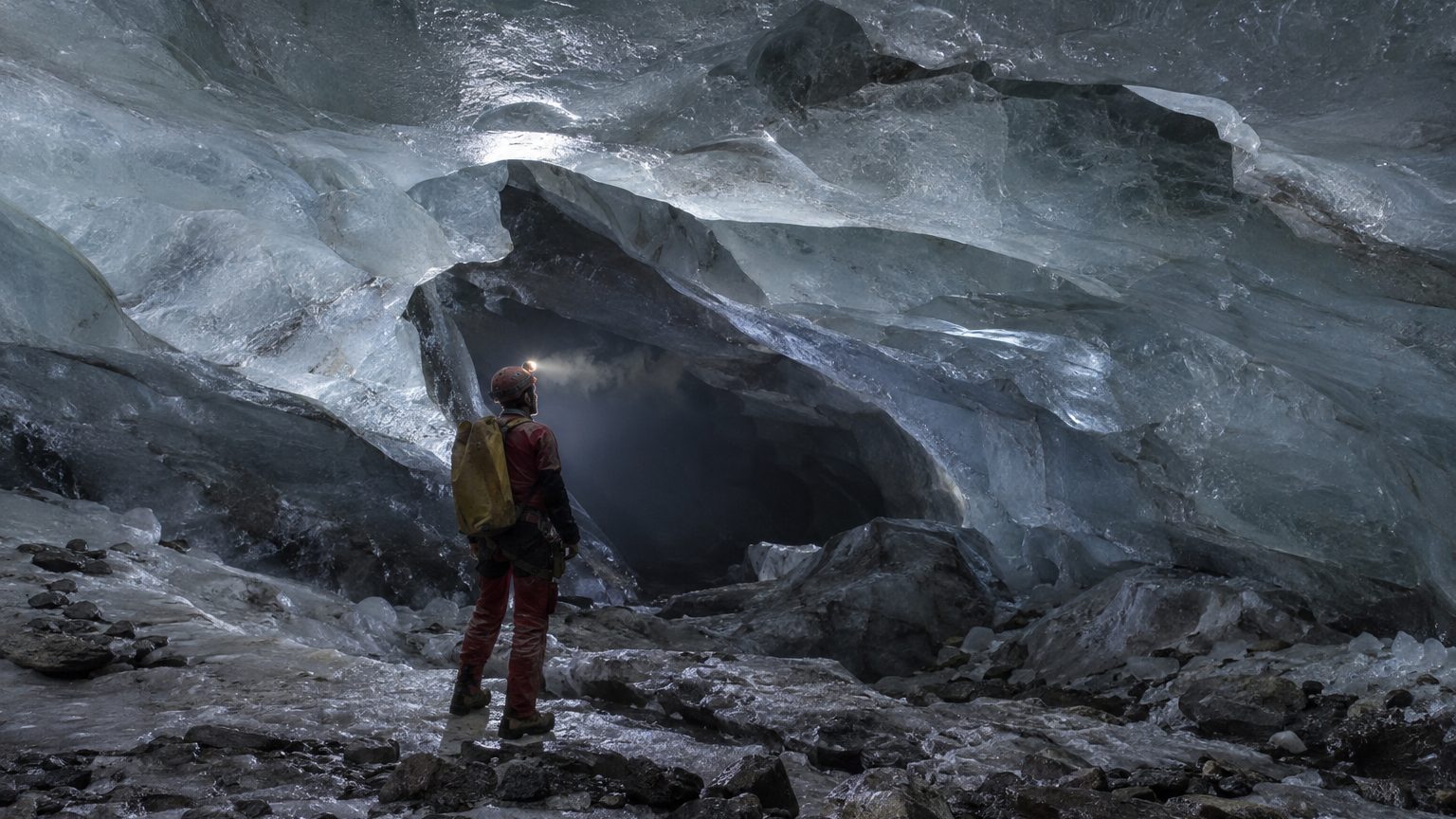
On September 14, 1962, the team remaining on the surface told Michel Siffre that the experiment was over. The 23-year-old cave explorer believed it to be August 20. He was missing 25 days, lost in the dark, without a watch, on an underground glacier.
Nobody had fed him false information.
A spelologist and geologist, he had descended alone on July 16, 1962 into the Scarasson abyss. His idea could be summed up in a single sentence: study his own wake-sleep rhythm in the absence of any temporal reference. He carried neither a watch nor a clock, and nothing informed him of the hour, the day, or the night. The experiment proper began the day after the descent, and it laid the groundwork for what would later be called the “out-of-time” experiments.
- Michel Siffre descended alone into the Scarasson cave on July 16, 1962.
- His wake-sleep cycle lasted about 24 hours and 30 minutes without any time cues.
- He resurfaced on September 17, after believing that it was August 20.
An underground glacier on the Italian side
The Scarasson abyss sits in the Marguareis massif, near the Franco-Italian border, but firmly on the Italian side: in the municipality of Briga Alta, in Piedmont. It overlooks La Brigue and Tende, two French neighboring villages, which explains why it is often thought to be in France. The confusion is common, though geography leaves no doubt.
Its depth varies depending on the account. In his book, Siffre cites about 130 meters, while other documents suggest around 100 meters. The underground glacier where he settled extends from approximately 100 to 130 meters below the surface, which roughly reconciles the two versions.
Conditions, however, leave no room for debate. The temperature stays below freezing, humidity reaches about 98%, and daylight never penetrates that deep. Rockfalls regularly endangered the young man, according to the account he published in 1963. His only companion would be a spider.
Why this glacier? A year earlier, Siffre had been seeking ice in the range when he discovered this buried mass in Scarasson. The Space Race, at the time pitting the United States against the USSR, fed his reflection on isolation: living underground without references was akin to training for living far from Earth.
A one-way radio
Siffre was not cut off from everything, but communication only worked in one direction. He called up to the surface by radio to signal the major moments of his life: waking, meals, and bedtime. His correspondents recorded these messages without ever giving him any information in return. A final date had been set in advance, and he did not know it.
No means to measure durations, outside or inside.
This setup yielded a result Siffre had not necessarily anticipated. His wake-sleep cycle lasted about 24 hours 30 minutes, a half-hour longer than a solar day. Left to his own devices, the human body does not stop: it runs on an internal clock that is slightly offset from the sun. It is this finding that earned him recognition as the first to demonstrate the existence of the human biological clock.
Yet there remains the mystery of the 25 days. A 24h30 cycle does not fully explain it, and that is where time perception comes into play. Accounts from the experiment report, for instance, that a task meant to last 2 minutes took more than 5. Time lived stretched, days seemed shorter than they were, and weeks passed without him counting them.
For him, summer lingered into August while September was already well underway.
A return carried on a man’s back
The announcement of the end came on September 14, but the ascent did not occur until the 17th. A three-day discrepancy, which explains why some accounts cite one date as the end and others another. Siffre emerged from the cave exhausted, utterly spent. Large opaque goggles were placed over his eyes to prevent being blinded by the daylight now that he returned to surface life.
He was then carried on a man’s back to the base camp. A helicopter evacuated him to Nice. For a 23-year-old who had just spent roughly two months underground, the return to normal life began with a medically assisted evacuation.
Long-duration “out-of-time” experiments were born from this experience.
The sequence that followed confirmed the scientific value of the test. Siffre went on to publish a book in 1963, Out of Time, which recounts the descent into Scarasson from the inside. He later repeated the experiment at the invitation of NASA. Others followed in his footsteps, up to the Deep Time project led by Christian Clot, which deliberately imprisoned a group underground, far from any clock.
Michel Siffre died on August 24, 2024, at the age of 85. As for the exact duration of his first descent, accounts give 60, 61, or 63 days depending on whether you count from the descent or from the official start of the trial, and whether you stop at the announcement or at the ascent. Hence the prudent phrasing you’ll see everywhere: about two months.
👉 A small gesture for Space Group? Follow us on Google, add us to your bookmarks, and find us on Google News so you never miss a discovery.
Sources: gallica.bnf.fr | mediatheques.strasbourg.eu
