
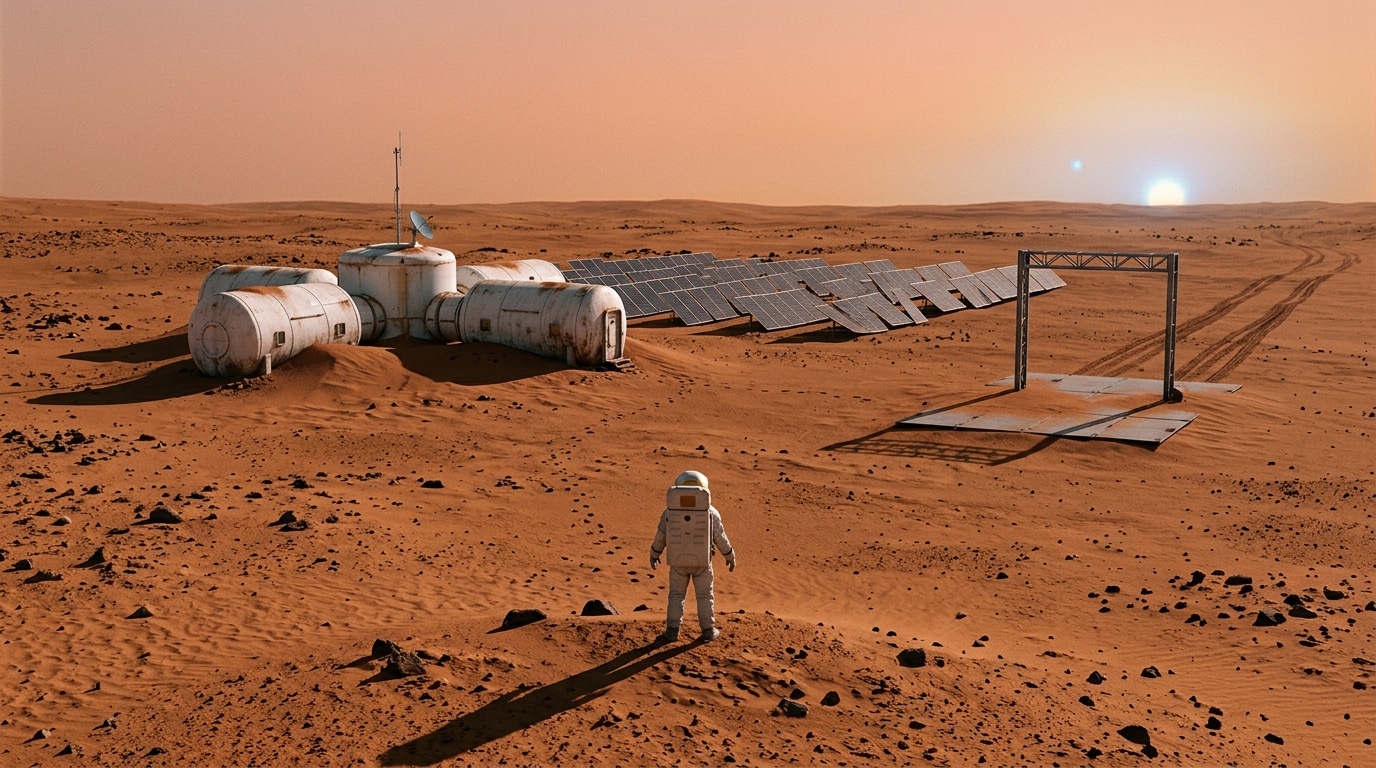
A space project can fail in two very different ways: a technical failure, a rocket exploding, or a lander crashing, or a financial collapse, quiet and without spectacle. Mars One, which promised settlers on Mars as early as 2027, experienced the latter option. In January 2019, it was a Swiss court that signed the project’s death sentence.
- Mars One received more than 200,000 applications in 2013, narrowed down to 1,058 finalists, for a one-way mission to Mars that was never realized.
- The project, valued at six billion dollars by Bas Lansdorp, never had a solid funding plan despite a Frankfurt Stock Exchange listing in 2016.
- On January 15, 2019, a Basel-Stadt civil court ordered the liquidation of Mars One Ventures AG, publicly revealed through court documents spotted on Reddit before any official confirmation.
- A Martian dream sold before being built
- Money, the real saboteur of the mission
- The quiet collapse of a media empire
A Martian dream sold before being built
Everything begins with a simple promise to grasp, yet dizzying to achieve: to send volunteers to settle permanently on the red planet, with no return ticket. The concept captivated far beyond the usual circles that follow space news. In 2013, the project drew 202,586 applications in just five months, from about 140 countries. That figure alone speaks to the scale of the collective fantasy surrounding Mars.
These applications were then narrowed to 1,058 finalists, intended to form the pool of future settlers. On paper, everything seemed to advance methodically. Mars One even awarded real study contracts to recognized players in the space sector: Surrey Satellite Technology Ltd to design a communications relay orbiter, and Lockheed Martin for a lander derived from the Phoenix probe, already successfully tested by NASA on Mars.
The founder Bas Lansdorp valued the entire operation at six billion dollars. A sum he himself described as a good deal, comparing it to the budget of a major event like the Summer Olympics. The argument is seductive, almost reassuring. Yet it hides a crucial question: where would this money really come from, and at what pace would it be raised?
Money, the real saboteur of the mission
For that is where the project stalls, long before any engineering questions about Mars are considered. In 2016, the Mars One Ventures PLC structure was taken over by the Swiss company InFin Innovative Finance AG, via a financial maneuver known as a reverse merger. The appeal for Mars One was immediate: this move granted it access to the Frankfurt Stock Exchange, a channel designed to raise fresh capital from investors.
In practice, this stock-market access did not suffice to bridge the gap between the declared ambitions and the actual resources available. The six-billion-dollar figure announced by Lansdorp remained a theoretical estimate, lacking a solid funding plan to secure the funds in the long term. A project so ambitious cannot rely on a single fundraising publicity stunt.
The outcome came on January 15, 2019: a civil court in Basel-Stadt ordered the liquidation of Mars One Ventures AG, the for-profit commercial arm of the project. The registration was officially entered in the cantonal commercial registry the following day. Mars One, a private Mars-colonization project, thus went bankrupt without ever launching a single mission to the Red Planet.
The quiet collapse of a media empire
There is something quite revealing about the way this bankruptcy was revealed to the public. It wasn’t a prepared press release or a pre-announced press conference. It began with court documents spotted by a Reddit user, who alerted the community even before the company officially confirmed the information, on February 11, 2019.
The court document itself remained extremely laconic, giving very few details about the precise reasons for the collapse. Bas Lansdorp confirmed the bankruptcy without providing further specifics about its actual scope. In an email dated the same day, he stated he was working with the bankruptcy administrator and an investor to find a solution, a phrasing that remained deliberately vague.
Lansdorp noted that only the for-profit company was affected, and that the non-profit foundation, meant to carry the scientific mission, continued to exist on paper. Its funding, however, became immediately uncertain. A few months earlier, during a debate held with MIT, he had already acknowledged that the twelve-year timeline aiming for a human landing in 2027 was largely fiction. A remark that, in hindsight, reads as a confession.
Mars One will probably be remembered as a striking example of a mismatch between the power of a narrative and the solidity of a business model. The project managed to mobilize hundreds of thousands of applicants, persuade space-industry players to sign study contracts, and occupy the media space for years. But no rocket needed to explode to end it: a Swiss civil court, a commercial register, and an evasive email were enough.
👉 A small gesture for Space Group? Follow us on Google, add us to your bookmarks, and find us on Google News so you don’t miss any discoveries.
