
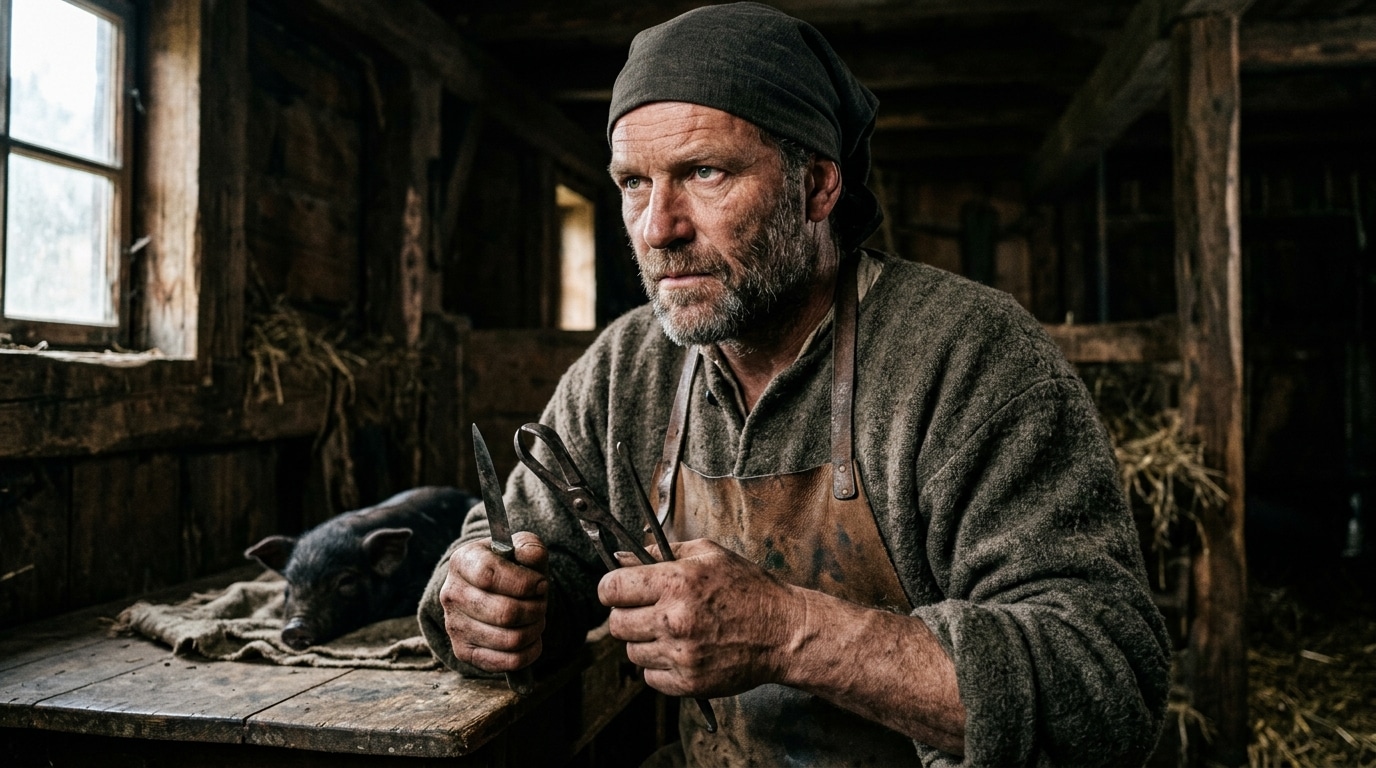
A man who castrates pigs to earn a living. He had received no medical training, and possessed no proper instruments. Yet legend has it that he alone performed a cesarean on his own wife, and that she survived. A story as fascinating as it is unverifiable.
- Jacob Nufer, a pig castrator with no medical training, is said to have performed a cesarean on his own wife around 1500.
- The only text recounting the episode dates to 1582, about eighty years after the events, with no contemporary proof.
- Today, cesarean sections account for about 21% of births worldwide, compared with 20% in France since 2007.
- A pig farmer turned surgeon, against his will
- An operation recounted eight decades after the facts
- Between popular legend and historical truth, a complete mystery
The history of medicine is full of tales where audacity often outpaces the scientific knowledge of the era. Jacob Nufer’s tale is one of them. The name has for centuries been linked to a surgical feat that even the most experienced Renaissance physicians might not have dared to attempt. Here is a look back at a story that deftly blends troubling facts and gaps in evidence.
A pig farmer turned surgeon, against his will
Credit: © DR
Jacob Nufer practiced a profession far removed from medicine. A pig castrator in Switzerland, he spent his days among animals, far from lecture halls and scholarly treatises. Nothing in his background suggested he would enter the annals of medical history.
According to the account that has circulated for generations, his wife would have been in labor for several days without delivering. Several midwives would have attempted to intervene, without success. The situation became critical, for both mother and child.
Facing the urgency, Nufer is said to have taken a radical decision. He reportedly performed the incision himself to extract the child, drawing on the experience he gained from operating on the animals he tended to daily. A rare daring, fueled by desperation as well as a form of pragmatic instinct.
An operation recounted eight decades after the facts
Here is the point that deserves our full attention. The episode would have taken place around 1500, but the first text that mentions it dates only from 1582. Nearly eighty years separate the alleged events from their written account.
That substantial delay raises questions. How could such a precise detail have traveled through several generations without distortion? Oral transmission at the time left ample room for amplification and embellishment of the facts.
The narrative published in 1582 also contains details that seem almost too perfect to be accurate. The child survived, the mother did as well, and she would even go on to give birth to several other children later, including twins. A sequence of successes that invites scrutiny, given the immense risks of infection and hemorrhage at the time.
Between popular legend and historical truth, a complete mystery
No contemporary document has ever been found to confirm this operation. Neither a parish registry, nor direct testimony, nor an administrative trace. Only this late text has sustained the legend for more than four centuries.
Historians remain cautious. Some view it as a story embellished over time, others as an authentic but largely romanticized incident. It is impossible to decide with certainty, lacking tangible evidence dating from the actual time of the events.
This ambiguity does not stop the anecdote from continuing to circulate, especially because it highlights a striking contrast. In a period when abdominal surgery almost systematically killed patients, the idea that a mere pig farmer could succeed where doctors failed holds undeniable narrative power.
To gauge the distance traveled since that era, one need only look at current figures. According to the World Health Organization, cesarean sections today account for more than one in five births worldwide, about 21%. This share keeps climbing, to the point that projections published in BMJ Global Health forecast a rate of 28.5% by 2030, i.e., nearly 38 million interventions each year. In France, according to DREES, this rate stabilized around 20% between 2007 and 2020, after rising from 11% in 1981 to 20% in 2007. A striking contrast with Nufer’s time, when such an operation was almost miraculous.
Beyond the question of its authenticity, the story of Jacob Nufer reminds us how thin the line between courage and despair could be in an era when medicine had so few tools. True or embellished, this anecdote continues to fascinate, and it reflects in its own way the enormous journey obstetric surgery has taken since the Renaissance.
👉 A small gesture for Space Group? Follow us on Google, add us to your favorites, and find us on Google News so you don’t miss any discoveries.
