
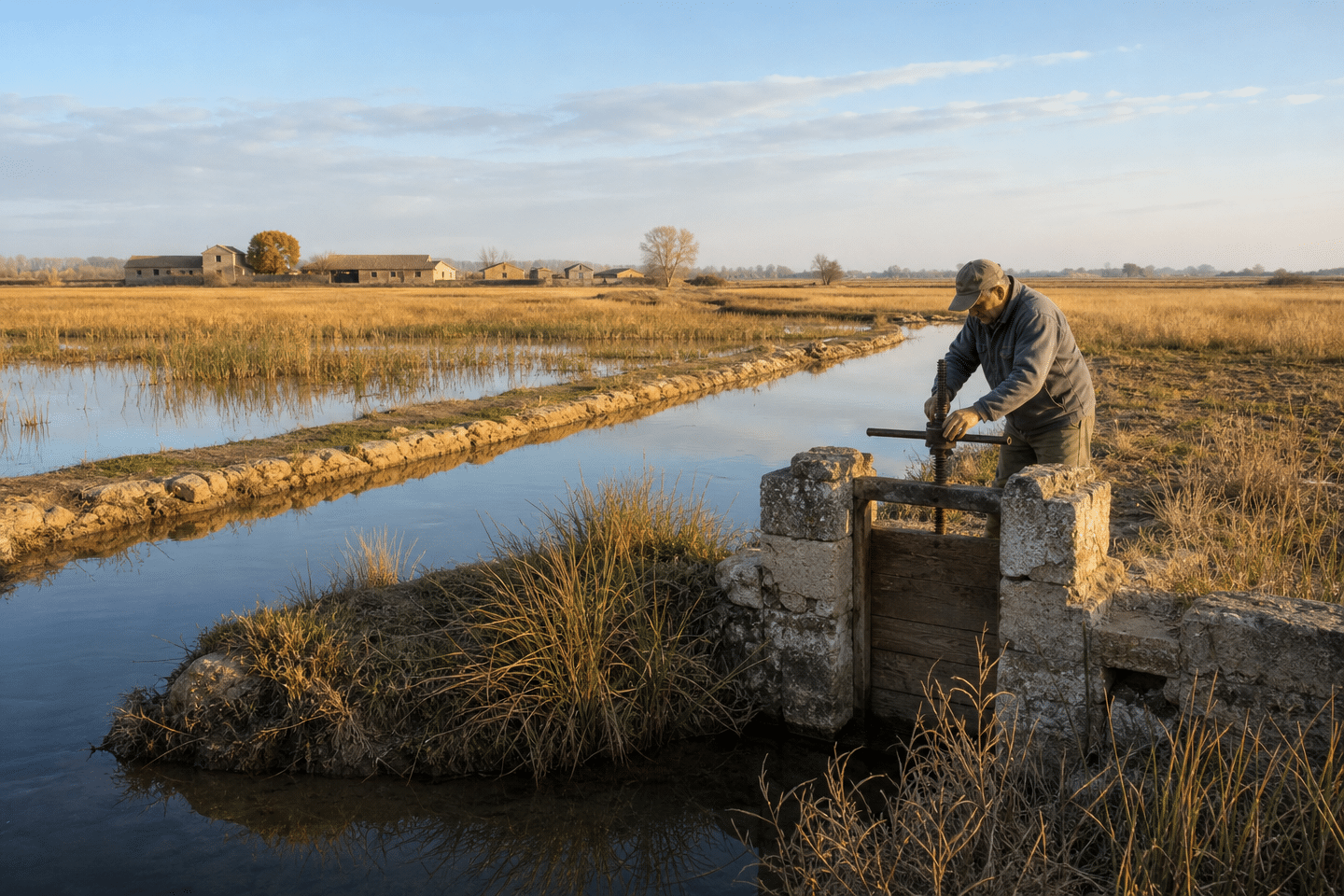
Gravitational irrigation involves letting water flow across a flat or gently sloped field so that it slowly seeps into the soil. In Crau, this centuries-old technique floods entire meadows every summer. The surprising result: it recharges an aquifer that supplies drinking water to hundreds of thousands of people in Provence.
- Gravitational irrigation of Crau’s hay meadows accounts for between 66% and 70% of the annual recharge of the Crau pebble aquifer, rainfall covering the rest
- This aquifer, estimated at 550 million cubic meters, operates in the opposite way to typical Mediterranean aquifers, with high water levels in summer and a decline in winter
- In irrigated zones, the water table can vary by more than 10 meters, compared with roughly 50 centimeters in non-irrigated areas, illustrating how drinking-water supply depends on this agricultural practice
- A canal dug in 1559 that still irrigates an entire territory
- Crau hay, a crop that hides an unsuspected hydraulic function
- 270,000 residents dependent on a aquifer recharged by flooded meadows
A Canal Dug in 1559 That Still Irrigates an Entire Territory
It all begins with the Craponne Canal, a structure excavated in 1559 to divert waters from the Durance toward the arid Crau plain in the Bouches-du-Rhône. At the time, the goal was straightforward: transform a gravel desert into arable land. Nearly five centuries later, the principle remains effective, with hardly any modification.
Today, a network of roughly 400 kilometers of channels crisscrosses the plain. The water from the Durance continues to move through this system according to the same gravity-driven logic inherited from the 16th century. This hydraulic mesh is far from a folkloric remnant: it still structures the agricultural economy and, as we will see, the region’s drinking-water supply.
What stands out is the system’s longevity. Few human infrastructures endure centuries without losing their usefulness. Here, the Craponne Canal has remained pertinent because it still meets the same need: irrigating soils that are naturally low in moisture in a region with dry, hot summers.
Crau Hay, a Crop That Conceals an Unsuspected Hydraulic Function
Crau hay, recognized by a protected designation of origin, is the emblematic product of this plain. Every spring and summer, from late March through late September, farmers deliberately flood their meadows. This act, which might seem counterproductive for a fodder crop, is actually at the heart of the system.
By letting the Durance water cover the plots, the farmers do more than irrigate their hay. They inject, unknowingly at first, a substantial amount of water into Crau’s gravelly soil. This water percolates slowly through the pebbles and eventually reaches the groundwater, located several meters below the surface.
Symcrau, the mixed administrative body that manages this aquifer, has quantified the phenomenon. Gravity irrigation of the meadows would account for between 66% and 70% of the aquifer’s annual recharge, with rainfall covering the remainder. Put differently, two-thirds of the water stored beneath the plain comes from an agricultural act, not from the sky.
This reversal has a striking effect on the natural rhythm of groundwater. While most Mediterranean aquifers fill in winter and drain in summer, Crau’s aquifer behaves in the opposite fashion. High water tables occur during the irrigation season, and the level declines in winter when irrigation ceases.
270,000 Residents Dependent on an Aquifer Recharged by Flooded Meadows
The Crau pebble aquifer is not a mere anecdotal reservoir. Its volume is estimated at 550 million cubic meters by Symcrau, a figure that conveys the scale of this underground water stock hidden beneath the plain’s pebbles.
This reserve provides drinking water to around 270,000 inhabitants according to aquifer contract documents, a figure the AFP also referenced as about 300,000 people in 2023. In either case, we are talking about a substantial population, well beyond the agricultural villages of the plain.
The extent of groundwater level fluctuations clearly shows the influence of irrigation. In non-irrigated areas, the level moves by about 50 centimeters over the year. In irrigated zones, this variation can exceed 10 meters. The difference illustrates how much the flooded meadows effectively steer the underground tap.
This reliance helps explain why Symcrau remains cautious about agricultural shifts. Cutting back on meadow irrigation, whether for economic reasons or water-management needs, could jeopardize the balance of the entire plain, according to statements from the union reported by AFP. Symcrau, a public body created in 2006, has overseen the Crau aquifer contract since 2016 in an effort to reconcile farming with drinking-water supply.
This situation reveals a rarely visible interdependence elsewhere: residents who drink potable water whose availability directly depends on a Renaissance-era farming practice. Crau hay is therefore not only a protected regional product; it is also, unbeknownst to most tap-users, a crucial lever of their water supply.
👉 A small gesture for Space Group? Follow us on Google, add us to your favorites, and find us on Google News so you don’t miss any discoveries.
