
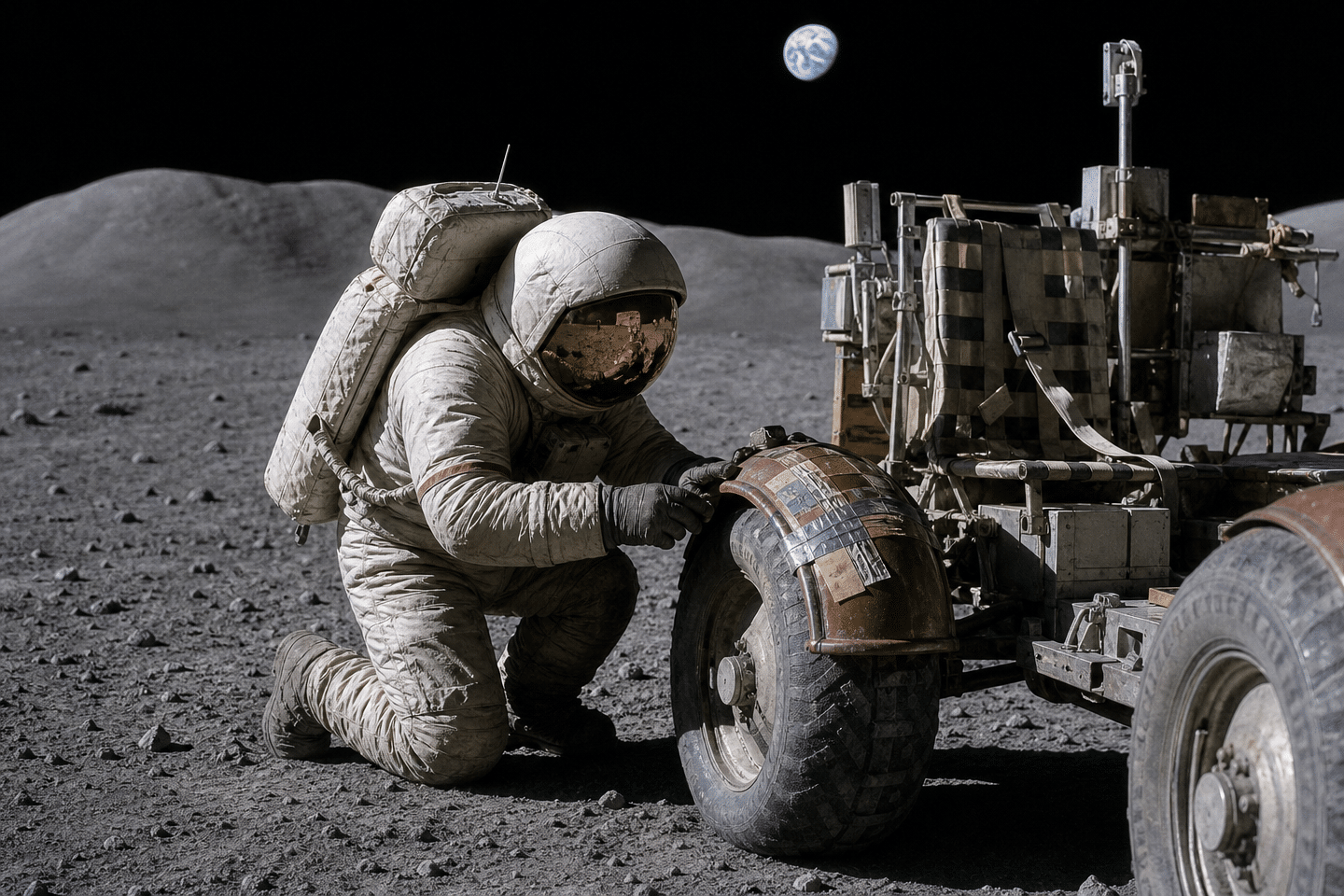
A hammer protruding, an unfortunate snag, and suddenly a lunar rover fender is reduced to shards. In December 1972, at Taurus-Littrow, Gene Cernan probably never imagined that such a seemingly trivial action would turn his mission into a makeshift space repair job, under Houston’s watchful eye.
- During Apollo 17, a hammer protruding from Gene Cernan’s suit pocket snagged and ripped the rear-right fender of the lunar rover, causing abrasive dust sprays.
- The ground team, led by John Young, devised a makeshift repair using laminated maps, tape, and telescope clamps, relayed to the crew before the second EVA.
- The repair held for 35.9 kilometers of driving, and the object has been preserved at the National Air and Space Museum since 1975.
- A ripped fender, and the mission risks ending up covered in dust
- Tape, laminated maps, and lamp clamps: the unlikely repair conceived during the lunar night
- From a makeshift fix to a museum piece: the unexpected fate of Apollo 17’s improvised fender extension
A ripped fender, and the mission risks ending up covered in dust
Everything begins during Apollo 17’s first EVA. Gene Cernan moves near the lunar rover, this small electric vehicle designed to cover long distances on terrain completely unfamiliar to Earth wheels. In the pocket fixed to his suit leg, a hammer protrudes slightly. A detail that seems insignificant until it catches the extension of the rear-right fender and tears it away.
Cernan attempts a makeshift repair on the spot, using gray tape. The fix holds for a moment, then finally gives way around mission elapsed time 122 hours 47 minutes, as the crew returns to the lunar module after exploring Station 1. Without this extension, the rear wheel would kick up a plume of fine dust directly onto the rover and the two astronauts.
This lunar dust is no trivial matter. Abrasive and electrostatic, it infiltrates everywhere, clings to suits, fouls instruments, and can even damage cabin seals. A fender that no longer serves its function is therefore a problem that goes well beyond mere cosmetic inconvenience: it is a real threat to the success of the upcoming EVAs.
Tape, laminated maps, and lamp clamps: the unlikely repair conceived during the lunar night
Cernan and Schmitt do not have the time or means to retrieve the piece that fell to the ground. The crew returns to rest, leaving the problem in the hands of the ground team in Houston. It is during this pause that one of the most ingenious solutions of the entire Apollo program is born.
According to several French-language sources, it was the ground support team, with John Young, the mission’s backup commander, who devised the repair. A ground-based night-time fix by John Young, the laminated-map “fender” protects Cernan and Schmitt from dust until departure; brought back to Earth, it is today kept at the Smithsonian. The method rests on a simple principle: fold laminated maps to recreate the shape of a fender, then hold them together with tape.
For attachment to the rover, two hose clamps typically used for a telescope serve as improvised clamps. All of this is transmitted to the crew before the start of the second EVA, which began on December 12, 1972 at 18:28:06.
Four laminated maps are eventually assembled according to the instructions received. In NASA photographs, the result is clearly visible: a cross of gray tape holding the maps together, all fixed to the rear-right of the rover by the two improvised clamps. An improbable makeshift fix, but devilishly effective.
From a makeshift fix to a museum piece: the unlikely fate of Apollo 17’s improvised fender extension
The real-world test soon follows. After 9.1 kilometers of driving, the repair remains in place. The photograph AS17-137-20979 captures the moment, just before the crew leaves Station 2, proof that the improvised fender extension perfectly fulfilled its mission: protecting the astronauts and the vehicle from lunar dust.
Thanks to this solution, the rover can continue its exploration without hindrance. In total, the vehicle travels 35.9 kilometers, accumulating 4 hours and 26 minutes of driving across the three Apollo 17 EVAs, for a total outside time of 22 hours and 4 minutes spent outside the lunar module.
That scrap of laminated cardboard and tape did not end its journey on the Moon. Brought back to Earth, the object was transferred in 1975 to the National Air and Space Museum by NASA’s Johnson Space Center, under inventory number A19760010000. The museum catalogs it as “Maps, Fender Extension, Lunar Roving Vehicle, Apollo 17,” naming Eugene Cernan as the official maker of the piece.
Ironically, this hurried repair, born from an accident and improvised on the fly, is today displayed as a standalone piece of American space heritage, alongside far more sophisticated objects from the same program.
This episode pretty well sums up the spirit of the Apollo program: advanced engineering capable of sending men to the Moon, but also the ability to solve a concrete problem with improvised means, a few maps, some tape, and lamp clamps. Sometimes the most memorable solutions aren’t the most sophisticated.
👉 A small gesture for Space Group? Follow us on Google, add us to your favorites, and find us on Google News so you don’t miss any discoveries.
