
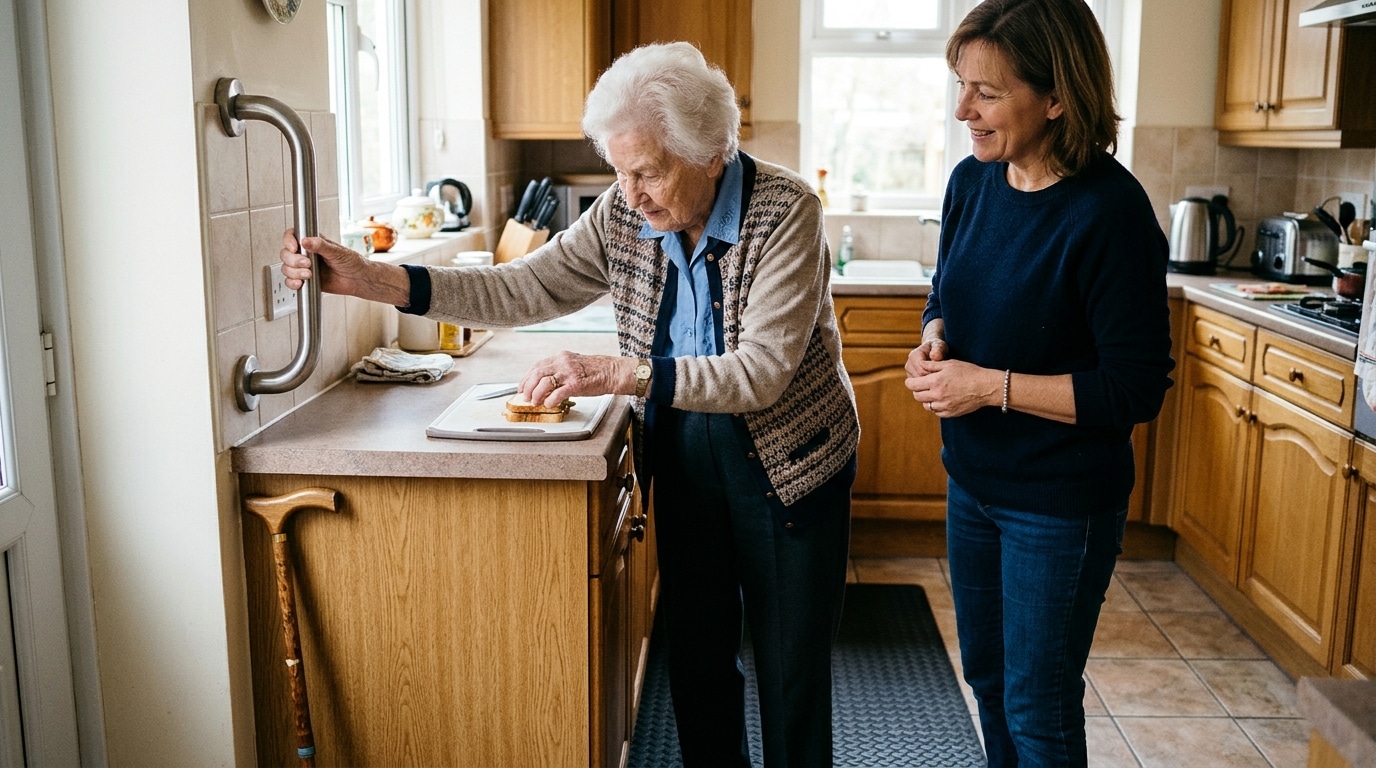
Trying to do everything for a loved one after a fall stems from a touching intention, but this protective reflex can produce the opposite effect of what is sought. Carrying the groceries, preparing every meal, accompanying every step to the living room: these gestures seem sensible when you have feared for someone you love. Yet, from the perspective of health professionals, this hyper-vigilance raises a real concern. The human body functions a bit like a muscle that stops being used: the less it is used, the weaker it becomes. Between the legitimate need to ensure safety and the risk of overdoing it, where is the right balance? Let’s go behind the scenes of recovery after a fall, to understand what truly helps and what, unintentionally, makes things harder.
- Trying to do everything for a loved one after a fall accelerates physical deconditioning and increases the risk of another fall.
- A thorough medical assessment helps identify the real causes of the fall (vision, blood pressure, medications, environment) to act effectively.
- Adapting the home and resuming a progressive, supervised physical activity promote lasting autonomy.
- Why excessive protection further weakens seniors after a fall
- Understanding the real causes of the fall to act effectively
- Relearning to move safely: adapted housing and progressive restoration of autonomy
Why Excessive Protection Further Weakens Seniors After a Fall
The protective instinct is natural, especially when a fall has frightened the whole family. But systematically substituting your help for daily tasks ends up, whether you intend it or not, depriving the person of their own motor cues. Getting up, walking to the kitchen, carrying a light bag: these seemingly small actions actually engage the muscles, joints, and sense of balance. Removing them speeds up a well-known phenomenon in geriatrics: physical deconditioning. Inactivity accelerates the decline in physical abilities more quickly than one might imagine, especially in older adults whose muscle mass is naturally diminishing with time. The result: the more you try to spare them, the more fragile they become. The body loses tone, confidence wanes, and the risk of another fall paradoxically rises. This is precisely the vicious circle doctors aim to avoid by encouraging a measured resumption of activity rather than a total stop.
Understanding the Real Causes of the Fall to Act Effectively
Before reorganizing an entire life around the fear of relapse, it seems essential to understand what actually happened. A fall is never purely accidental: it often results from a combination of factors that should be identified with a health professional. A slippery rug, inadequate hallway lighting, a drop in blood pressure upon standing, a medication that causes dizziness, vision that worsens without others noticing—the possible causes are numerous and sometimes surprising. This is precisely the value of a thorough medical assessment, which can include balance testing, a review of current treatments, or checks of vision and hearing. Seeking the real causes of the fall allows action where it matters most, rather than uniformly restricting movement as a precaution. A targeted approach is always better than a broad restriction that ends up affecting morale as much as the body.
Relearning to Move Safely: Adapted Living Environment and Progressive Reinstatement of Autonomy
Once the causes are identified, the question becomes: how can safety be ensured without immobilizing the person? The answer often lies in two complementary components. On one hand, adapting the living environment to reduce daily hazards: removing slippery carpets, installing grab bars in the bathroom, improving lighting in passageways, clearing cluttered walkways. On the other hand, supporting a gradual and supervised return to physical activity, because tailored activities, strength training, and specific balance work actively contribute to preventing future falls. This may include physiotherapy sessions, simple exercises to practice at home, or an accompanied daily walk in the initial stages. The idea is not to restart everything at once, but to progress step by step, according to the person’s real abilities, gradually increasing the difficulty. Here are some concrete levers to consider with a health professional:
- A balance assessment performed by a physiotherapist or a physician
- Exercises to strengthen the lower limbs
- The adaptation of risky areas in the home
- A guided return to walking, with or without assistive devices
- Regular follow-up to adjust the program according to progress
This guided resumption requires patience, for both the person involved and their surroundings, but it remains the best guarantee of lasting autonomy.
Protecting a loved one after a fall does not mean doing everything for them, but rather helping them regain confidence in their own abilities, step by step. Regular dialogue with the care team allows adjusting the right level of assistance, neither too much nor too little. In the end, it is often by granting a little freedom that we protect best.
👉 A small gesture for Space Group? Follow us on Google, add us to your favorites and find us on Google News so you don’t miss any discovery.
