
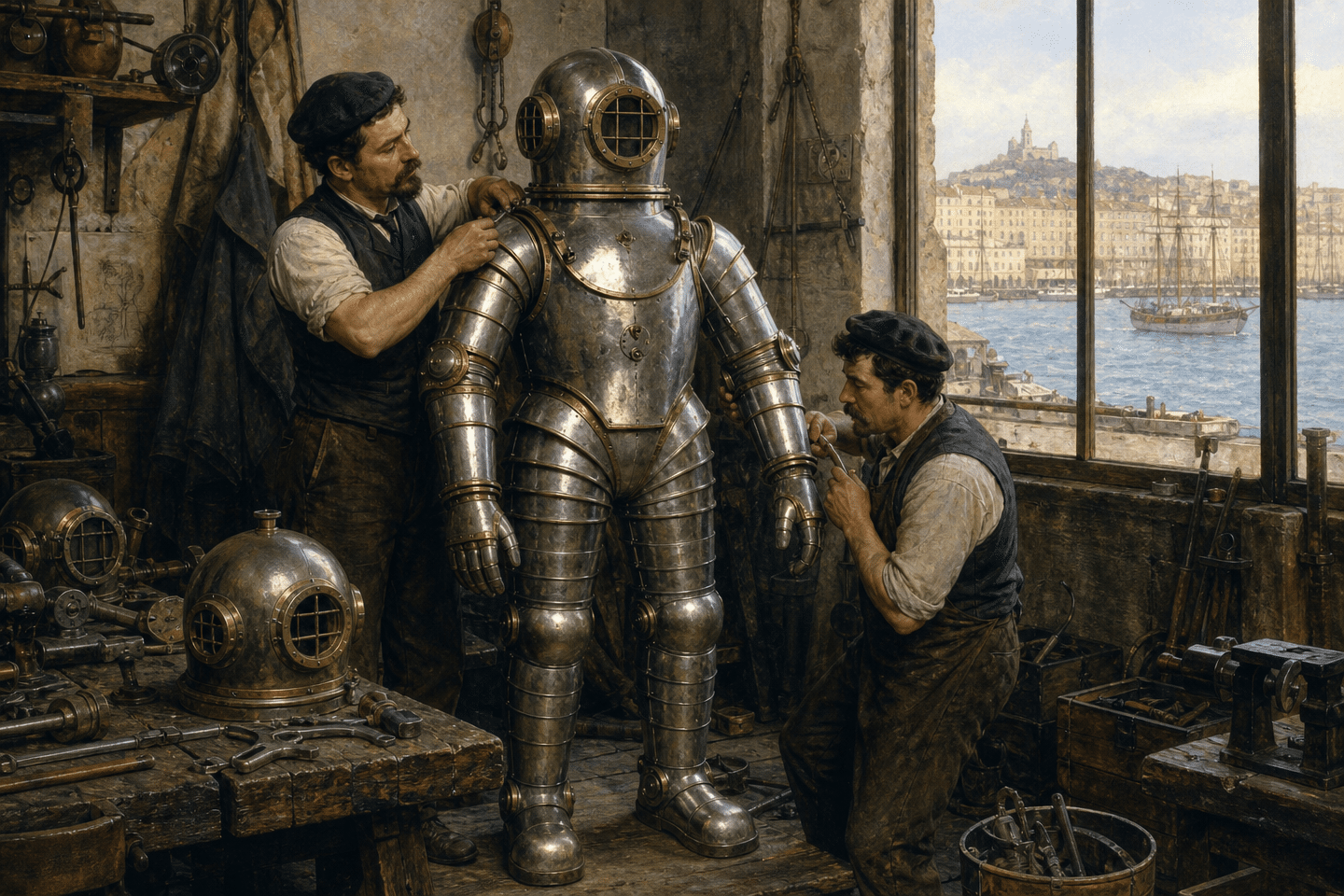
A knight’s armor protects against iron and fire, not water. Yet in 1882, two engineers from Marseille borrowed that martial logic to face a far different adversary: the pressure of the depths. Their all-metal, jointed diving suit—resembling a shell—promised to push the boundaries of underwater exploration. More than that, it would reveal the limits of its era.
- The diving suit, patented in 1882 by the Carmagnolle brothers, stands 190 cm tall, weighs 260 kg, and aimed to reach depths beyond 60 meters
- Despite 22 rotary joints allowing movement, waterproofing at the fabric-and-leather joints was never perfectly achieved
- Remaining a prototype that never dipped underwater in real conditions, it has been housed since 1939 at the National Maritime Museum in Paris
- A knight’s armor designed to confront the abysses
- 22 rotary joints: the mechanical feat that never fulfilled its promises
- From the depths of a Marseille workshop to the display cases of the National Maritime Museum
A Knight’s Armor Designed to Confront the Abysses
Alphonse and Théodore Carmagnolle were not isolated dreamers. As early as 1866, these two engineers based in Marseille filed a series of patents for a fully metal suit, conceived to endure where fabric and rubber fail. Their obsession: to give man a rigid shell capable of accompanying him far below the reach of the era’s flexible diving suits.
The result, officially registered under patent number 152761 on December 20, 1882, looks strikingly like a knight’s suit of armor. The National Maritime Museum even describes it as having a “lobster-shell-like” appearance—a vivid image of its hybrid look between animal carapace and medieval helm.
The objective was no small feat. This diving suit was meant to enable descents beyond 60 meters, a depth hard to reach for soft equipment of the time without risking the diver being crushed by water pressure. To achieve this, the Carmagnolle brothers bet everything on the rigidity of metal rather than the suppleness of waterproofed fabric.
The final piece leaves a strong impression with its dimensions. It stands 190 centimeters tall, 92 centimeters wide, and 97 centimeters deep, weighing 260 kilograms when assembled. Even when seated, the device retains a height of 172 centimeters, proof that the diver essentially disappeared inside his hull.
22 Rotary Joints: The Mechanical Feat That Never Fulfilled Its Promises
To ensure that a rigid suit does not become a metal coffin, mobility was essential. Here lies the real tour de force of the Carmagnolle brothers: their diving suit includes 22 rotary joints distributed across the structure to permit movement of the arms, legs, and torso.
Each articulation functions like a small mechanical ball joint, much like a tournament armor that would let the knight bend an elbow without exposing skin. On paper, the concept sits on solid ground and demonstrates a rare technical mastery for the era.
The problem lies elsewhere, precisely where two metal pieces meet. To allow rotation without sacrificing watertightness, the engineers inserted thin strips of fabric lined with leather between each joint. On paper, the solution looks elegant. In water, it turns out to be the Achilles heel of the entire construction.
Despite hundreds of hours of work to refine these joints, perfect watertightness was never achieved. The National Maritime Museum is clear on this point: water eventually leaks in at these joints, condemning the suit to remain a prototype rather than a functional diving tool.
From the Depths of the Marseille Workshop to the Display Cabinets of the National Maritime Museum
The manufacture of this diving suit was not a matter of improvisation. A Parisian armorer was charged with turning the plans of the two Marseille brothers into reality after more than a year of meticulous work. The choice of craft is no accident: who better than an armorer to bring to life a true armor intended for water rather than combat?
The materials tell the same martial lineage. Steel, glass for the portholes, canvas, pigskin leather for the joints, and lead for ballast: each component recalls equipment more suited to a soldier than to a modern diver.
The artifact then passed through decades before joining public collections. It entered the museum as a donation, with an acquisition dated 1939, from the René Piel Establishments. Since then, it has been preserved under inventory MnM 1 PA 20 at the National Maritime Museum, housed in the Palais de Chaillot in Paris.
This unique piece even crossed borders once. In 1992, it traveled to Germany to be shown at the Hanseboot fair in Hamburg, as part of the exhibition The Divers, evidence of the enduring interest in this testament to French ingenuity directed at underwater exploration.
Thus, this diving suit never actually explored a wreck nor walked the seabed in real conditions. Yet it remains a precious document of a period when mechanical ingenuity sought its path, even if it meant dressing a man in a knight’s armor to send him into the depths.
👉 A small gesture for Space Group? Follow us on Google, add us to your bookmarks, and find us on Google News to never miss a discovery.
