
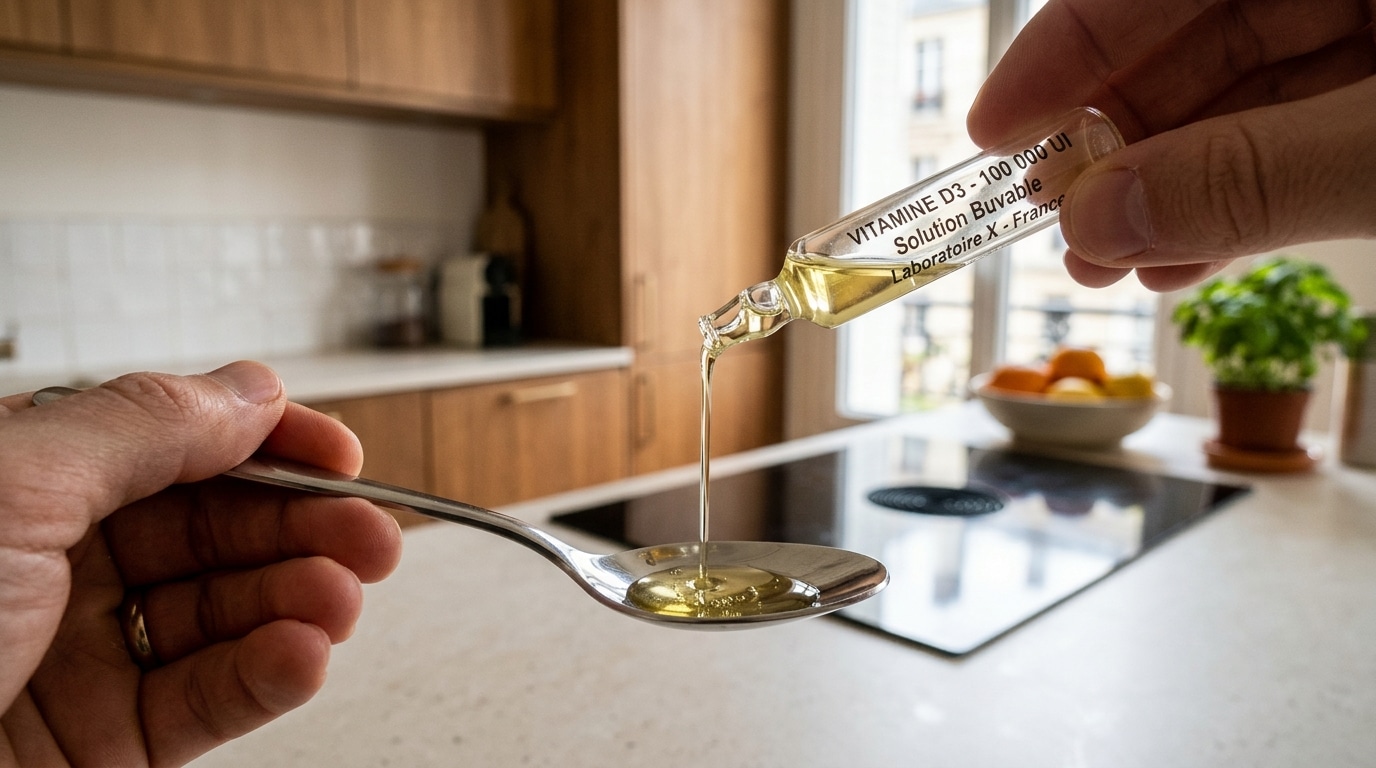
One shot, a single dose of 100,000 UI of vitamin D, and the blood level soars within a few days. This protocol, long favored in France for its simplicity, is now being questioned by specialists. Autumn and winter are precisely the times when many French people pull this small bottle from the back of the medicine cabinet, following the doctor’s or pharmacist’s advice. A quick, almost everyday gesture that seems to fix the issue in an instant. But what exactly happens in the body after this sudden peak? And more importantly, why are some doctors beginning to shift their stance and favor another approach?
- High monthly doses of vitamin D (60,000 IU or more) may raise the risk of falls, fractures, and premature mortality according to several studies.
- The GRIO now recommends daily supplementation of 800 to 1,000 IU, paired with calcium, for people at risk of osteoporosis rather than spaced-out vials.
- A blood test measuring 25(OH)D is recommended before any supplementation, with the goal of reaching a level between 30 and 60 ng/mL.
- The Vitamin D Peak After the Injection: A Dramatic but Temporary Effect
- What Studies Reveal in the Weeks Following the Single Dose
- Why Daily Supplementation Is Gaining More Traction Among Experts
- What Patients at Risk of Osteoporosis Should Take Away Today
The Vitamin D Peak After the Injection: A Dramatic but Temporary Effect
Taking a 100,000 IU shot is a bit like opening the floodgates of a dam. The blood concentration of vitamin D, measured as 25(OH)D, rises rapidly and noticeably on a blood test. This pattern is one of the well-established French practices, especially in prophylaxis during the winter period, from November to April, where a 100,000 IU injection every two to three months remains a classic benchmark. The other commonly used option is a 50,000 IU injection every one to two months. On paper, the idea is appealing for its simplicity: a single dose, no need to think about it for weeks, and a visibly rising blood level. But this peak, impressive as it is, tells only part of the story. Vitamin D does not simply rise and stay at a fixed level: it falls back down, sometimes faster than expected, and this is precisely what has intrigued researchers for years.
What Studies Reveal in the Weeks Following the Single Dose
That is where things get more complex. Several studies have looked into what actually happens after a high intermittent dose, and the results are striking. The New Zealand ViDA trial, conducted in a generally healthy population for two and a half to more than four years, found that a monthly dose of 100,000 IU cholecalciferol did not prevent falls or fractures. Even more, a randomized trial published in JAMA Internal Medicine involving 200 people aged 70 and older who had already fallen, linked the highest monthly doses, 60,000 IU, to an increased risk of falls. Broadly speaking, the GRIO Osteoporosis Research and Information Group cites studies suggesting that high intermittent doses of 60,000 IU per month or more can raise the risk of falls, fractures, and even premature mortality in certain populations. The proposed explanation is that these hormonal roller coasters, with a very high peak followed by a gradual drop, disrupt certain physiological mechanisms rather than stabilizing them in the long term. In other words, the body does not tolerate large swings, even when vitamin D is essential.
Why Daily Supplementation Is Gaining More Traction Among Experts
In light of these findings, French specialists now prefer daily supplementation when feasible for people with osteoporosis or at risk of it, rather than substantial bolus doses spaced out. The GRIO formalized this stance in a clear position: a steady, moderate intake is better than a single large bolus. Concretely, a daily dose of 800 to 1,000 UI combined with calcium has shown to reduce falls and non-vertebral fractures in deficient older adults. The fundamental idea is simple: by delivering vitamin D day by day, peaks and troughs are avoided, helping the body maintain a more stable level over time. Before any supplementation, the GRIO also recommends measuring the concentration of 25(OH)D, aiming for a value between 30 and 60 ng/mL. In certain precise cases, particularly when there are symptoms of osteomalacia or when the concentration falls below 12 ng/mL, a loading dose remains advised to catch up quickly. And when daily formulations are not available or reimbursed, the GRIO recommends continuing intermittent administration, but with the lowest possible dose, at or below 50,000 IU, and with the shortest possible interval between doses.
What Patients at Risk of Osteoporosis Should Take Away Today
In practice, everything depends on an individual’s profile. For the general population, spaced injections remain a common, supervised regimen, as with ZymaD 80,000 IU, whose labeling recommends one injection every one to two months for adults and older adults in prophylaxis, not exceeding 600,000 IU per year. But for people with osteoporosis or at risk, the logic changes and regularity becomes preferable to intensity. Certain situations deserve year-round attention, not just during winter: this includes individuals who are obese, have dark skin, experience little sun exposure, or wear clothing that covers most of the skin. Here are the key points to keep in mind to navigate this landscape:
- A prior blood test helps determine your 25(OH)D level before any decision.
- In people at risk of osteoporosis, the daily approach is currently favored when feasible.
- High monthly doses or those given at longer intervals are not without consequences and should be discussed with a healthcare professional.
- People at risk of deficiency year-round should have ongoing monitoring beyond the winter period alone.
Ultimately, nothing replaces a discussion with one’s primary care physician or pharmacist to tailor the most suitable regimen to an individual’s circumstances. Vitamin D remains a valuable ally for bones, and much more, provided we let it work gradually rather than demanding a sudden sprint of action.
👉 A small gesture for Space Group? Follow us on Google, add us to your favorites, and find us on Google News so you don’t miss any discovery.
