
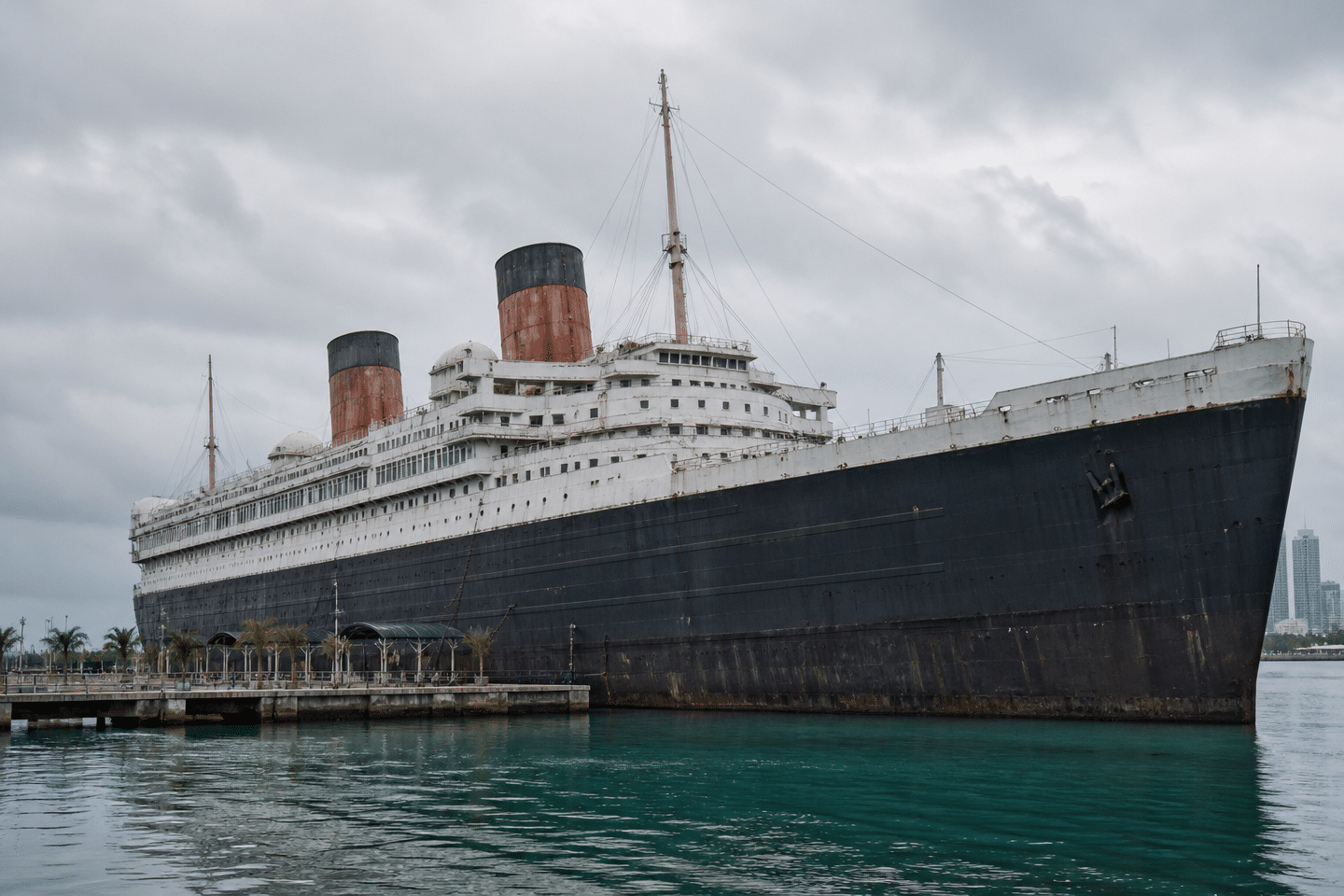
How did a symbol of the French merchant navy end up abandoned on an Indian beach? The ocean liner France, renamed Norway, held the title of the longest passenger ship ever built. A deadly explosion in Miami sealed its fate in mere minutes, turning this giant of the seas into a memory frozen in time.
- On May 25, 2003, a boiler explosion at the Port of Miami killed eight crew members and led to the ship’s permanent retirement.
- The NTSB investigation found that a faulty weld on boiler number 23, already cracked since the 1970s and poorly repaired, was the cause of the tragedy.
- Towed to Germany and then sold for scrap under the name Blue Lady, the vessel was dismantled on India’s Alang beach between 2006 and 2009.
- A Sea Giant Born to Break All Records
- The Day the Explosion Frozen the Liner Forever
- From a Miami dock to Alang beach: the quiet end of a legend
A Sea Giant Born to Break All Records
Built to embody the prestige of France’s transatlantic fleet, the ocean liner France long bore the proud title of the longest passenger ship ever launched. Its elongated hull, graceful lines, and imposing scale made it a veritable showcase of French naval prowess, capable of rivaling the era’s greatest transatlantic liners.
Yet the operation of such a behemoth came with a high price, and the decline of traditional transatlantic crossings eventually caught up with the vessel. In 1979, it changed hands and name: Norwegian Cruise Line bought it and renamed it Norway, granting it a second life in the burgeoning Caribbean cruise circuit.
Under its new colors, the liner enjoyed decades of success. It cruised the Caribbean, carried thousands of vacationers each year, and, despite its age, retained a special aura among enthusiasts of historic ships. No one then imagined that its future would tilt in less than half an hour, on a May morning in 2003.
The Day the Explosion Frozen the Liner Forever
On May 25, 2003, the Norway had just completed a week-long Caribbean cruise and docked in Miami with 2,135 passengers and about 1,000 crew members aboard. Shortly after docking, around 6:37 a.m., a boiler exploded within the ship’s bowels. Carlos A. Alvarez, the director of the Miami-Dade Police, would describe it as an accident, with a blast of steam and high-pressure gas shooting into an aft compartment.
Initial reports spoke of four deaths and at least twenty-one injuries. The final count would rise to eight crew members dead. The NTSB investigation, the American agency charged with such inquiries, identified the tragedy’s origin: a weld on a joint of a high-pressure boiler failed, releasing nearly twenty tons of water at extremely high temperature, instantly transformed into scalding steam.
Investigators pinpointed the culprit: boiler number 23, one of four on board, ravaged by an extended fatigue crack. More troubling still, cracks had already been found on the original welds as early as the 1970s and had simply been ground down and repaired by re-welding. Those interventions would, in fact, have accelerated corrosion and further weakened the structure over time.
Federal authorities did not delay in punishing the operator. Norwegian Cruise Line Limited pleaded guilty to gross negligence in operating the vessel and was fined one million dollars, with thirteen point seven-five million dollars in provisional damages awarded to victims and their families.
From a Miami Dock to Alang Beach: the Quiet End of a Legend
After the explosion, the Norway would never again venture to sea on a commercial cruise. The liner, too damaged and too costly to repair, was towed from Miami to Bremerhaven, Germany, where it remained immobilized for almost two years without prospect of return to service.
In May 2005, the ship finally left German waters, not to resume service, but to embark on its final journey toward Malaysia, and then to Indian demolition yards. Sold for scrap, it was renamed Blue Lady, erasing the two names France and Norway that had once marked its history.
The Indian Supreme Court allowed dismantling of the ship in early August 2006, and the Blue Lady was beached off Alang a few days later, using the region’s beaching method to strip large vessels. Demolition work stretched for about two years and concluded in 2009, bringing to a close the existence of what had been the world’s longest liner.
Today, only photographs, accounts and a few relics preserved by enthusiasts remain to testify to the ship’s grandeur. From the France of transatlantic glory to the Blue Lady dismantled on a Gujarat beach, the vessel’s story encapsulates the fragility of even the most remarkable technical feats in the face of time and a single weld’s failure.
