
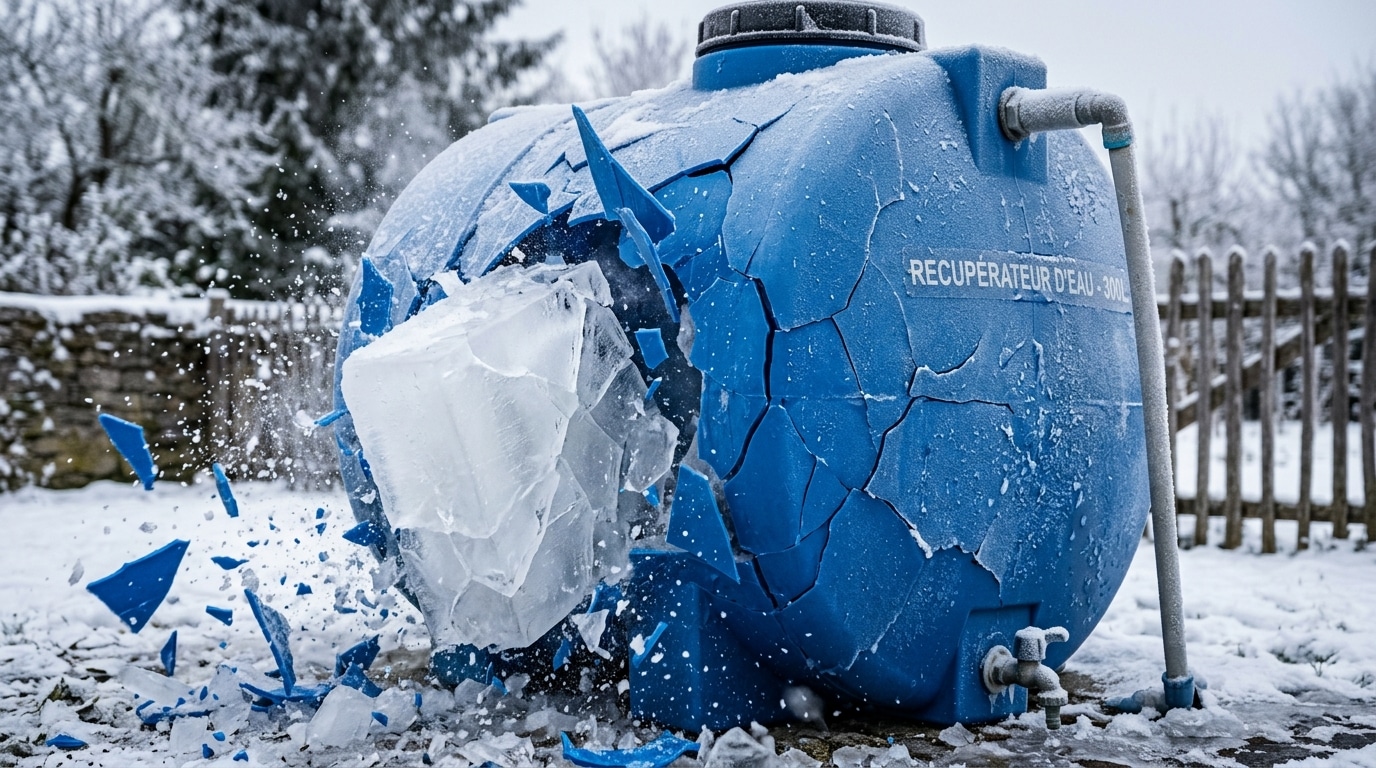
Your rainwater harvesting tank stands proudly at the base of the gutter, ready to face winter. Except that it hides a secret that few people know. When the temperature drops and the water inside turns to ice, it’s not just a matter of the thermometer lowering. A physical phenomenon well known to scientists, but often forgotten by homeowners, begins to operate. And its consequences can be costly. Between a tank that cracks, a connector that bursts, and a gutter that deforms, the damage from an ill-anticipated winter can run into hundreds of euros. So before the cold settles in for good, it’s time to understand why this water reservoir can become a real time bomb.
- When freezing, water expands by about 9% of its volume, which puts the tank under pressure.
- Ice can crack the tank, cause the connector to burst, and deform the gutter.
- Before frosts, drain the tank, leave the faucet slightly open, and unplug the downspout connector.
- Why a 300-liter tank can gain nearly 27 liters when freezing
- The real risks for the tank, the connector, and the gutter
- What to do before the first frosts to protect your installation
Why a 300-liter tank can gain nearly 27 liters when freezing
This is a physical property of water that many people overlook: unlike most liquids, it expands when it becomes solid rather than contracting. Specifically, when freezing, water gains about 9% of its volume. Applied to a 300-liter tank filled to the brim, this expansion represents nearly 27 extra liters once ice forms. A volume with nowhere to go if the container is closed or already full. This peculiarity is explained by the crystalline structure of ice, which is more airy than that of liquid water, occupying more space. The result: a tank filled just before a cold spell becomes mechanically pressurized as soon as freezing sets in, even if nothing on the outside hints at it.
The real risks for the tank, the connector, and the gutter
This volume expansion is no minor event for garden equipment. The walls of a plastic tank, even thick ones, can crack under the pressure exerted by ice expanding from the inside. Once cracked, the tank becomes unusable and must be replaced entirely, which is an avoidable expense. The connector, that small fitting linking the downspout to the reservoir, is often the most fragile part of the installation. Filled with stagnant water, it can literally burst under the frost, forcing the replacement of the whole piece in spring. As for the gutter itself, if water remains trapped in bends or in the downspouts, the ice can deform metal or PVC, or even cause leaks that go unnoticed until heavy rains. All these little issues, added together, turn a quiet winter into a sequence of costly repairs.
Measures to take before the first frosts to protect your installation
Fortunately, protecting against these damages doesn’t require major work or expensive equipment, just a bit of foresight as forecasts predict frost. The first rule is simple: before frosts, drain the tank, or at least drain it partially to prevent stagnant water from freezing en masse. Then remember to leave the faucet slightly open to allow the remaining water to flow rather than staying blocked and freezing in the plumbing. The last essential reflex: unplug the downspout connector, this connecting piece often sacrificed first during a bout of freezing. Here are the three actions to remember before the cold arrives:
- Drain or empty the tank to limit the volume of stagnant water
- Leave the faucet slightly open to facilitate drainage
- Unplug the downspout connector to prevent it from bursting
These few minutes spent in the garden before the first cold spell prevent many unpleasant surprises at thaw. A simple, almost trivial gesture, but one that makes all the difference between a tank that makes it through the winter unscathed and an installation to replace come spring.
