
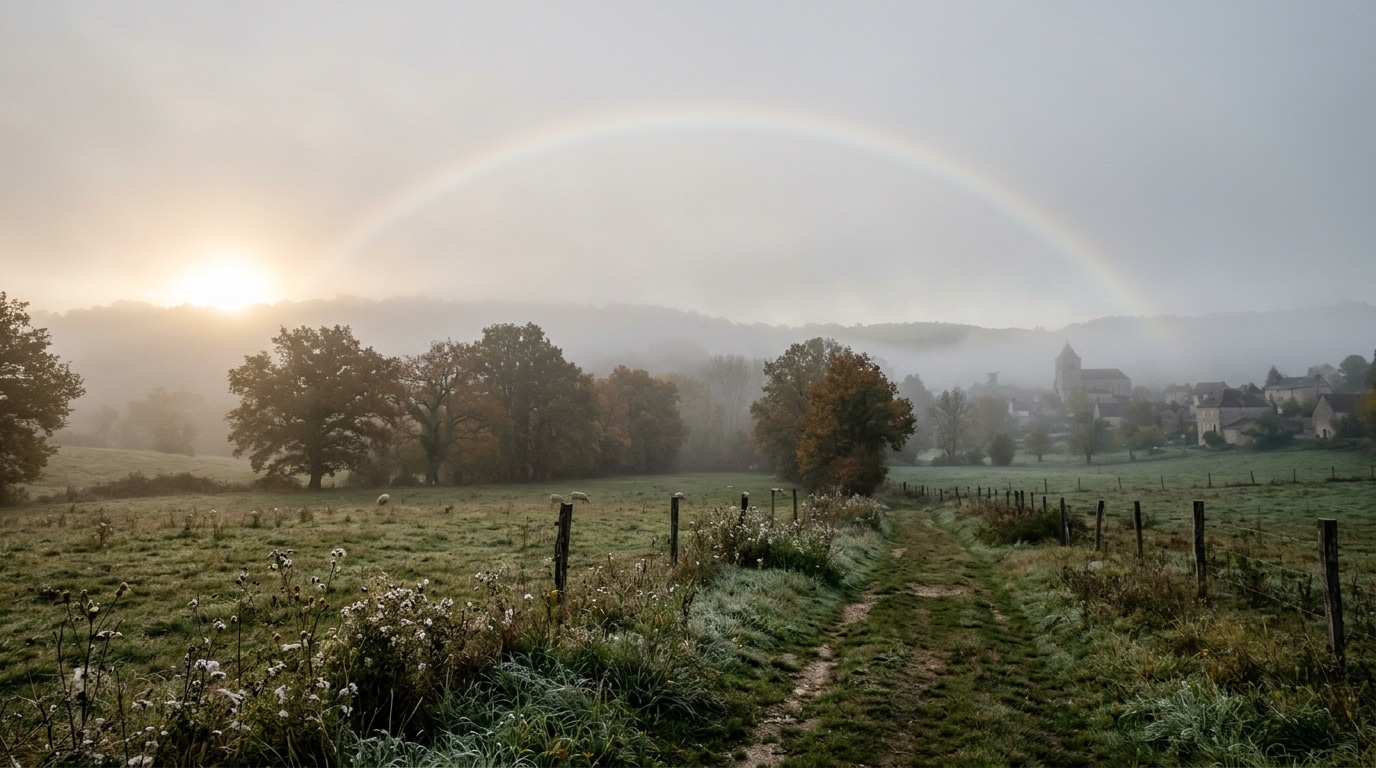
The fog clings to the plain this weekend and it will not hesitate to settle in. The cause: a powerful anticyclonic block that locks the weather over France, with pressure rising sometimes up to 1030 hPa. As a result, mornings stay gray and damp, while the mountains and the Mediterranean coast enjoy a sky that is well clear. But this stubborn fog hides a small surprise for early risers: after a shower, facing the sun, a nearly white arc can form in the mist. A rare phenomenon, often missed by the more hurried, but one can learn to spot it.
- The anticyclonic block (pressure up to 1030 hPa) promotes persistent morning fog on the plain this weekend and beyond.
- In fog, droplets under 0.05 mm cause diffraction that overlaps colors, creating a broad pale white arc rather than a classic rainbow.
- If visibility is below 50 meters, the speed limit is 50 km/h and you should never use your high beams, which create a blinding white wall.
- When fog turns the rainbow into a white arc
- Why the tiny droplets erase the colors
- Where and how to observe this rare phenomenon after a shower
When fog transforms the rainbow into a white arc
Everyone looks for the classic rainbow after a shower, with its vivid colors from red to violet. But when fog gets involved, a completely different spectacle unfolds in the sky. An arc within the fog, sometimes called a white rainbow, forms when light interacts with very small mist or fog droplets. These droplets are much smaller than ordinary raindrops: the colors spread and overlap more, producing a wide, pale, or nearly white arc. This fogbow, as meteorologists in English-speaking countries name it, is not a failed rainbow. It is a genuine optical phenomenon that deserves one’s attention at the right moment. With the current anticyclonic setup, which favors gray, stubborn mornings in the plain, the conditions are just right to observe it more often than usual.
Why the tiny droplets erase the colors
The difference lies in the size of the droplets. In a classic rainbow, sunlight slows as it enters the water drop, disperses, reflects internally, and exits, then disperses again. This mechanism separates the colors clearly, according to the famous sequence red, orange, yellow, green, blue, indigo, violet, popularized by Isaac Newton. But in fog, droplets generally measure less than 0.05 mm in diameter—much smaller than rain drops. At this scale, another phenomenon comes into play: diffraction. Light spreads more, and the different colors overlap instead of remaining well separated. The result is a white arc, edged with red on the outside and blue on the inside, much wider and paler than a ordinary rainbow. A detail to know so as not to confuse this subtle halo with a failed or poorly formed rainbow.
Where and how to observe this rare phenomenon after a shower
To spot this white arc, you need to stand with your back to the sun, facing the fog or mist, exactly as you would for a classic rainbow. The mornings of this weekend, characterized by stubborn greys on the plain, provide favorable ground, especially in valleys and humid areas, where Morbihan has already experienced thick fog persisting for a good part of the day. The right window is just after a shower, when the sun peeks through the mist. But beware, this skyward quest must never override road safety. Dense fog remains the leading cause of reduced visibility on autumn roads in France. If visibility drops below 50 meters, the maximum allowed speed falls to 50 km/h, including on motorways. And above all, never use your high beams in fog: they create a white wall that blinds more than it lights, recalls the Road Safety authorities. Observe the sky, yes, but never take your eyes off the road while driving.
This type of anticyclonic blocking is not about to disappear. Models forecast a pressure anomaly exceeding +20 hPa between the north of the British Isles and Iceland for the coming week, followed by an anomaly of +5 to +10 hPa still persisting the week after. In other words, misty mornings have bright days ahead in this late autumn meteorological period, which runs until November 30. Plenty of opportunities to glimpse this famous white arc, provided you keep a lookout early in the morning and keep safety on the road as a priority.
