
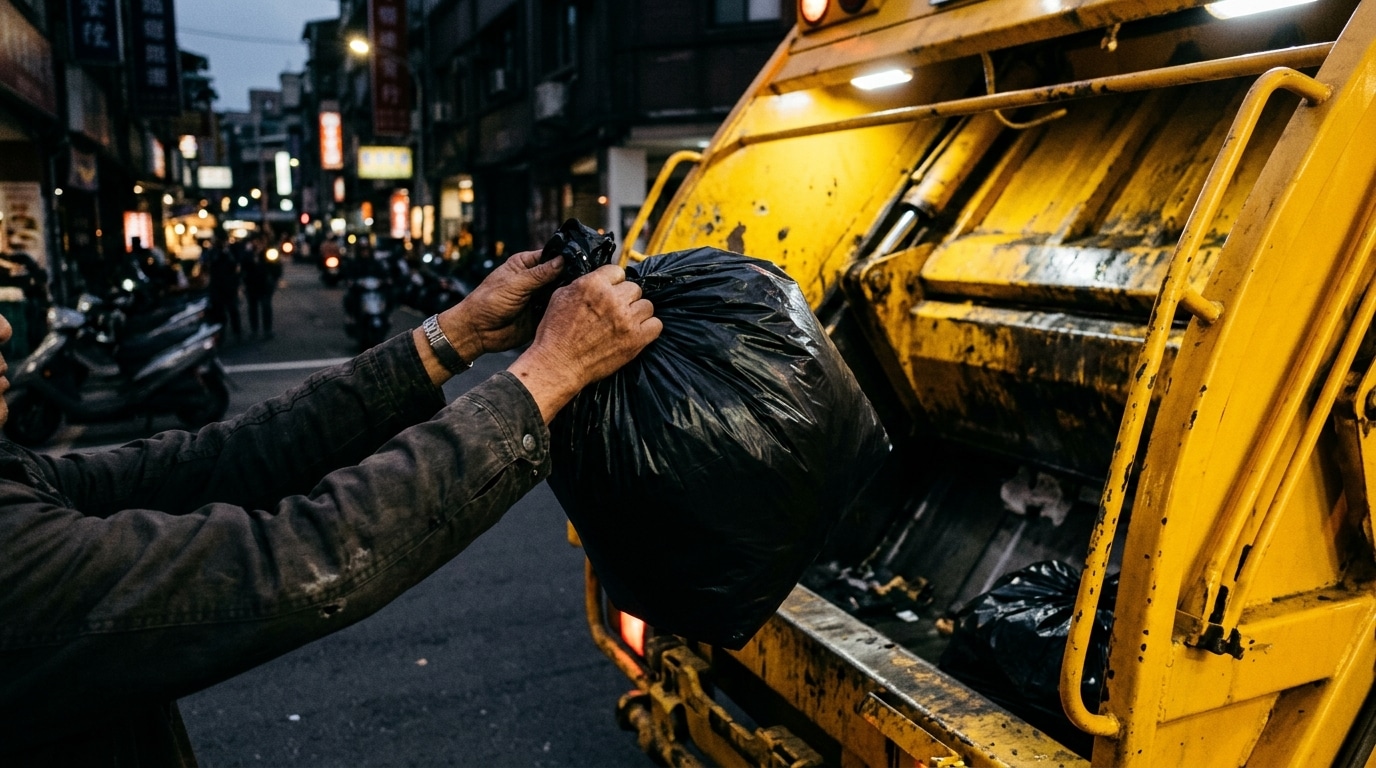
In Taipei, you don’t need sirens or honking to know the garbage truck is coming: a Beethoven melody is enough. Since the 1960s, this sonic ritual has paced the daily lives of residents, who head out with their bags at the first notes. A simple, musical, and remarkably effective system.
- Since the 1960s, Taipei’s garbage trucks broadcast “Für Elise” or “The Virgin’s Prayer” to signal their arrival to residents.
- Sorting is organized between a yellow compacting truck for household waste (blue bags government-approved and paid for) and a second vehicle for food waste and recyclables.
- Thanks to this system, Taipei’s recycling rate has risen from about 2% in 2000 to nearly 67% today.
- A Beethoven melody rather than a shrill siren
- A system born in the 1960s, still faithful to its schedule
- Why this music has transformed residents’ relationship with waste
A Beethoven melody, not a shrill siren
Imagine a Taipei street at the end of the day. No aggressive rumble, no anxiety-inducing sound. Just the opening notes of “Für Elise” drifting from the yellow truck’s loudspeakers. It’s the signal: time to bring out the trash.
This musical choice is far from incidental. An AFP report published in late July 2025 described this everyday scene with precision: residents on the sidewalk, plastic bags in hand, ready to drop their waste into the compactors as soon as the vehicle stops.
Two pieces share the official repertoire. The first, as noted, is Beethoven. The second is “The Virgin’s Prayer,” a composition by Polish pianist Tekla Badarzewska-Baranowska. According to Taipei’s Environmental Protection Department, cited by AFP, these musical garbage trucks have been part of the island’s soundscape for more than sixty years.
And as is often the case with traditions that stand the test of time, the repertoire has gradually evolved locally. In the Longtan district of Taoyuan, the local philharmonic orchestra even adapted two Hakkan (Hakka) classics for the region’s garbage trucks, proof that this soundtrack has become an integral element of local identity.
A system born in the 1960s, still faithful to its schedule
The origin of this music lies in a rather tasty technical detail. Taiwan imported German garbage trucks in the 1960s, already equipped with loudspeakers programmed to broadcast “Für Elise.” The arrival of “The Virgin’s Prayer” in the repertoire remains more enigmatic: no source provides a precise account of how this second piece came to brighten Taiwan’s streets.
Be that as it may, the passing rhythm has remained metrically reliable. Trucks operate five days a week, most often in the late afternoon and evening, when inhabitants return from work and can dispose of their waste.
Sorting, meanwhile, is organized between several distinct vehicles. The ordinary household waste bags go to the yellow compactor truck—the one that plays the music. Food waste and recyclables are entrusted to a second vehicle equipped with separate bins. A well-tuned logistical ballet, where each truck has a precise function.
This system took formal shape in 1994, when Taipei City launched the policy known as “no bag touches the ground.” At the time, the music trucks passed twice in the evening. The concept later spread far beyond the capital, eventually becoming a nationwide standard.
Why this music has transformed residents’ relationship with waste
To understand the value of this setup, one must return to the context that gave it birth. In the decades following its rapid economic growth, Taiwan saw waste volumes soar. Traditional landfills became saturated and could no longer absorb the rising output. A new approach was needed.
The answer rested on three pillars: recycling, incineration, and above all, direct accountability of residents. Rather than letting waste pile up in anonymous communal bins, the system imposes a concrete, individual act from every person.
This act carries a cost, quite literally. Taipei residents are required to purchase blue plastic bags, government-approved, to place their household waste. This paid bag acts as a subtle economic lever: the less waste produced, the less money spent. A simple principle, but devastatingly effective at nudging behavior.
The numbers speak for themselves. According to AFP, Taipei’s recycling rate stands at roughly 67% today, up from about 2% in 2000. A dramatic progression that shows how a simple device—an urban tune broadcast on the street—when coupled with coherent policy, can durably reshape collective behavior.
What stands out in the end is the system’s coherence. The music isn’t merely a charming gadget—it embodies a social routine, a collective reference point that structures residents’ days as reliably as a clock. Other cities around the world are still seeking the ideal formula to encourage sorting and curb waste. Taiwan, for its part, found its solution more than six decades ago, and it continues to play, night after night, at the corner of every street.
